“Come, Let Us Reason Together”: Trade Unions at Rowntree & Co. in the 1920s Part 4: Irene Pickup

This is part 4 of The Rowntree Society’s research into the relationship between the Rowntree family and trade unions in the 1920s.  In the previous parts we explored Seebohm Rowntree’s approach to industrial relations at Rowntree & Co., how the General Strike of 1926 impacted the company, and the life of Chief Shop Steward Fred Hawksby.  You can find them here.  This part will tell the story of Irene Pickup, important trade unionist at Rowntree’s and their first Assistant Chief Shop Steward.

Researching Pickup

We at The Rowntree Society had already come across Irene Pickup in our research about Rowntree women (see here).  We were keen to revisit this work and discover more about her life.  We followed the same methodology we used for researching Fred Hawksby; consulting census and similar records, as well as documents held in the Rowntree archives at the Borthwick Institute for Archives, including issues of the Cocoa Works Magazines.  This time we also ended up consulting the Trade Union Congress’s (TUC) archives and finding out about the Bryn Mawr Summer School for Women Workers in Industry held in Pennsylvania, USA.  From this we were able to uncover Pickup’s remarkable life story as an award-winning trade unionist at Rowntree & Co.

Pickup’s Early Years

Irene Pickup was born in July 1897 and spent her early childhood living in a terrace house on Upper Hannover Street in the Leeman Road area of York with her parents and younger sister, Violet.  Her father worked as a railway greaser, likely at the nearby carriage works.  She went to St. Paul’s School in Holgate, and when she was 12 started attending Bishophill & Clementhorpe School.

However, by the 1911 census her mother had died, her sister was living with wider family members in York, and her father was lodging with a work colleague and his family in Holgate.  Irene had been moved to Hull – the census records her living in a terrace house with an aunt and uncle and two cousins.  She was 13 at the time of the census, and this disruption in her life following the death of her mother was likely due to the kind of poverty cycles Seebohm talks about in ‘Poverty: a study of town life’.

Places Irene Pickup lived and worked in York – Google Maps 8th May 2025

Irene Pickup back in York

Ten years later, Pickup appears in the 1921 census as having moved back to York.  She is recorded as working at Rowntree’s and living as a lodger at Dorothy Wilson’s Hospital on Walmgate, just by the bridge over the Foss.  This is notable as, at this time, Dorothy Wilson’s Hospital was an almshouse.  Pickup was only 24, with the other people living there much older and described as “inmates”.  She is the only person living there in the 1921 census who is described as a lodger, suggesting that her status was different to the other residents.  As a single woman who never married, Pickup would likely have earned enough to cover rent but would still have faced significant legal and social barriers to renting or owning property independently.  Almshouses or similar accommodation may have been among her only realistic options.  She lived at Dorothy Wilson’s Hospital until around 1939, most likely in a dormitory as she is never recorded as having a room number, unlike other residents.

Dorothy Wilson’s Hospital building in 2025 – The Rowntree Society

At some point around 1939, Pickup’s housing situation changed. The 1939 register records Pickup as having moved into what would have been a newly built house in Holgate and living there with her by then retired father.  She stayed living there until her death in 1969.  In her later years, her sister Violet lived there with her.  It had taken decades for the family to come back together after her mother’s death and loss of their home when she was 12 or 13.

Irene Pickup at The Cocoa Works

Pickup started working at the Cocoa Works in 1915 aged 18, initially as a chocolate piper, and then in the Almond Department where she became a Shop Steward and sat on their departmental council.[1]  In 1919 she was part of the delegation from Rowntree’s to the government’s Interim Industrial Reconstruction Committee where she represented women workers in the negotiations over nationally imposed pay and working conditions.[2]  Pickup must have been on the Central Works Council (CWC) by 1921 as she is cited as playing a key role in developing the Works Rules.[3]  However, the first time she is mentioned in the minutes is from the 8th February 1922 meeting where she is first voted onto the CWC’s executive.[4]   Alongside her work in the CWC, Pickup was a strong advocate for the education provided at the Cocoa Works.  She was involved in its organisation and encouraged the women workers to engage with the education opportunities offered to them by Rowntree & Co.[5]

thumbnail of IMAGE 3 Almond Dept 1920 Borthwick Rowntrees_7_133Almond Department at Rowntree’s Cocoa Works 1920 – Borthwick Institute for Archives Rowntree Photo 7/133

Although the sources we found span several decades, together they give us a sense of what Irene Pickup was like as a person and how she was regarded by those around her.  In the obituary she wrote for Seebohm Rowntree following his death in 1954, Pickup said, “When I look back and recall some of the interviews I had with him, at a time when my views were much less moderate than they are now, I realise just how tolerant he was.”[6]  On her retirement, the Cocoa Works Magazine stated, “Her rise from the ranks, and her keen interest in workers’ welfare, coupled with a high level of intelligence and sense of justice enabled [Pickup] to reach well-balanced views on most workroom problems, and the Management greatly regrets the loss of her unique experience and personality…”.[7]  In 1952 William Wallace wrote a letter to Seebohm Rowntree discussing whether the spirit of Joseph Rowntree still existed at the Cocoa Works.  In it, he describes having raised the question with Irene Pickup and concludes that “few other people are likely to be either so well informed on this subject or so willing to be frank.”[8]

Irene Pickup and the opening an article by her in the Cocoa Works Magazine Christmas 1925

In 1925, Pickup was given the position of Assistant Chief Shop Steward working with Fred Hawksby.[9]  This new position was not just to help Hawksby and cover the work in his absence, but it also meant that the women in the factory got their own chief representative.  This may well have been something Seebohm recognised he needed after the incident described in part 1, where the women had rallied behind Jack Baker’s militancy.

However, unlike Hawksby, Pickup did not stay working in her paid Shop Steward role, as in 1937 she became part of the management team of the Cream Packing Department where she stayed until her retirement in 1952.[10]

International Trailblazer

In addition to her contribution to industrial relations at Rowntree’s Cocoa Works during the 1920s, Irene Pickup also became an important figure in the wider trade union movement both in Britain and internationally.

In 1926, ahead of their first women’s conference, the Trades Union Congress (TUC) set out to find the woman who had done “the best work” for trade unions in the country that year.[11]  To do so, they established a set of criteria for which points were awarded up to a maximum of 100.  These points were allocated for factors such as the number of years spent as a member of a trade union, number of years as a shop steward, participation in negotiations with employers, and attendance of TUC education classes.[12]  Pickup achieved 77 points, more than any other nominee.  She was awarded a TUC Gold Badge for the achievement at the women’s conference which was held alongside the other events of the annual congress of 1926 in Bournemouth.[13]  The official report records that 85 delegates attended, representing 38 affiliated organisations, and notes as a remarkable feature the large number of women who attended as visitors – suggesting that even at a women’s conference, the majority of official delegates were men.[14]

TUC Women’s Conference 1926 Bournemouth – TUC Library Collections, London Metropolitan University

Coverage in the October 1926 issue of the CWM was extensive with an editorial dedicated to Pickup receiving the award, and an article by Seebohm Rowntree introducing the new education programme, entitled “Industrial Strife and the Way Out”.[15]  It also printed the speech Pickup made at the TUC’s women’s conference where she stated, “I feel it is a duty, as an ordinary rank and file member, to try and educate our women, and even our men… and I am perfectly certain that when we do that, we shall not have the ills which we have with us to-day” and “I am perfectly certain the men will have to “sit up” and take notice of the women in the future more than they done in the past.”[16]

Irene Pickup receiving her award at the TUC Woman’s Conference 1926 – Cocoa Works Magazine October 1926

In 1927, Seebohm arranged for Pickup to attend the Bryn Mawr College Summer School for Women Workers in Industry.[17]  Bryn Mawr College is in Pennsylvania, USA and was originally founded by Quakers.  Their Summer Schools ran from 1921 to 1938 and were radical in many ways: in how they were taught, in the kind of women who attended – many like Irene did not have a university education – and in the behaviour of the students (who would instigate protests about their accommodation and join picket lines on organised outings).[18]  Pickup was the first international student to attend and made such a marked contribution that they continued to fund international scholarships in the following years.  The year before Pickup attended, they admitted the first African American students to the course.[19]  The school’s ethos is illustrated by the fact that one of its teachers was the sociologist W.E.B. Du Bois – among the first African Americans to gain a PhD, an anti-racist campaigner, and an early thinker in what we now call de-colonialism.[20][21]

Women Workers at the Bryn Mawr Summer School – Smith, H.W. 1929 Public Domain

Irene Pickup and Seebohm Rowntree

Irene Pickup had a lot of affection for Seebohm, even if she was not as close to him as Hawksby became.  In the obituary she wrote following his death in 1954, she said “we who worked with him not only glimpsed his ideals but saw them put into practice here at the Cocoa Works.  But it is not only those employed here who have benefited from his life and work —his influence has been felt throughout the world.  When I went to America…, I found that the people I met there knew far more about Seebohm Rowntree than some of his own employees, and I felt very proud to be a member of his staff”.[22]

Pickup’s own contribution received national recognition when she received the British Empire Medal in 1953.  On her retirement in 1952, she was given a half page column in the Cocoa Works Magazine which states that her “departure has left a gap in many Cocoa Works activities”.[23]  However, her death in 1969 – 17 years later – sadly only warranted a single line noting her passing.[24]

————————————————————-

This is the end of Part 4 of “Come, Let Us Reason Together”: Trade Unions at Rowntree & Co. in the 1920s.  Parts 1, 2 & 3 can be found here.

————————————————————-

We presented this research at our 2025 York Festival of Ideas event as part of the Joseph Rowntree Centenary.  You can see the recording of the event here:

————————————————————-

Researched and written by Nick Smith, Executive Director of The Rowntree Society.

Additional research by The Rowntree Society’s research volunteers, Maisie Brenchley & James Heathfield.

References and Footnotes

[1] Cocoa Works Magazine Summer 1952 pp.22

[2] Cocoa Works Magazine June 1921:273-4; Cocoa Works Magazine Summer 1952 pp.22

[3] Cocoa Works Magazine Summer 1952 pp.22

[4] Central Works Council Minutes 8th Feb 1922: Borthwick Institute for Archives R/WC/2/2; Cocoa Works Magazine March 1922

[5] E.g. Cocoa Works Magazine October 1926 pp.231,242

[6] Rowntree & Co. Memorial Booklet for Seebohm Rowntree: Borthwick Institute for Archives RFAM/BSR/JRF/1/12/6

[7] Cocoa Works Magazine Summer 1952 pp.22

[8] Letter from William Wallace discussing whether the ‘JR Spirit’ still prevails at the Cocoa Works: Borthwick Institute for Archives JRF/RCO/6/8

[9] Cocoa Works Magazine April 1925 pp.9; Cocoa Works Magazine Summer 1952 pp.22

[10] Cocoa Works Magazine Summer 1952 pp.22

[11] Report of Proceedings at the 58th Annual Trades Union Congress 1926 pp.64: http://www.unionhistory.info/reports/ accessed 14th April 2026

[12] Cocoa Works Magazine October 1926 pp.230

[13] Cocoa Works Magazine October 1926 pp.230; Report of Proceedings at the 58th Annual Trades Union Congress 1926 pp.64: http://www.unionhistory.info/reports/ accessed 14th April 2026

[14] Report of Proceedings at the 58th Annual Trades Union Congress 1926 pp.64: http://www.unionhistory.info/reports/ accessed 14th April 2026

[15] Cocoa Works Magazine October 1926

[16] Cocoa Works Magazine October 1926 pp.242

[17] Rowntree & Co. Memorial Booklet for Seebohm Rowntree: Borthwick Institute for Archives RFAM/BSR/JRF/1/12/6; Smith, H.W. 1929 Women Workers at the Bryn Mawr Summer School New York: American Association for Adult Education pp.222-223: https://archive.org/details/womenworkersatbr00smit accessed 14th April 2026

[18] https://en.wikipedia.org/wiki/Bryn_Mawr_Summer_School_for_Women_Workers_in_Industry accessed 14th April 2026

[19] Ard, A.K. 1992 Powerful Learning: A Study of the Bryn Mawr Summer School for Women Workers in Industry 1921-1938 ASHE Annual Meeting Paper Association for the Study of Higher Education pp.5-6: https://archive.org/details/ERIC_ED352902/ accessed 14th April 2026

[20] Hollis, K. 1994 ‘Liberating Voices: Autobiographical Writing at the Bryn Mawr Summer School for Women Workers, 1921-1938’ College Composition and Communication 45(1):31–60

[21] For more on the Bryn Mawr Summer School: its official history published in 1929 and two documentary films made about it in the 1980s are available online via the Internet Archive website

[22] Rowntree & Co. Memorial Booklet for Seebohm Rowntree: Borthwick Institute for Archives RFAM/BSR/JRF/1/12/6

[23] Cocoa Works Magazine Summer 1952 pp.22

[24] Cocoa Works Magazine Spring 1969 pp.39

Support Us

Our work is enabled by grant funding from the Joseph Rowntree Foundation, the Joseph Rowntree Charitable Trust, and the Joseph Rowntree Reform Trust. If you would like to make a financial donation to further support our work, it is easy to pay online (with or without Gift Aid) by clicking the link below. You can get in touch with us about other ways of giving via info@rowntreesociety.org.uk

Donate

“Come, Let Us Reason Together”: Trade Unions at Rowntree & Co. in the 1920s Part 2: The 1926 General Strike

This is part 2 of The Rowntree Society’s research into the relationship between the Rowntree family and trade unions in the 1920s.  In part 1 we explored Seebohm Rowntree’s approach to industrial relations at Rowntree & Co.  You can read it here.  This part will examine how the 1926 General Strike impacted Rowntree & Co. as well as Seebohm’s attempts at industrial conciliation in its aftermath.

The General Strike at the Cocoa Works

“Class warfare threatens us today – not because we hate on another, but because we love ourselves – because groups and individuals, bent on their own private ends, forget the common good” – Seebohm Rowntree, 1914[1]

The General Strike which began on 4th May 1926, grew out of a dispute by mining unions who were striking to prevent wage reduction for mine workers.  The TUC called a general strike of all workers whose industries benefited from coal – this particularly impacted transport and heavy industry which used coal for electricity.  Seebohm Rowntree had little sympathy for the mine owners and disagreed with doing away with the minimum wages for miners.  He thought that the miners were paid less than those who worked less hazardous and more pleasant occupations.  However, he was also against the idea of a general strike as he saw it as revolutionary and had little sympathy with A.J. Cook, the General Secretary of the Miners Federation of Great Britain.[2]

thumbnail of IMAGE 1 AJ Cook 1926 Creative CommonsA.J. Cook in 1926 – Degwards CC BY-SA 4.0 via Wikimedia Commons

During the General Strike, there were some exceptions where trade unionists were given exemptions from striking – including those involved in food manufacture.  Seebohm and the Rowntree’s board thought their company would therefore be exempt from the strike and that the impact on their Cocoa Works factory would be minimised.  However, some of Rowntree’s transport and maintenance engineers were called out on strike by their unions.[3]  Another issue facing the company was the disruption to coal supplies.  Seebohm had been making sure to stockpile additional coal since the Railway strike of 1919.[4]  However, coal shortages would disrupt the electrical supply to the factory, which led to the board taking the decision to put the Cocoa Works on short time.  This was presented to a Central Works Council meeting on Monday 3rd May 1926, where Seebohm explained they would only work Mondays, Tuesdays, and Wednesdays during the upcoming strike.[5]

On Wednesday 5th May, Fred Hawksby – Rowntree’s Chief Shop Steward and the president of the York branch of the National Union of General and Municipal Workers (NUGMW) – reported to an emergency meeting of the Central Works Council that his union considered Rowntree’s to be a food factory meaning its members could continue to work.  However, despite this, the Transport & General Workers Union considered what Rowntree’s produced to be luxury goods, and so they did not qualify for the food manufacturers’ exemption.[6]  This meant that the factory would have to close as transport workers would not carry their goods.

Notices to staff from Rowntree & Co. and their branch of the National Union of General Worker about the Cocoa Works being put on short time during the General Strike – Borthwick Institute for Archives R/DH/OO/20/8

The impact of the General Strike on Rowntree & Co. having to close the Cocoa Works was, therefore, forced on them not by masses of their own workers striking but instead due to a decrease in the electricity supplied from the York Corporation, and striking transport workers.  Some of these transport strikers were Rowntree’s employees, and another group of Rowntree’s workers who were called to strike were the maintenance engineers.  However, mitigations were agreed with the Cocoa Works maintenance engineers so that they could strike without major disruption to the factory.

William Wallace, an assistant to Seebohm, recalls in his unpublished autobiography that he was approached by the maintenance engineers before the strike.  They said they were reluctant to strike due to having no grievance with Rowntree’s, but they were anxious to serve the best interests of their union.  Wallace took them to see Seebohm.  According to his account, Seebohm “…smiled his friendly smile and said it was a little quaint that he was asked to advise whether they should strike, but if they didn’t this might leave an unhappy relationship with their fellow trade unionists outside.  So, his advice was that they should do their utmost to leave important factory machinery so that it would run for days without skilled maintenance and just strike!”.[7]

Transport workers at the Cocoa Works unloading fruit in
1920 –
Borthwick Institute for Archives Rowntree Photo 6/456    

Clarence Northcott, Rowntree’s Labour Manager, recalls that Hawksby was also reluctant to strike but was told by F.G. Fryer, one of the directors, that it would be his duty as a trade unionist to strike should he be called to.[8]  When the General Strike was called off by the TUC the following week, Hawksby told the board of directors that his union branch had voted overwhelmingly not to join the strike had it continued.[9]  This inversion of industrial relations at Rowntree’s, with management telling workers to strike, is typified by an event on 13th May.  The strike had been called off the day before, but this did not stop a Rowntree’s assistant manager turning away lorries accusing the drivers of being “black legs” – strikebreakers.[10]

Industrial Conciliation and Secret Deals

In the years just before and during the 1920s, Seebohm Rowntree got involved in attempts to mediate industrial disputes outside of his own company, particularly those with a national impact and involving the government.  He would form a team, usually including some of his assistants who were working on his sociological research and others from the Cocoa Works, to examine the dispute and develop potential resolutions.  They would then organise secret meetings with both sides in the dispute to see where they would be willing to compromise and how much of his proposals they would accept.  He insisted that these meetings were kept secret so as not to prejudice the negotiations but also, he did not want credit, believing it was more powerful for the unions and the government/employers to be seen to have reached an agreement between them than by his outside influence.  In addition, there is something of Seebohm’s Quakerism in wanting to be in the background – letting the outcome of the negotiations, the industrial “peace” which followed speak for itself.  He called these methods “industrial conciliation”.[11]

Seebohm with David Lloyd George – front cover of May 1920 issue of the Cocoa Works Magazine

Seebohm could be inventive in how he managed to meet trade unionists, particularly those who would not agree to meet through the usual ways.  This would involve asking his assistants to find out where union leaders were going to be and then doorstop them.  Once even going as far as climbing the back stairs of the headquarters of the National Union of Railwaymen to approach their General Secretary, Jimmy Thomas, during the 1919 Railway Strike with news of provisional agreement from the government for a deal.  Seebohm was helped in getting the government to agree to his plan by his friendship with then Prime Minister, Lloyd George.[12]

Whilst Seebohm’s industrial conciliation was successful in the Railway Strike and earlier coal disputes, it didn’t go as well after the 1926 General Strike.  On its eve, Seebohm sent Wallace to London on the last train out of York, to talk to people in parliament and trade union leaders.  Wallace says he met J.R. Clynes, MP and President of the N.U.G.M.W, and Jimmy Thomas – who as well as a union leader was also an MP – at the House of Commons.  He also visited other trade unionists elsewhere in the capital.  He relates that “every trade unionist I met was friendly to me and to Rowntree’s, but nobody seemed in a position to give the necessary authority”.  Although he does report that Thomas “quite literally wept”.[13]  This is not the only report of one of Seebohm’s team making Thomas cry![14]

Jimmy Thomas c.1920 – Library of Congress Prints & Photographs Division LC-DIG-ggbain-29625

After the General Strike was called off, Seebohm was concerned for the impact it would have on the miners’ unions who were still on strike, particularly as the government was working on Trade Disputes and Trade Unions Act which banned sympathy strikes, general strikes, and mass picketing as well as diminished the unions political impact.  Seebohm felt that the mine owners’ attitude was uncooperative and that the, by then, Conservative government was too hardline.  This time, Seebohm turned to his assistant, F.D. Stuart and Liberal politician and editor of The Economist, Walter Lawton.  Together they drew up possible terms of a settlement and began work to convince the unions and government to agree to it.  The main difficulty lay in persuading A.J. Cook, the General Secretary of the Miners Federation, even to meet with them.  This led Stuart to tracking Cook down at a public meeting in the Midlands and eventually got him to reluctantly sign their document to say he agreed with the proposals.[15]  However, Cook went public, accused Seebohm of harassment and being the cause of his mental distress[16] – something that Seebohm continued to deny for the rest of his life.[17]  The attempted conciliation subsequently failed.

Later, in 1928, Stuart mentioned to Joseph Jones, secretary of the Yorkshire Miners Association, that he could never understand why the Miners Federation had refused to accept the terms of Seebohm Rowntree’s proposals.[18]  This led to an investigation by the Miners Federation into Cook’s role in making secret deals.[19]  The difficulties Seebohm had dealing with Cook was one of the key reasons for his conciliation plan falling apart, although Seebohm put the blame fully on the concurrent attempt by Church of England bishops.[20]

The impact of this failure continued to be felt by both Seebohm and Stuart for years afterward.  In 1935, a young sociologist Dennis Chapman came to York to work with Seebohm on this second Poverty study.  He was left disappointed by the experience, and even more so when he was let go in September 1936 when Seebohm moved away from York (other research assistants were kept on).  Later Chapman repeatedly made serious allegations about Seebohm’s involvement with trade unions, based on conversations he had had with Stuart and documents he saw in Seebohm’s personal archive.  The core of these was that Seebohm’s industrial conciliation was working under Sir Alfred Mond, an industrialist and politician who moved away from Lloyd George’s Liberal Party to join the Conservative Party in 1926.[21]  Mond had developed a movement which became known as “Mondism” which aimed to curtail the power of the trade unions by enforcing collaboration with employers and banning strikes.  Chapman’s most serious allegation is that Mond gave Stuart a cheque of £70,000 to pass to Jimmy Thomas so that he could clear his stock market debts.  This was a bribe to end the General Strike.[22]  Chapman alleges he saw a receipt for this cheque in Seebohm’s papers.[23]

Excerpt from final draft of a report by W.T. Layton on the Rowntree led attempted mediation of the coal dispute in July 1926.  Annotation in Seebohm’s handwriting referring to A.J. Cook’s account as “certainly quite untruthful” – Borthwick Institute for Archives RFAM/BSR/JRF/8/5/4/5

While there is some truth in Chapman’s allegations, notably that Seebohm did try to exert influence over union leaders – although not to the extent alleged.  Superficially, there are also similarities between Seebohm’s approach to trade unions and Mondism.  Both emphasised co-operation between workers and employers, and that improved efficiency would lead to better pay for workers.[24]  However, as we have seen, Seebohm tended to side much more with the workers and their trade unions, and in his own business encouraged more radical and dissenting voices to be heard through the Central Works Council and Cocoa Works Magazines.[25]  His approach to conciliation seems to have been more grounded in Quakerism than in any plan to curtail the power of the unions, despite his dislike of industrial action such as strikes.  That Chapman seems to have genuinely believed his allegations to be true, is supported by his accounts remaining consistent over several decades.  The first record of them is from 1956[26], and he recounted that Seebohm and Mond bribed Thomas to call off the General Strike in an interview Chapman gave to the BBC in the early 1980s.[27]  The latter was for a documentary about Seebohm Rowntree which was pulled due to the BBC being unable to confirm or deny Chapman’s allegations.[28]

Our research has not been able to find any evidence to link Seebohm with Mond.  We went through the list of people invited by Mond to his talks with the TUC,[29] but they did not include any Rowntree connections.  In addition, Mond publicly proposed the ideas which became known as Mondism in December 1927 with the first Mond-Turner talks in 1928, whereas Seebohm was doing his industrial conciliation from at least 1919.  It is known that Thomas had debts[30] and was involved in various efforts to end the General Strike.[31]  However, aside from Chapman’s claims, there has yet to be discovered any evidence of him receiving money from either Mond or Seebohm.[32]

Files from Seebohm Rowntree’s archive relating to ‘Industrial Conciliation’ and the General Strike – Borthwick Institute for Archives RFAM/BSR/JRF/8/3-5

When Seebohm Rowntree moved to Hughenden, near High Wycombe in 1936, he asked his assistants to help him destroy parts of his archive by burning.  Chapman was involved in this and stated in 1956 that “it was in this holicaust (sic) that all papers relating to the General Strike in 1926 vanished.  BSR (Seebohm) also destroyed the files, such as they were, relating to Industrial Conciliation…”[33].  He specifically states the receipt for the cheque to Thomas was destroyed as part of this.[34]  However, not all of these papers were burned as there remain many documents relating to both the General Strike and industrial conciliation in Seebohm’s archive at the Borthwick Institute for Archives in York.[35]  Seebohm continued to add to them up until at least the 1940s, and they contain several letters to associates asking for their recollections and for copies of related documents which he remembers but does not have.[36]  They contain no mention of Mond or anything relating to money paid to Thomas, but do use phrases such as “industrial conciliation” and other accounts which were subsequently repeated by Chapman, suggesting that these are the files he was referring to.

————————————————————-

This is the end of Part 2 of “Come, Let Us Reason Together”: Trade Unions at Rowntree & Co. in the 1920s.  Parts 1, 3 & 4 can be found here.

————————————————————-

We presented this research at our 2025 York Festival of Ideas event as part of the Joseph Rowntree Centenary.  You can see the recording of the event here:

———————————————————-

Researched and written by Nick Smith, Executive Director of The Rowntree Society.

Additional research by The Rowntree Society’s research volunteers, Maisie Brenchley & James Heathfield.

References and Footnotes

[1] Rowntree, B.S. 1914 The Labourer and the Land Dent pp.57

[2] Briggs, A. 1961 A Study if the Work of Seebohm Rowntree 1871-1954 Longmans pp.255-256

[3] Fitzgerald, R. 1995 Rowntree and the Marketing Revolution 1862-1969 Cambridge University Press pp. 273; Northcott, C. 1956 Memorandum of interview with C. H. Northcott: Borthwick Institute for Archives RFAM/BSR/JRF/11/26

[4] Cocoa Works Magazine Christmas 1920 pp.192

[5] Central Works Council Minutes 3rd May 1926: Borthwick Institute for Archives R/WC/2/2

[6] Central Works Council Minutes 5th May 1926: Borthwick Institute for Archives R/WC/2/2

[7] Wallace, W. 1985 I Was Concerned pp.141-142: Borthwick Institute for Archives JRRT/8/2/54; Hills, R.I. 1980 The General Strike in York 1926 Borthwick Papers No.57 pp. 12

[8] Northcott, C. 1956 Memorandum of interview with C. H. Northcott: Borthwick Institute for Archives RFAM/BSR/JRF/11/26

[9] Northcott, C. 1956 Memorandum of interview with C. H. Northcott: Borthwick Institute for Archives RFAM/BSR/JRF/11/26

[10] Hills, R.I. 1980 The General Strike in York 1926 University of York – Borthwick Papers 57 pp.23

[11] Briggs, A. 1961 A Study if the Work of Seebohm Rowntree 1871-1954 Longmans pp.247-268; Seebohm Rowntree’s Archives at the Borthwick Institute for Archives: Rail Strike 1919 RFAM/BSR/JRF/8/3, Coal Dispute 1921 RFAM/BSR/JRF/8/4, General Strike 1926 RFAM/BSR/JRF/8/5; Chapman, D. 1956 Memorandum of interview with Dennis Chapman: Borthwick Institute for Archives RFAM/BSR/JRF/11/27

[12] Briggs, A. 1961 A Study if the Work of Seebohm Rowntree 1871-1954 Longmans pp.250

[13] Wallace, W. 1985 I Was Concerned pp.142: Borthwick Institute for Archives JRRT/8/2/54

[14] E.g. also see Briggs, A. 1961 A Study if the Work of Seebohm Rowntree 1871-1954 Longmans pp.251

[15] Briggs, A. 1961 A Study if the Work of Seebohm Rowntree 1871-1954 Longmans pp.256-260, Appendix B pp.359-364; Chapman, D. 1956 Memorandum of interview with Dennis Chapman: Borthwick Institute for Archives RFAM/BSR/JRF/11/27; Layton, W. T. 1928 Memorandum Attempted mediation in the Coal dispute. Memorandum of events in the first fortnight of July 1926: Borthwick Institute for Archives RFAM/BSR/JRF/8/5/4/5

[16] Layton, W. T. 1928 Memorandum Attempted mediation in the Coal dispute. Memorandum of events in the first fortnight of July 1926: Borthwick Institute for Archives RFAM/BSR/JRF/8/5/4/5 – note: next to the part of this report which gives Cook’s account, there is written in what looks like Seebohm’s handwriting “which is certainly quite untruthful”.

[17] Later correspondence on the General Strike: Borthwick Institute for Archives RFAM/BSR/JRF/8/5/6

[18] Briggs, A. 1961 A Study if the Work of Seebohm Rowntree 1871-1954 Longmans pp.267

[19] Cliff, T. 1986 ‘The Tragedy of A.J. Cook’ International Socialism 2:31 Spring 1986 pp. 69–111 https://www.marxists.org/archive/cliff/works/1986/xx/ajcook.html accessed 9/3/2026; Briggs, A. 1961 A Study if the Work of Seebohm Rowntree 1871-1954 Longmans pp.267

[20] Briggs, A. 1961 A Study if the Work of Seebohm Rowntree 1871-1954 Longmans pp.260-265; Correspondence between BSR and William Temple, Archbishop of York: Borthwick Institute for Archives RFAM/BSR/JRF/8/5/6/1

[21] Chapman, D. 1956 Memorandum of interview with Dennis Chapman: Borthwick Institute for Archives RFAM/BSR/JRF/11/27

[22] Interview with Dennis Chapman in ‘BBC programmes on Joseph Rowntree and BSR’: Borthwick Institute for Archives RFAM/BSR/JRF/11/39

[23] Chapman, D. 1956 Memorandum of interview with Dennis Chapman: Borthwick Institute for Archives RFAM/BSR/JRF/11/27; Interview with Dennis Chapman in ‘BBC programmes on Joseph Rowntree and BSR’: Borthwick Institute for Archives RFAM/BSR/JRF/11/39

[24] Rowntree, B.S. 1921 The Human Factor in Business Longmans, Green & Co.

[25] See ‘Come, Let Us Reason Together’ part 1: https://www.rowntreesociety.org.uk/come-let-us-reason-together-trade-unions-at-rowntree-co-in-the-1920s-part-1/

[26] Chapman, D. 1956 Memorandum of interview with Dennis Chapman: Borthwick Institute for Archives RFAM/BSR/JRF/11/27

[27] Interview with Dennis Chapman in ‘BBC programmes on Joseph Rowntree and BSR’: Borthwick Institute for Archives RFAM/BSR/JRF/11/39

[28] Letters to C. Rowntree and Jean Rowntree from BBC producer Allan Kassell 1982: Borthwick Institute for Archives RFAM/BSR/JRF/11/39

[29] McDonald, G.W. & Gospel, Howard F. 1973 ‘The Mond-Turner Talks, 1927-1933: A Study in Industrial Co-Operation’ The Historical Journal Vol.6:4 pp.807-829

[30] Thorpe, A. ‘“I am in the Cabinet”: J. H. Thomas’s Decision to Join the National Government in 1931’ Historical Research 64: pp.389-402

[31] Schneer, J. 2026 Nine Days in May: The General Strike of 1926 Oxford University Press

[32] The Rowntree Society researchers failed to find any evidence of money being paid to Thomas from Alfred Mond or Seebohm Rowntree, the BBC’s researchers in the early 1980s failed to uncover any (see Borthwick Institute for Archives RFAM/BSR/JRF/11/39), nor has Dr. Jonathan Schneer (pers. comm. 2/2/2026)

[33] Chapman, D. 1956 Memorandum of interview with Dennis Chapman: Borthwick Institute for Archives RFAM/BSR/JRF/11/27

[34] Chapman, D. 1956 Memorandum of interview with Dennis Chapman: Borthwick Institute for Archives RFAM/BSR/JRF/11/27; Interview with Dennis Chapman in ‘BBC programmes on Joseph Rowntree and BSR’: Borthwick Institute for Archives RFAM/BSR/JRF/11/39

[35] Borthwick Institute for Archives: RFAM/BSR/JRF/8/3, RFAM/BSR/JRF/8/4, RFAM/BSR/JRF/8/5

[36] E.g. see Exchange of letters between BSR and W. T. Layton 1951: Borthwick Institute for Archives RFAM/BSR/JRF/8/5/6/3

Support Us

Our work is enabled by grant funding from the Joseph Rowntree Foundation, the Joseph Rowntree Charitable Trust, and the Joseph Rowntree Reform Trust. If you would like to make a financial donation to further support our work, it is easy to pay online (with or without Gift Aid) by clicking the link below. You can get in touch with us about other ways of giving via info@rowntreesociety.org.uk

Donate

“Come, Let Us Reason Together”: Trade Unions at Rowntree & Co. in the 1920s Part 1

Introduction

As part of our Rowntree Political Connections and Influences Project, The Rowntree Society carried out research into the trade unions at Rowntree’s & Co. in the 1920s.  We discovered a story which took us from York to the village of Asenby, and as far afield as Pennsylvania in the USA!  It also showed how the management at the Rowntree company involved their workers in the running of their Cocoa Works factory, the wider involvement the family had in trade union politics, and how some employees who struggled with poverty to become key changemakers with national (and even international) acknowledgement.

To tell this story, we focused on three people:

  • Benjamin Seebohm Rowntree, usually known as just Seebohm, the son of Joseph Rowntree and the company’s first Labour Director.  He became company Chairman in 1923 following the retirement of his father but significantly also kept the role of Labour Director.
  • Fred Hawksby, president of the York Branch of the National Union of General and Municipal Workers (NUGMW for short) and the main union leader at Rowntree’s.
  • Irene Pickup, another member of the NUGMW and became a leading trade union leader playing a significant role in representing women workers.

As the research was carried out in 2025, we chose to focus on the 1920s to make the connection to the Joseph Rowntree Centenary, as it was the decade of Joseph’s death.  This decade also marked a period of transition for the Quaker Rowntree family – as a family where one generation succeeded the previous, with Seebohm and his cousin Arnold primarily taking over from the leadership of Joseph.  Each had different roles and responsibilities across the many Rowntree interests and initiatives.

There were also changes within the company where Seebohm became Chairman amid a political climate with the decline of the Liberal Party, which many of the Rowntrees were involved, and the rise of the Labour Party.  Most relevant to our focus, it was a decade of increased trade union activism and breakdowns in industrial relations.  1920, 1921 and 1926 saw the most labour disputes than in any other of the years between the two world wars.  For Rowntree & Co. the 1920s marked the first time growth had slowed for a sustained period since Fruit Pastilles became popular in the early 1880s.  Some years there were losses, and others growth, leading to lay-offs or increased employment from year to year.[1]

We’re going to tell this Rowntree history over four parts.  This first section will focus on Seebohm, Rowntree & Co. and their trade unions.  Subsequent parts will focus on the 1926 General Strike, Fred Hawksby and Irene Pickup.

Trade Unions at the Cocoa Works

Joseph Rowntree was chairman of Rowntree & Co. from 1883 until his retirement in 1923 – although even after his retirement, he continued to come to work in his office at the York factory right up to his death in February 1925.  Guided by his Quaker faith, he valued his workers, respected their opinions, and was keen for them to better themselves.  In 1890, he started to build the ‘garden factory’ at Haxby Road known as the Cocoa Works.  By 1920, it included a railway connecting to the NER branch line, sports facilities and social activities, medical provision (including a doctor and dentist), library and education programmes.  Other worker benefits included a pension scheme, and a welfare officer and social workers whose role included visiting absent employees to see how they could be helped.

Panoramic View of the Cocoa Works, Haxby Road – Borthwick Institute for Archives: JRF/RCO/11/4/1

Joseph’s concerns about wealth inequality and how Rowntree & Co. could work towards a more just distribution were set out in a memorandum he wrote to his children in 1907.  This also included his views relating to workers’ control of business and their entitlement to an increased share of the profits:

“…the enormous increase of wealth which has come to the country since the introduction of machinery has not been at all evenly distributed over the population, and that the share of the great body of workers has been inadequate.  I suppose almost all social reformers would admit that the problem of the distribution of wealth is, in this country, much more urgent than the problem of its creation; and I have no doubt, as the intelligence and self-control of the workers increase, that claims of a reasonable kind will be made under which, in one way or another, the share of profit which comes to labour will be increased, while the share which comes to capital will be lessened.  Now the temptation to the Directors of the Cocoa Works, both in their position as Directors and as well-to-do Politicians, will be to take a merely capitalistic view of these demands, and not to look at them from the true Christian standpoint.  I believe we have been right so far in creating a Pension Fund and establishing a minimum rate of wages as first steps towards meeting this problem of a juster distribution of wealth.  Whether in the future, any profit-sharing scheme (already in force in a few of our most responsive positions) or anything in the nature of a co-operative scheme, should be entered upon I cannot say.  What I wish to urge, however, is, that the steps we have hitherto take are, I think, probably only the first steps which it will be right for the Company to take, and I hope that those upon whom its direction rests will be prepared, as new problems present, to deal with them with large-hearted and unselfish intelligence.”[2]

One of Joseph’s key initiatives to further these aims was the establishment of the company’s first Labour Department in and the appointment of his son, Seebohm Rowntree, as the first Labour Director in 1897.

However, Rowntree & Co. were initially not welcoming to trade unions; despite the first departments becoming unionised in 1913[3], requests by workers for trade union recognition were still being refused in 1916.  This did not deter the unions as by 1919, 90% of workers were union members and this high membership remained throughout the 1920s.[4]  The vast majority belonged to the National Union of General Workers, which became National Union of General and Municipal Workers (NUGMW) in 1924.  It is now the GMB Union which still represents workers at the factory on Haxby Road run by Nestlé.

Such high union membership led to a change in approach at Rowntree’s, although the company maintained its opposition to becoming a “closed shop” which would have meant compulsory trade union membership.  In 1926, Fred Hawksby stated that, “no objection was or has been offered by the firm to their employees joining a Trade Union.  On the other hand, they feel that it is desirable that the employees should be members of a Trade Union…” and “I have been making inquiries with regard to the Shop Steward movement in other factories and have not been able to find one where the Shop Stewards enjoy such privileges as they do in this factory”.[5]
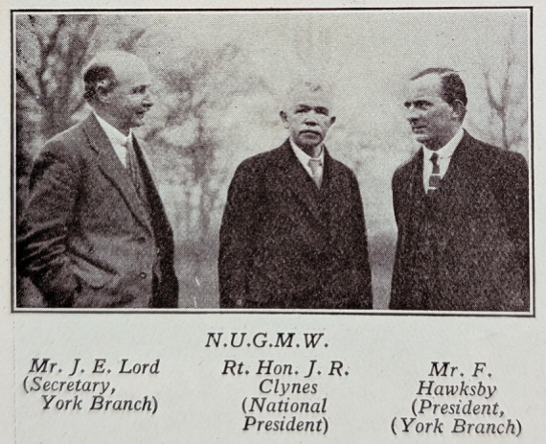
Three Members of the NUGMW – Cocoa Works Magazine Easter 1926

However, there were a couple of aspects of the trade union movement where both Joseph and Seebohm remained opposed:

  1. Industrial Action: both compared trade unions taking industrial action to warfare which is a particularly strong comparison for Quaker pacifists such as themselves.[6]  However ethical in their business practices, the Rowntrees were still business owners who benefitted more from the success of the company than the thousands of workers they employed.  They did, however, insist that education was the way to avoid industrial action – both for workers and employers with Seebohm writing in 1926 that “…on both sides, goodwill must be reinforced by education.”[7]
  2. Socialism: the Rowntree family had a long association with the Liberal Party, not just as members but also as Liberal councillors and MPs.  Seebohm had a close relationship with Lloyd George who, as Prime Minister, invited Seebohm to be an advisor and sit on many of his government committees.  In an Adult School class of 1897, Seebohm spoke out against socialism saying that he agreed with its aims of equality of opportunity but did not believe it presented practical ways of achieving it.[8]  However, his biographer, Asa Briggs, thought that Seebohm did not really understand socialism and he also had strong connections, sometimes friendships with notable socialists and even anarchists.[9]  J.R. Clynes, the National President of the N.U.G.M.W. and Labour Party leader 1921-22, once referred to Seebohm by saying, “here comes the greatest socialist of us all – he does the things we talk about”.[10]

Seebohm Rowntree’s ‘Human Factor’

Seebohm Rowntree was Rowntree & Co.’s Labour Director from 1897 to 1936 and Company Chairman from 1923 to 1941.  Although he held the same Quaker beliefs in ethical business practices as his father, Joseph, he was in many ways a different kind of person.

He was described by Clarence Northcott – a colleague who will be introduced more fully below – as having inherited his mother, Tonie’s, precision and realistic attention to detail.  He was described as being precise in all things; very punctual, intensely ordered, he got through a remarkable volume of work, and had exacting standards which he expected others to match.[11]

Northcott also commented on Seebohm’s management style saying, “I’ve met many men, but never one with the same knack of handling men”.  However, he noted that he was much better at dealing with groups of people than individuals and was not the best judge of character.[12]  Despite this, Seebohm seems to have had his father’s knack for finding and bringing in people to help him with his work; several would become loyal and trusted assistants and advisors.
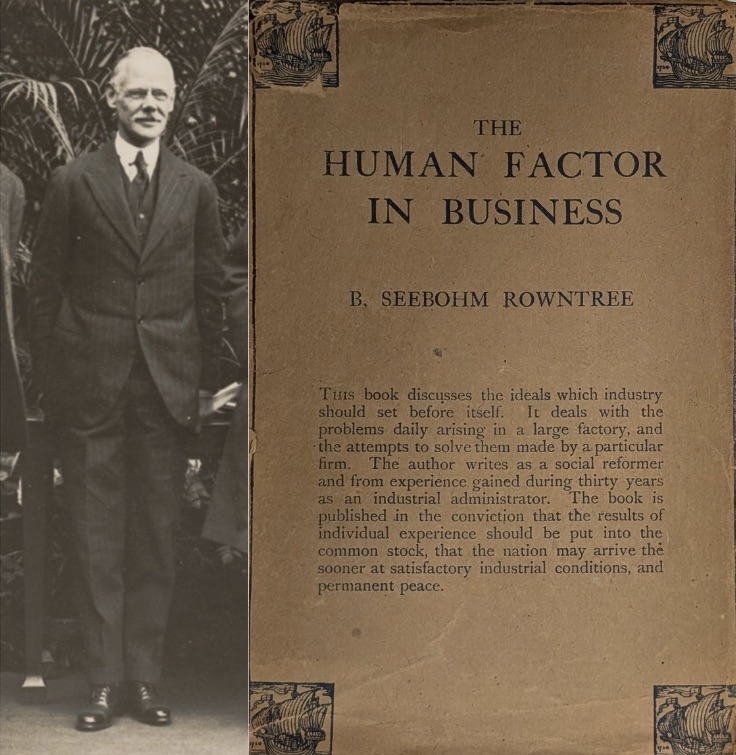
Seebohm Rowntree in 1923 & front cover of The Human Factor in Business (pub. 1921) Seebohm photo: Borthwick Institute for Archives Rowntree Photo 4/053 

Seebohm had published his influential work, Poverty: a study of town life, in 1901 with one of its key assertions being that a leading cause of poverty was workers receiving pay that was insufficient for a decent standard of living.[13]  He continued with his sociological research outside of his work in the Rowntree company, which was funded mainly through the Joseph Rowntree Charitable Trust (JRCT),[14] but also occasionally by both the Joseph Rowntree Social Services Trust (now the Joseph Rowntree Reform Trust) and the Joseph Rowntree Village Trust (now the Joseph Rowntree Foundation).  There was overlap between these two roles in what Seebohm was advocating – the company becoming the practical expression of his theory, with an added element of having to protect his reputation; how could he argue nationally for better wages and working conditions if this wasn’t being attempted at the Cocoa Works?  There was also an overlap in the people he employed which blurred the distinction between Charitable Trust funded research and company employees with several people moving between them.

Two people who were key to Seebohm’s dealing with trade unions in the 1920s:

  • In 1919, he brought the Australian sociologist, Clarence Northcott to work with him at Rowntree’s.  Northcott was a Methodist and had similar views regarding industrial democracy and that co-operation would produce an ethical society.[15]  He was given the role of Labour Manager in 1924 – and took over the day-to-day work that Seebohm had been doing as Labour Director once he became Company Chairman.[16]

Factory Organisation by Clarence H. Northcott et al Title Page (pub. 1928)

  • William Wallace: trained as a solicitor and first met Seebohm in 1914, after he writing to him praising his work on social reform and asking to help him with a “lead” which could get 23-year-old Wallace a job.[17]  Wallace could not enlist to fight in the First World War due to poor eyesight, so Seebohm got Wallace a job working in government on the Reconstruction Committees.[18]  In 1919, Wallace moved to York to live in New Earswick and was given work by Seebohm to do investigations into the viability of profit-sharing schemes and unemployment insurance.  Although employed by Rowntree & Co., Wallace seems used as an independent advisor and as Seebohm’s ‘private secretary’ – sometimes working on company business as well as on other initiatives funded by the JRCT.[19]  Even after Seebohm’s retirement in the 1940s, Wallace remained employed by Rowntree’s and eventually became Chairman in 1952.

William Wallace in 1929 – Bortwick Institute for Archives Rowntree Photo 6/261

But there were others too, including F.D. Stuart.  He became one of Seebohm’s most loyal assistants who helped him with much of his sociological studies, but was also sometimes asked to talk to trade unionists outside of Rowntree & Co.

Seebohm and his team advocated for his vision of ethical management through publications such as The Human Needs of Labour in 1919, The Human Factor in Business in 1921, and Industrial Unrest: a way out in 1922.  They attended and organised business conferences to encourage other businesses to take up their ideas; most notably establishing the Management Research Groups, and what are now known as the Rowntree Business Lectures.  These can be found online here, and include several talks and other contributions from Fred Hawksby.

Industrial Unrest: A Way Out by Benjamin Seebohm Rowntree (pub. 1922)

Rowntree’s Central Works Council

One of the Seebohm’s key initiatives was the establishing workplace democracy in the company through the system of works’ councils.  This was first set up in 1919, and each department had its own council.  Workers were elected to their departmental council by members of their department, with at least one position reserved for a trade union shop steward.[20]  From its inception, it included women workers – meaning that up to 1928 they were able to vote in their workplace before they could in Parliamentary elections.

The members of the departmental councils then elected who would represent them in the Central Works Council.  This body had real power within the company with only the topics of wages and working conditions outside its remit[21]; although, as will be explained below, even these were challenged.  The trade unions could raise their own concerns separately from the Works Council[22] but in practice it seems that most, if not all, of the worker representatives elected were either Shop Stewards or actively involved with the union.

Seebohm states in The Human Factor in Business that although “neither membership of the council nor voting is confined to trade unionists, but, as a non-unionist would stand but little chance of election, it may be said that the committees are substantially trade union bodies so far as the representation of workers is concerned”.[23]  Although we have not been able to find direct evidence to prove that this, it is likely that union meetings would agree on proposals to bring to the Works Council.  In addition to Seebohm, Northcott, Wallace, Hawksby, and Pickup all in different documents state the strong union involvement.[24]  Elected workers were given time away from their usual duties to attend meetings and carry out other Works Council activities.

Rowntree & Co.’s Central Works Council 1920 – annotated from original in Cocoa Works Magazine November 1920

The Central Council was divided into different committees, each responsible for various aspects of life at the Cocoa Works.  In 1920, the Executive Committee consisted of Seebohm as the Chairman, with his brother Stephen Rowntree representing the directors, T.H. Appleton – the factory manager and also a director was Deputy Chairman, and Fred Hawksby was Vice-Chairman.[25]  There were some changes to its members through the 1920s, with Irene Pickup and Jack Baker being elected to it in 1922, but Seebohm, Appleton and Hawksby were constants.

Other committees included the Joseph Rowntree Memorial Committee which organised Joseph’s memorial service at the factory following his death in 1925.  A spin off from this was responsible for building the Joseph Rowntree Memorial Library at the front of the factory – money was raised from the workers to pay for its interior.

Appeals Committee

The Appeals Committee was established so that workers who felt they had been unfairly disciplined could challenge it.  It consisted of an equal number of workers and management and had the power to overturn or reduce disciplinary decisions.  A case from 1922 involved a worker who had punched his overlooker.  He had support of many colleagues and was represented at the Appeals Board hearing by both a shop steward and another council member.  His punishment of dismissal was reduced to a 4-week suspension since he had been provoked by the overlooker and there was a consensus that this overlooker was quite irritating.  Seebohm was informed as well as Hawksby.  Hawksby confirmed that the overlooker was someone who the men found challenging to work under.[26]

William Wallace was sometimes part of the Appeals Committee and in his unpublished autobiography, he recollects his discomfort at overturning decisions made by Seebohm and the other directors.  Years later he spoke to Seebohm about a specific case and Seebohm responded by telling him that he originally thought the punishment was too severe but was outvoted by the board, so all Wallace had done was reinstate Seebohm’s original intent.[27]

Works Rules

Starting in 1921, the new Works Rules for the running of the Cocoa Works were drawn up in collaboration between workers and management through the Central Council.[28]  Irene Pickup is credited with playing a key role in this.[29]  The new Works Rules were implemented in early 1922, and Seebohm declared that they are an agreed code, not one implemented on the workforce.[30]

Psychology Department

A committee was also established to set up the Psychology Department which employed first industrial psychologist in a British company.  It took years to get this appointment right, not just finding the best person but also the terms of the role.[31]  The role wasn’t just to look after what we would now call the mental health of the workers, but there was more of an emphasis in working out how to get the most work from people.  A key part was the “time and motion” studies which would ascertain how fast factory tasks could be achieved and then implement that as the expectation.  Overlookers were responsible for making sure workers met this as a minimum.[32]  An aspect negotiated for the Psychology Department was that no time and motion study could be carried out without prior agreement from the trade union.[33]

Profit Sharing Scheme

Profit Sharing Scheme was finally implemented in 1923 and had been drawn up by a committee which included J.B. Morrell, Wallace, Pickup and had Hawksby as its chairman.[34]  This divided profits made above a set threshold between workers who earned below a certain wage.  Both Seebohm and the union had been sceptical about this at first and Joesph was the driving force behind it.[35]  Reaching an agreement with the union via the Central Council was essential to its implementation, a key aspect being that everyone got the same amount.  This meant lower paid workers received a bonus of a higher percentage of their earnings than higher paid colleagues.[36]

Jack Baker and Trade Union Militancy

During our research, Jack Baker was a name that kept coming up – particularly in relation to more militant union requests and positions.  He worked in the Melange Department; he was likely a Shop Steward and was a member of the Central Council and served on its Unemployment and Executive Committees – so played an influential and important role.  Examples of his demands recorded in the minutes of the Central Council include a call for the union to request Rowntree’s becoming a “closed shop”, and that a workers’ representative should sit on the committee which decided the wage structure.[37]  His positions were often supported by other trade unionists including both Hawksby and Pickup,[38] but he seems to have been a constant thorn in management’s side – he had an ability to really get to Seebohm.

Northcott relayed an incident where redundancies were being made, and he had divided the workforce into several meetings where Seebohm would explain what was happening and why.  In one, Baker stood up and attacked management in what Northcott describes as “fierce terms” and was applauded by many of the women workers.  Despite Hawksby standing up and asserting that Baker’s views were not representative of the general workforce, after the meeting Seebohm was furious – not at Baker who he expected this from but because of the women who supported him!  Seebohm’s wife, Lydia, said that that evening he had “sunk into a complete melancholia” and she had to persuade him not to give everything up.[39]

A Central Works Council Meeting 1920 – Borthwick Institute for Archives Rowntree Photo 25/045

Baker was not the only one who was more militant.  An important flash point in a Central Council meeting came in August 1921, when W.H. Goodson of the Cream Department asserted that the workers wanted control of the company, not just to be consulted.  The minutes of this meeting record Goodson using phrases such as “tackling the root causes” and “the evils” of the present industrial system which are reminiscent of the language used by Joseph Rowntree in his 1904 Memorandum setting up his three Trusts.[40]

Often Seebohm responded to these demands by reaffirming the status quo reminding them that the Board of Directors were appointed by shareholders and had no power to entrust their responsibilities to others.  He also regularly asserts the need for co-operation based on shared aims – the success of the business and welfare of its staff, and that dissatisfied staff have the right to go to their union who will raise it with management and the board.[41]

Fred Hawksby, as the leader of the union, could also demonstrate militancy.  Northcott describes an incident where Seebohm’s oldest son, Joseph Seebohm Rowntree, who oversaw the Psychology Department, sent someone to undertake a Time and Motion study without first agreeing it with the union.  As soon as Hawksby learned of this, he went straight to Seebohm and said, “either you get your man out of that department by this afternoon, or I bring this whole factory out on strike”.  Hawksby got his way, and I’m sure Seebohm would have also had strong words with his son![42]

It is, however, repeatedly noted how few and far between these incidents were.  Rowntree’s generally had good relations with their unions – this is noted widely by both management and trade unionists.

Cocoa Works Magazine

First started in the early 1900s by Joseph Rowntree as a way of staying in touch with the growing number of workers, the Cocoa Works Magazine is an incredible source of evidence with the whole life of the company and factory reflected in its pages.  It allowed management to communicate with the work force.

Excerpts of Cocoa Works Magazines from the 1920s

Throughout the 1920s, there were repeated articles and references to trade unions and industrial relations.  Debates were played out with both workers and management able to set out their views through editorials, articles and records of speeches given at the Cocoa Works.  It also contained the Central Works Council minutes including details of the debates and who said what.  Guest writers from outside the factory were invited to contribute and these included those high up in the N.U.G.M.W. such as Will Thorne (one of its founders) and J.R. Clynes.  Such openness is remarkable in a company magazine that generally reflected management’s stance, particularly when it allowed space for more militant perspectives.

————————————————————-

This is the end of Part 1 of “Come, Let Us Reason Together”: Trade Unions at Rowntree & Co. in the 1920s.  Parts 1, 3 & 4 can be found here.

———————————————————–

We presented this research at our 2025 York Festival of Ideas event as part of the Joseph Rowntree Centenary.  You can see the recording of the event here:

———————————————————-

Researched and written by Nick Smith, Executive Director of The Rowntree Society.

Additional research by The Rowntree Society’s research volunteers, Maisie Brenchley & James Heathfield.

Reference and Footnotes

[1] As can be seen through the updates given by management in the Cocoa Works Magazines throughout the 1920s

[2] Rowntree, J. 1907 Memorandum from Joseph Rowntree to his children on wealth: Borthwick Institute for Archives RFAM/BSR/JRF/1/1/5

[3] Hawksby, F. 1926 ‘The Value and Importance of the Shop Steward Movement’ Cocoa Works Magazine Easter 1926 pp.194

[4] Thorne, W. 1927 ‘The Story of the N.U.G. & M. W.’ Cocoa Works Magazine Christmas 1927 pp.345; Fitzgerald, R. 1995 Rowntree and the marketing revolution Cambridge University Press pp.252-253; Sheils, B. 2024 Seebohm Rowntree and the Conditions of Work: an illustrated talk accessed 10/9/2025

[5] Hawksby, F. 1926 ‘The Value and Importance of the Shop Steward Movement’ Cocoa Works Magazine Easter 1926 pp.194

[6] E.g. Joseph Rowntree’s Christmas Letter in Cocoa Works Magazine Christmas 1920; Seebohm Rowntree’s views on the 1926 General Strike: Rowntree, B.S. ‘Christmas Message’ Cocoa Works Magazine Christmas 1926 pp.250; Briggs, A. 1961 A Study of the Work of Seebohm Rowntree Longmans pp.255-6

[7] Rowntree, B.S. ‘Industrial Strife and the Way Out: forward to the Educational Programme for 1926-27’ Cocoa Works Magazine October 1926 pp.321

[8] Briggs, A. 1961 A Study of the Work of Seebohm Rowntree Longmans pp.23

[9] E.g. Sidney & Beatrice Webb, Piotr Kropotkin: Briggs, A. 1961 A Study of the Work of Seebohm Rowntree Longmans pp.23; Pitt, S. 2022 ‘Benjamin Seebohm Rowntree and Piotr Kropotkin: A friendship transcending politics?’ New Rowntree Histories accessed 11/9/2025

[10] As relayed by Northcott, C. 1956 Memorandum of interview with C. H. Northcott: Borthwick Institute for Archives RFAM/BSR/JRF/11/26

[11] Memorandum of interview with C. H. Northcott: Borthwick Institute for Archives RFAM/BSR/JRF/11/26

[12] Memorandum of interview with C. H. Northcott: Borthwick Institute for Archives RFAM/BSR/JRF/11/26

[13] Rowntree, B.S. 1901 Poverty: a study of town life Macmillan https://wellcomecollection.org/works/cv2ekdg7/items

[14] Freeman, M. 2004 The Joseph Rowntree Charitable Trust: a study in Quaker Philanthropy and Adult Education 1904-1954 Sessions

[15] Bourke, H. 2000 ‘Northcott, Clarence Hunter (1880–1968)’ Australian Dictionary of Biography  adb.anu.edu.au/biography/northcott-clarence-hunter-11256 accessed 16/10/25

[16] Fitzgerald, R. 1995 Rowntree and the marketing revolution Cambridge University Press pp.270-271; Memorandum of interview with C. H. Northcott: Borthwick Institute for Archives RFAM/BSR/JRF/11/26

[17] Borthwick Institute for Archives WW/11/1/2/1

[18] Wallace, W. 1985 I Was Concerned pp.67-100: Borthwick Institute for Archives JRRT/8/2/54

[19] Forrester, H. 1990 William and Nancie: a celebration of marriage William Sessions pp.101-106, Wallace, W. 1985 I Was Concerned pp.101-139; see Freeman, M. 2004 The Joseph Rowntree Charitable Trust: a study in Quaker Philanthropy and Adult Education 1904-1954 pp.81 – although not named some of Wallace’s work is included in Seebohm’s JRCT funded 1921 publication, The Human Factor in Business

[20] The Rules and Regulations of the Works Councils set out in March 1919 are reprinted in Appendix A of Briggs, A. 1961 A Study of the Work of Seebohm Rowntree Longmans pp.349-364; Original documents relating to the Works Councils are held by the Borthwick Institute for Archives: R/WC; Correspondence between factory manager T.H. Appleton and trade unions e.g. Borthwick Institute of Archives: R/DP/F/11/2/9/18

[21] Briggs, A. 1961 A Study of the Work of Seebohm Rowntree Longmans pp.350

[22] Briggs, A. 1961 A Study of the Work of Seebohm Rowntree Longmans pp.350

[23] Rowntree, B.S. 1921 The Human Factor in Business Longmans, Green & Co. pp134

[24] E.g. Wallace, W. 1985 I Was Concerned pp.67-100 Borthwick Institute for Archives JRRT/8/2/54; C.H. Northcott, C.H. 1927, ‘Co-operation with Employees’, Offprint from Confectionery Journal Borthwick Institute for Archives: R/DL/L/24; Pickup, I. ‘The Value of the Central Works Council’ Cocoa Works Magazine Christmas 1925; Hawksby, F. ‘The Value and Importance of the Shop Steward Movement’ Cocoa Works Magazine Easter 1926

[25] Cocoa Works Magazine November 1920 pp.156-7; Central Works Council Minutes: Borthwick Institute for Archives R/WC/2

[26] Minutes of the Appeals Committee 4th April 1922 and related documents: Borthwick Institute of Archives R/WC/CA/1/1, R/WC/CA/2/1, R/WC/CA/5

[27] Wallace, W. 1985 I Was Concerned pp.128-129: Borthwick Institute for Archives JRRT/8/2/54

[28] Cocoa Works Magazine June 1921 pp.269-270, 274

[29] Cocoa Works Magazine Summer 1952 pp.22

[30] Cocoa Works Magazine December 1921 pp.33

[31] Briggs, A. 1961 A Study of the Work of Seebohm Rowntree Longmans pp.235; Cocoa Works Magazine March 1923 pp.177-178; also see Cocoa Works Magazines from May 1920 to 1923

[32] Fitzgerald, R. 1995 Rowntree and the marketing revolution Cambridge University Press pp.265; 267-268

[33] Wallace, W. 1985 I Was Concerned pp.122: Borthwick Institute for Archives JRRT/8/2/54; Northcott, C. 1956 Memorandum of interview with C. H. Northcott: Borthwick Institute for Archives RFAM/BSR/JRF/11/26

[34] Central Works Council Minutes 3rd May 1922 Cocoa Works Magazine June 1922

[35] Briggs, A. 1961 A Study of the Work of Seebohm Rowntree Longmans pp.173

[36] Cocoa Works Magazine December 1922 pp.150

[37] Cocoa Works Magazine Christmas 1920 pp.189,191

[38] E.g. Central Works Council Minutes 1st March 1922 Cocoa Works Magazine June 1922

[39] Northcott, C. 1956 Memorandum of interview with C. H. Northcott: Borthwick Institute for Archives RFAM/BSR/JRF/11/26

[40] Cocoa Works Magazine December 1921 pp.31

[41] e.g. Cocoa Works Magazine December 1921 pp.31; Cocoa Works Magazine October 1926 pp.321; Cocoa Works Magazine April 1927 pp.272

[42] Northcott, C. 1956 Memorandum of interview with C. H. Northcott: Borthwick Institute for Archives RFAM/BSR/JRF/11/26

Support Us

Our work is enabled by grant funding from the Joseph Rowntree Foundation, the Joseph Rowntree Charitable Trust, and the Joseph Rowntree Reform Trust. If you would like to make a financial donation to further support our work, it is easy to pay online (with or without Gift Aid) by clicking the link below. You can get in touch with us about other ways of giving via info@rowntreesociety.org.uk

Donate