

Researching Joseph Rowntree: Quaker, Philanthropist, Industrialist, Social Innovator
This blog is part of the Joseph Rowntree Centenary and has been written by Fiona Grimshaw, a former Executive Director of The Rowntree Society, and researcher for the JR100 List. The JR100 List is one hundred notable stories and aspects curated from the archives we’re sharing on our social media and website throughout 2025. This list attempts to cover the wide ranging influence and legacy of Joseph Rowntree’s life, and will continuously be added to until we have shared all 100! You can find the list here.
As a former Executive Director of the Rowntree Society, it was both a pleasure and a privilege to be asked to contribute to the celebrations during 2025 to mark 100 years since Joseph Rowntree died. Sustained by his sincere Quaker faith, Joseph was a York confectionery businessman, philanthropist and social reformer. It is difficult to overestimate the impact that this unassuming personality and his descendants have had in York, nationally and globally. It is a considerable legacy. Their work lives on in the three Joseph Rowntree Trusts which were established by Joseph and who continue to work to influence social change today.

My brief was to curate one hundred stories about Joseph and his legacy using archival material and images. This would form a social media and website campaign running from the anniversary of Joseph’s funeral in February throughout 2025. At the start of the project there was some concern that a target of one hundred stories might be too ambitious but, given my knowledge of Rowntree archival material and other resources available, I was confident that this was not going to be a problem. And, indeed, as I immersed myself in Joseph’s life, family, social vision and legacy, it became clear that I was going to have to make some hard decisions as to what not to include. I became quite proficient at weaving themes together to include as much of Joseph’s story as possible.
During my tenure as Executive Director, The Rowntree Society’s programme of work was very much focused on women and factory workers (a personal interest of mine) and on the company’s role in colonial economies in Africa and the Caribbean which benefited from unfree and/or exploitative labour systems. This project was an opportunity to effectively go back to where the Rowntree story began and to utilise recent research to view events from different perspectives.
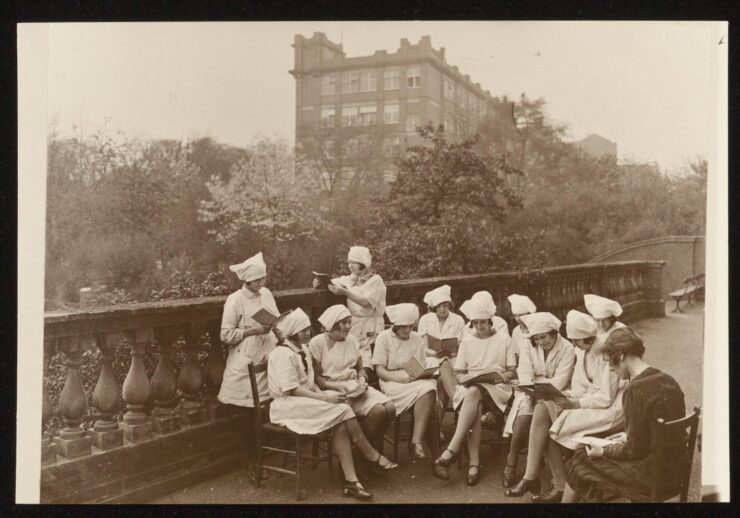
I quickly established that there were one hundred stories ready to be told. Assisted by the fact that the Borthwick Institute for Archives at the University of York has the largest deposits of Rowntree family, company and trust records anywhere in the world, I was ready to start developing each story. I originally organised my research into topic areas e.g. Quaker faith; family; company; trusts; philanthropic activities but it became clear that a more impactful approach would be to form the whole into a narrative loosely following Joseph’s life and linking the stories with the people, places and events which would really bring them to life.

It is very easy to form an image of Joseph as a elder statesman who appears in images as an affable grandfatherly figure – which by all accounts he was – but this masks the fact that he was a passionate campaigner for social justice throughout his life and that his early writing on subjects such as poverty and temperance was radical and to the point. I was keen that the younger Joseph in his earlier years should shine through and that, where possible, his own words from essays, books, memoranda and correspondence written by him should be used. His 1904 Founder’s Memorandum which established the Rowntree Trusts was written later in his life but is hugely significant in setting out his social vision so had to be included. I also wanted to make sure that much earlier essays, notably On Modern British Civilisation: In what it consists and in what it does not consist and Pauperism in England and Wales, both written in the 1860s, should get their fair share of the attention. However, these earlier writings proved difficult to track down. The Borthwick does not have copies of the originals. We made a joint approach to the Society of Friends Library in London and were excited to find that they did have copies that they could make available to us. It is a great day for a researcher when a success like this occurs – we had feared that On Modern British Civilisation may have been lost.

One of the joys of researching a subject that will appear digitally and on social media is the opportunity to undertake image research. Many images that I chose to include are already extant in the public domain through various media and form an important part of Joseph’s story but I set myself the challenge of finding others that are less well known. Working with an archivist with an encyclopaedic knowledge of the Rowntree archives meant that I could enquire about a particular person or subject and suggestions would magically appear by return email. Some of my personal favourites are: a younger Joseph in 1858; Joseph driving his car and the family at son John Wilhelm Rowntree’s wedding.
As I write this blog, the JR100 List – as it came to be known – has been running on social media for some months and it has been very pleasing to see the level of engagement with Joseph, his life and legacy. This makes all the research worthwhile. It has been a privilege to have the opportunity to revisit this remarkable man. Joseph’s legacy is still so relevant in our modern world – agencies still work to resolve poverty; provide affordable housing and improve educational opportunities. If Joseph were here today, it is likely that he would be disappointed that we are still wrestling with some of the issues for which he campaigned throughout his life.

In conclusion, I would like to thank the trustees, staff and volunteers of the Rowntree Society; the Rowntree Trusts and the Borthwick Institute for Archives for their support and input into the JR 100 List and for the opportunity to come face to face with Joseph Rowntree a century after his death. When I first started undertaking historical research it was difficult to achieve very much without spending large amounts of time in a library or archive or both – and I love to spend hours in an archive really immersing myself in the people and stories. Thanks to our modern digital world, I was able to accomplish most of my research from my desk at home looking out over my lovely garden, which Joseph, with his love of nature, would have wholeheartedly appreciated.
You can find out more about Joseph Rowntree, his life and legacy here.
Fiona Grimshaw Biography
Fiona Grimshaw is a former Executive Director of the Rowntree Society with a lifelong interest in history and heritage which led to her obtaining an MA in History from Sheffield University. The first 25 years of her career were in commercial and business roles in the health and IT sectors. She moved to Yorkshire 15 years ago, working in York for 10 years at the National Railway Museum and the Rowntree Society – with brief stints in Haworth and Bradford. Fiona studied for and obtained an MA in Museum & Artefact Studies to kickstart her museum and heritage career. Fiona now works on freelance projects with both a heritage and business focus and is a visiting lecturer at Durham University.