
Refugees & Rowntrees
The Rowntree Society’s Refugees & Rowntrees Event, proudly hosted by The Mount School
As part of Refugee Week, we explored how the Rowntree family (including Mount School Old Scholars), company, and Trusts supported refugees across the twentieth century.
Attendees discovered the stories of Belgian refugees during the First World War, former Mount pupils Jean and Tessa Rowntree’s humanitarian work in Prague ahead of the Nazi invasion and the resettlement of Ugandan Asian refugees in York during the 1970s.
The event brought together historical archives, community stories, and local heritage, exploring how members of the Rowntree family, the Rowntree company, Joseph Rowntree Trusts, and The Mount School were involved in supporting refugees during times of conflict and displacement across the twentieth century.
This event also highlighted The Rowntree Society’s work with refugee groups and communities in York, bringing past and present experiences together. There will be an exhibition and a talk featuring several speakers.
The Mount School has a strong Quaker history dating back to 1785 with one of its School Houses called Rowntrees, to pay respects to this leading Quaker family with such important connections to the establishment and history of the school. The leading independent school is coeducational in Prep, and proudly all girls for Senior School and Sixth Form, which reflects the original intention of the school as aQuaker college to educate women.
More content from this event will be coming soon!
“Come, Let Us Reason Together”: Trade Unions at Rowntree & Co. in the 1920s Part 4: Irene Pickup
This is part 4 of The Rowntree Society’s research into the relationship between the Rowntree family and trade unions in the 1920s. In the previous parts we explored Seebohm Rowntree’s approach to industrial relations at Rowntree & Co., how the General Strike of 1926 impacted the company, and the life of Chief Shop Steward Fred Hawksby. You can find them here. This part will tell the story of Irene Pickup, important trade unionist at Rowntree’s and their first Assistant Chief Shop Steward.
Researching Pickup
We at The Rowntree Society had already come across Irene Pickup in our research about Rowntree women (see here). We were keen to revisit this work and discover more about her life. We followed the same methodology we used for researching Fred Hawksby; consulting census and similar records, as well as documents held in the Rowntree archives at the Borthwick Institute for Archives, including issues of the Cocoa Works Magazines. This time we also ended up consulting the Trade Union Congress’s (TUC) archives and finding out about the Bryn Mawr Summer School for Women Workers in Industry held in Pennsylvania, USA. From this we were able to uncover Pickup’s remarkable life story as an award-winning trade unionist at Rowntree & Co.
Pickup’s Early Years
Irene Pickup was born in July 1897 and spent her early childhood living in a terrace house on Upper Hannover Street in the Leeman Road area of York with her parents and younger sister, Violet. Her father worked as a railway greaser, likely at the nearby carriage works. She went to St. Paul’s School in Holgate, and when she was 12 started attending Bishophill & Clementhorpe School.
However, by the 1911 census her mother had died, her sister was living with wider family members in York, and her father was lodging with a work colleague and his family in Holgate. Irene had been moved to Hull – the census records her living in a terrace house with an aunt and uncle and two cousins. She was 13 at the time of the census, and this disruption in her life following the death of her mother was likely due to the kind of poverty cycles Seebohm talks about in ‘Poverty: a study of town life’.
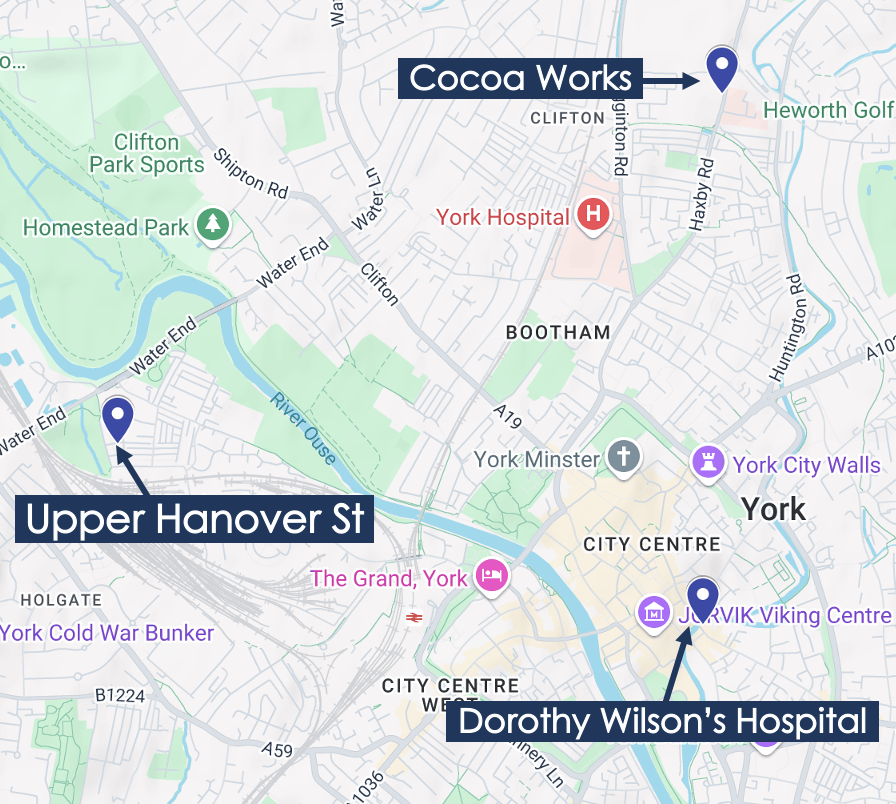
Places Irene Pickup lived and worked in York – Google Maps 8th May 2025
Irene Pickup back in York
Ten years later, Pickup appears in the 1921 census as having moved back to York. She is recorded as working at Rowntree’s and living as a lodger at Dorothy Wilson’s Hospital on Walmgate, just by the bridge over the Foss. This is notable as, at this time, Dorothy Wilson’s Hospital was an almshouse. Pickup was only 24, with the other people living there much older and described as “inmates”. She is the only person living there in the 1921 census who is described as a lodger, suggesting that her status was different to the other residents. As a single woman who never married, Pickup would likely have earned enough to cover rent but would still have faced significant legal and social barriers to renting or owning property independently. Almshouses or similar accommodation may have been among her only realistic options. She lived at Dorothy Wilson’s Hospital until around 1939, most likely in a dormitory as she is never recorded as having a room number, unlike other residents.
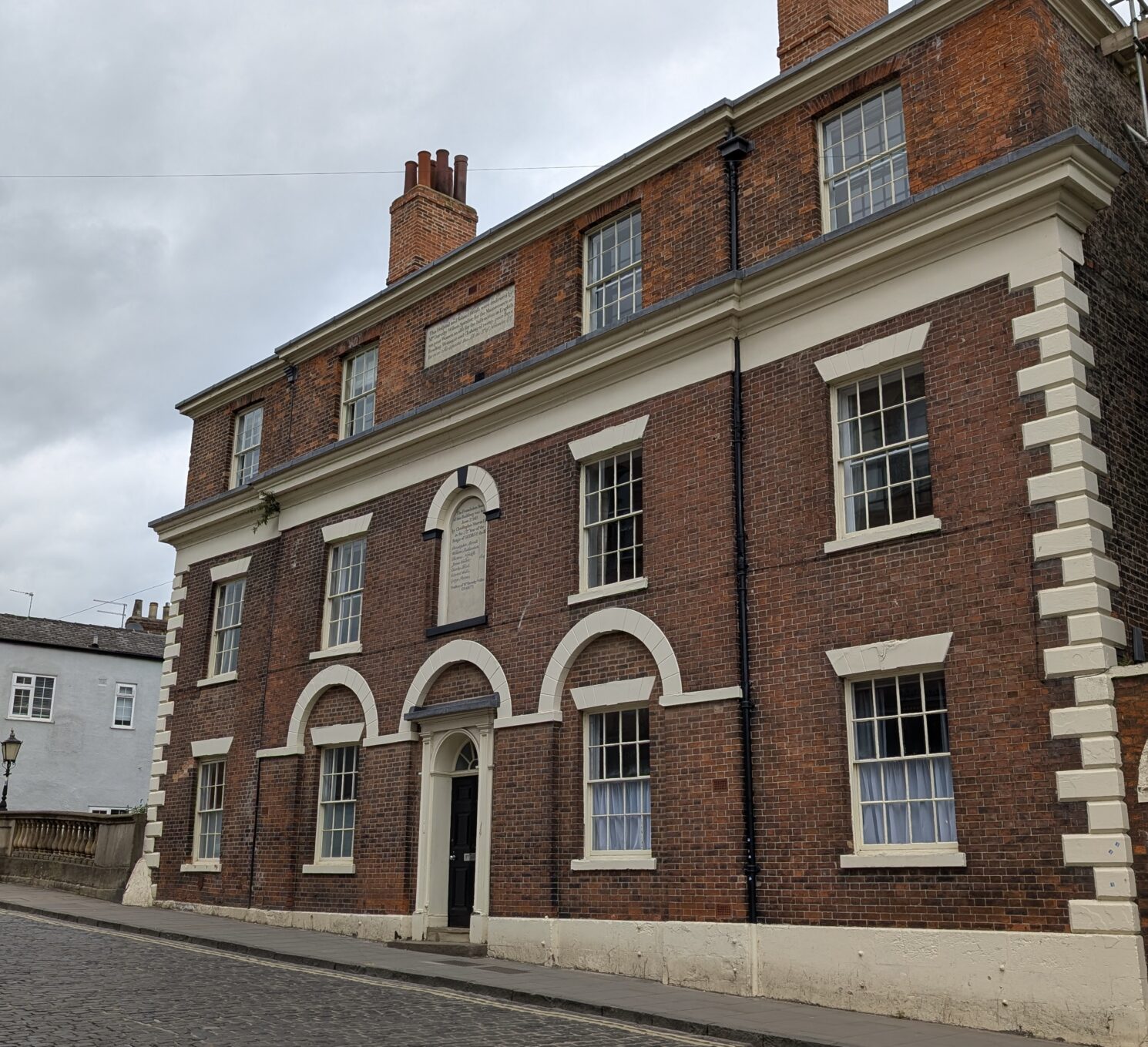
Dorothy Wilson’s Hospital building in 2025 – The Rowntree Society
At some point around 1939, Pickup’s housing situation changed. The 1939 register records Pickup as having moved into what would have been a newly built house in Holgate and living there with her by then retired father. She stayed living there until her death in 1969. In her later years, her sister Violet lived there with her. It had taken decades for the family to come back together after her mother’s death and loss of their home when she was 12 or 13.
Irene Pickup at The Cocoa Works
Pickup started working at the Cocoa Works in 1915 aged 18, initially as a chocolate piper, and then in the Almond Department where she became a Shop Steward and sat on their departmental council.[1] In 1919 she was part of the delegation from Rowntree’s to the government’s Interim Industrial Reconstruction Committee where she represented women workers in the negotiations over nationally imposed pay and working conditions.[2] Pickup must have been on the Central Works Council (CWC) by 1921 as she is cited as playing a key role in developing the Works Rules.[3] However, the first time she is mentioned in the minutes is from the 8th February 1922 meeting where she is first voted onto the CWC’s executive.[4] Alongside her work in the CWC, Pickup was a strong advocate for the education provided at the Cocoa Works. She was involved in its organisation and encouraged the women workers to engage with the education opportunities offered to them by Rowntree & Co.[5]
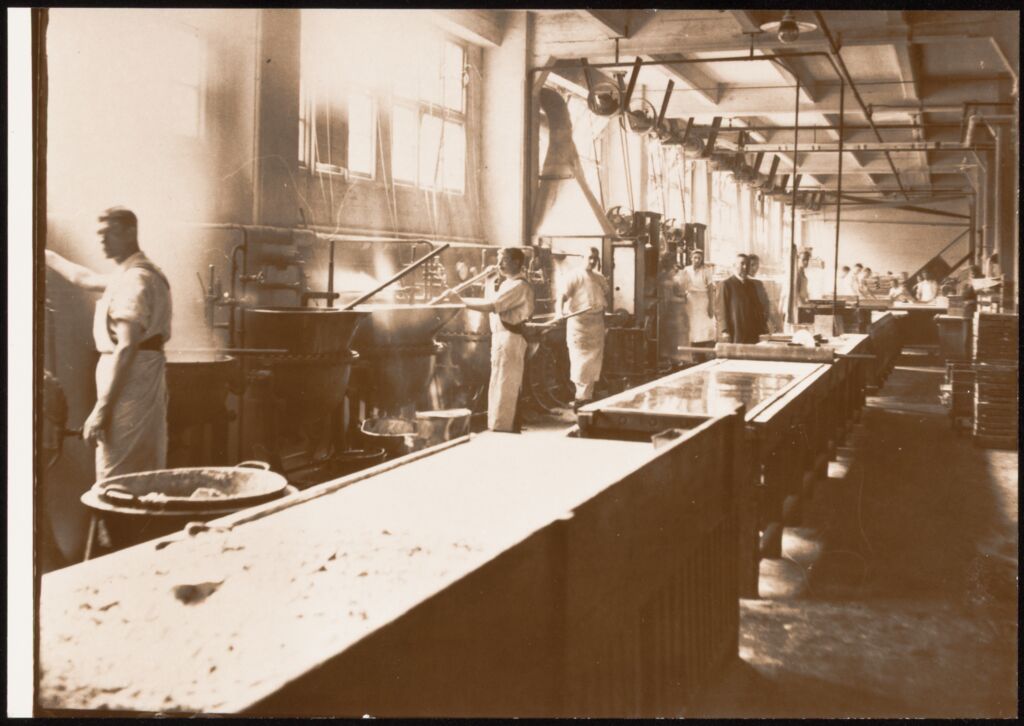
Almond Department at Rowntree’s Cocoa Works 1920 – Borthwick Institute for Archives Rowntree Photo 7/133
Although the sources we found span several decades, together they give us a sense of what Irene Pickup was like as a person and how she was regarded by those around her. In the obituary she wrote for Seebohm Rowntree following his death in 1954, Pickup said, “When I look back and recall some of the interviews I had with him, at a time when my views were much less moderate than they are now, I realise just how tolerant he was.”[6] On her retirement, the Cocoa Works Magazine stated, “Her rise from the ranks, and her keen interest in workers’ welfare, coupled with a high level of intelligence and sense of justice enabled [Pickup] to reach well-balanced views on most workroom problems, and the Management greatly regrets the loss of her unique experience and personality…”.[7] In 1952 William Wallace wrote a letter to Seebohm Rowntree discussing whether the spirit of Joseph Rowntree still existed at the Cocoa Works. In it, he describes having raised the question with Irene Pickup and concludes that “few other people are likely to be either so well informed on this subject or so willing to be frank.”[8]
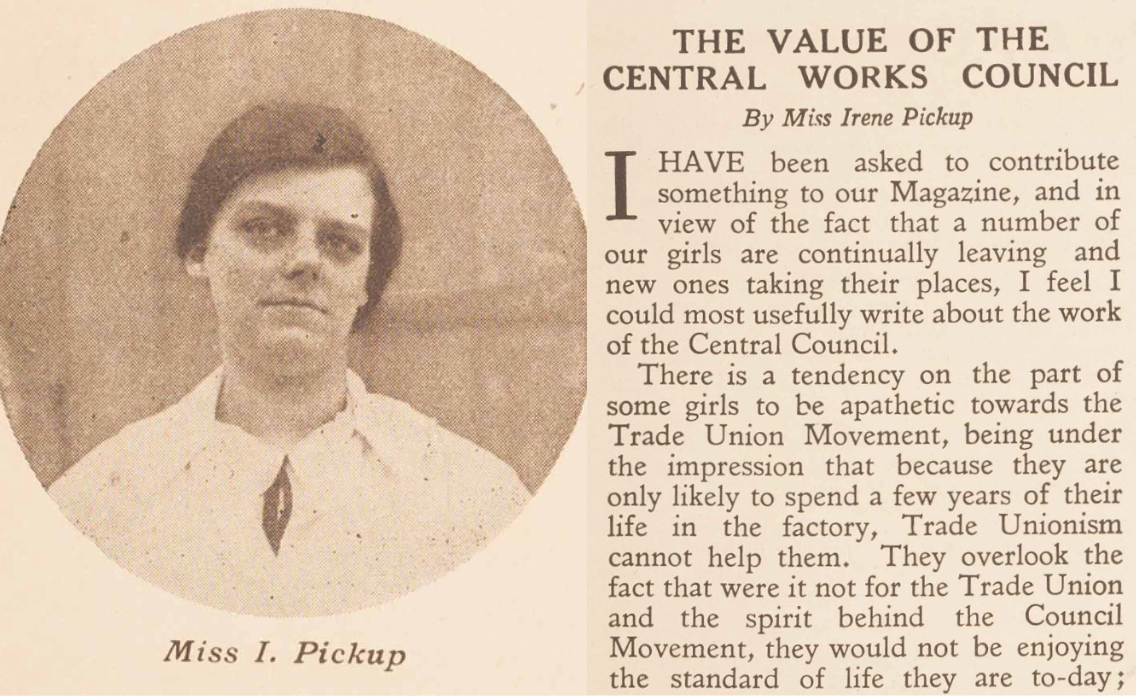
Irene Pickup and the opening an article by her in the Cocoa Works Magazine Christmas 1925
In 1925, Pickup was given the position of Assistant Chief Shop Steward working with Fred Hawksby.[9] This new position was not just to help Hawksby and cover the work in his absence, but it also meant that the women in the factory got their own chief representative. This may well have been something Seebohm recognised he needed after the incident described in part 1, where the women had rallied behind Jack Baker’s militancy.
However, unlike Hawksby, Pickup did not stay working in her paid Shop Steward role, as in 1937 she became part of the management team of the Cream Packing Department where she stayed until her retirement in 1952.[10]
International Trailblazer
In addition to her contribution to industrial relations at Rowntree’s Cocoa Works during the 1920s, Irene Pickup also became an important figure in the wider trade union movement both in Britain and internationally.
In 1926, ahead of their first women’s conference, the Trades Union Congress (TUC) set out to find the woman who had done “the best work” for trade unions in the country that year.[11] To do so, they established a set of criteria for which points were awarded up to a maximum of 100. These points were allocated for factors such as the number of years spent as a member of a trade union, number of years as a shop steward, participation in negotiations with employers, and attendance of TUC education classes.[12] Pickup achieved 77 points, more than any other nominee. She was awarded a TUC Gold Badge for the achievement at the women’s conference which was held alongside the other events of the annual congress of 1926 in Bournemouth.[13] The official report records that 85 delegates attended, representing 38 affiliated organisations, and notes as a remarkable feature the large number of women who attended as visitors – suggesting that even at a women’s conference, the majority of official delegates were men.[14]
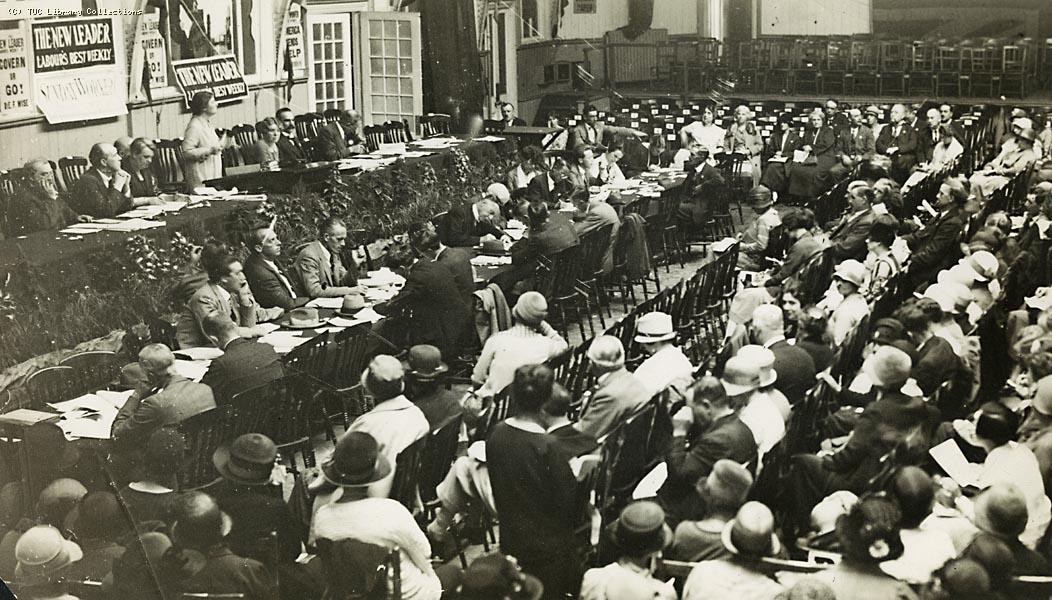
TUC Women’s Conference 1926 Bournemouth – TUC Library Collections, London Metropolitan University
Coverage in the October 1926 issue of the CWM was extensive with an editorial dedicated to Pickup receiving the award, and an article by Seebohm Rowntree introducing the new education programme, entitled “Industrial Strife and the Way Out”.[15] It also printed the speech Pickup made at the TUC’s women’s conference where she stated, “I feel it is a duty, as an ordinary rank and file member, to try and educate our women, and even our men… and I am perfectly certain that when we do that, we shall not have the ills which we have with us to-day” and “I am perfectly certain the men will have to “sit up” and take notice of the women in the future more than they done in the past.”[16]
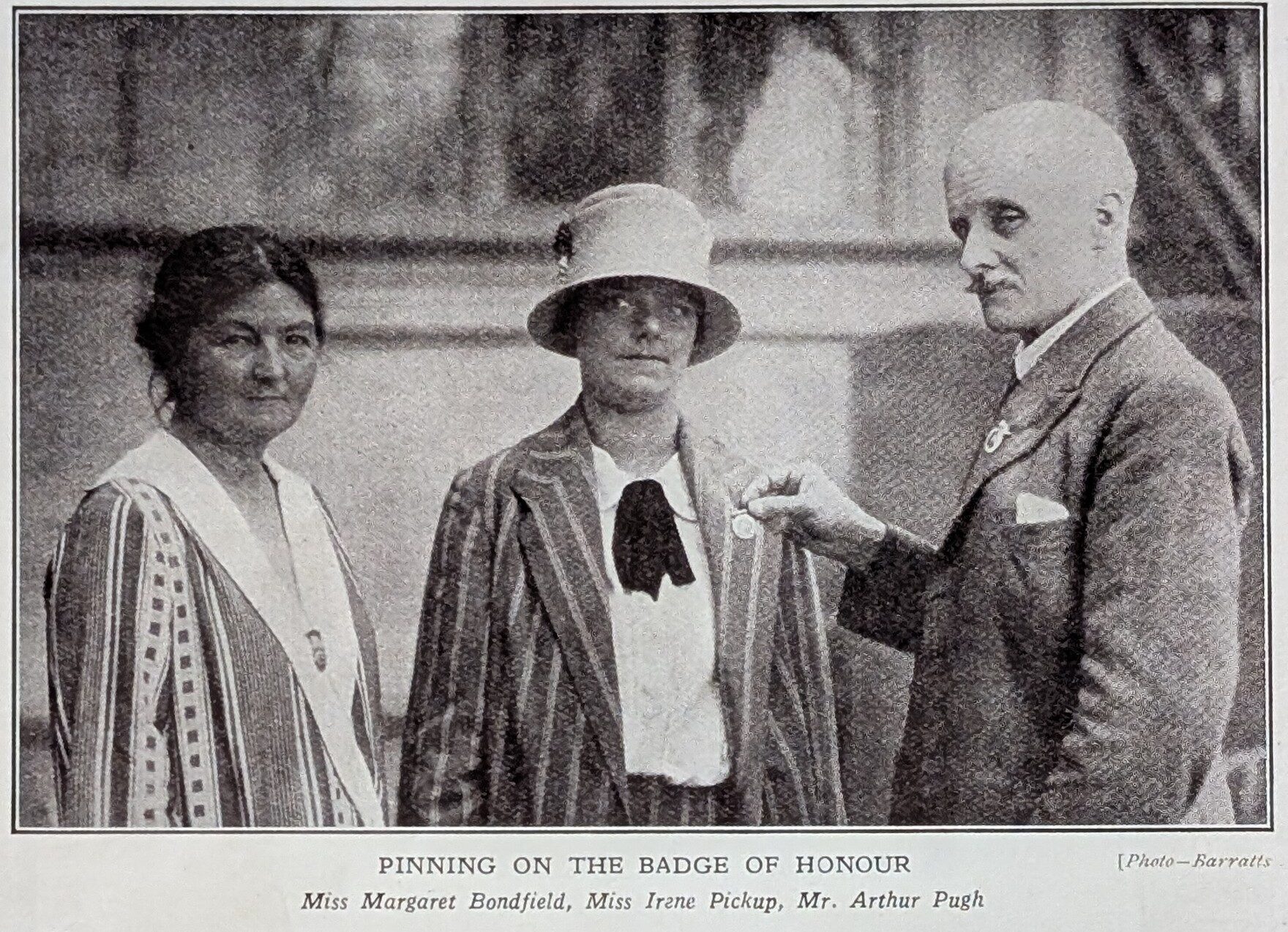
Irene Pickup receiving her award at the TUC Woman’s Conference 1926 – Cocoa Works Magazine October 1926
In 1927, Seebohm arranged for Pickup to attend the Bryn Mawr College Summer School for Women Workers in Industry.[17] Bryn Mawr College is in Pennsylvania, USA and was originally founded by Quakers. Their Summer Schools ran from 1921 to 1938 and were radical in many ways: in how they were taught, in the kind of women who attended – many like Irene did not have a university education – and in the behaviour of the students (who would instigate protests about their accommodation and join picket lines on organised outings).[18] Pickup was the first international student to attend and made such a marked contribution that they continued to fund international scholarships in the following years. The year before Pickup attended, they admitted the first African American students to the course.[19] The school’s ethos is illustrated by the fact that one of its teachers was the sociologist W.E.B. Du Bois – among the first African Americans to gain a PhD, an anti-racist campaigner, and an early thinker in what we now call de-colonialism.[20][21]
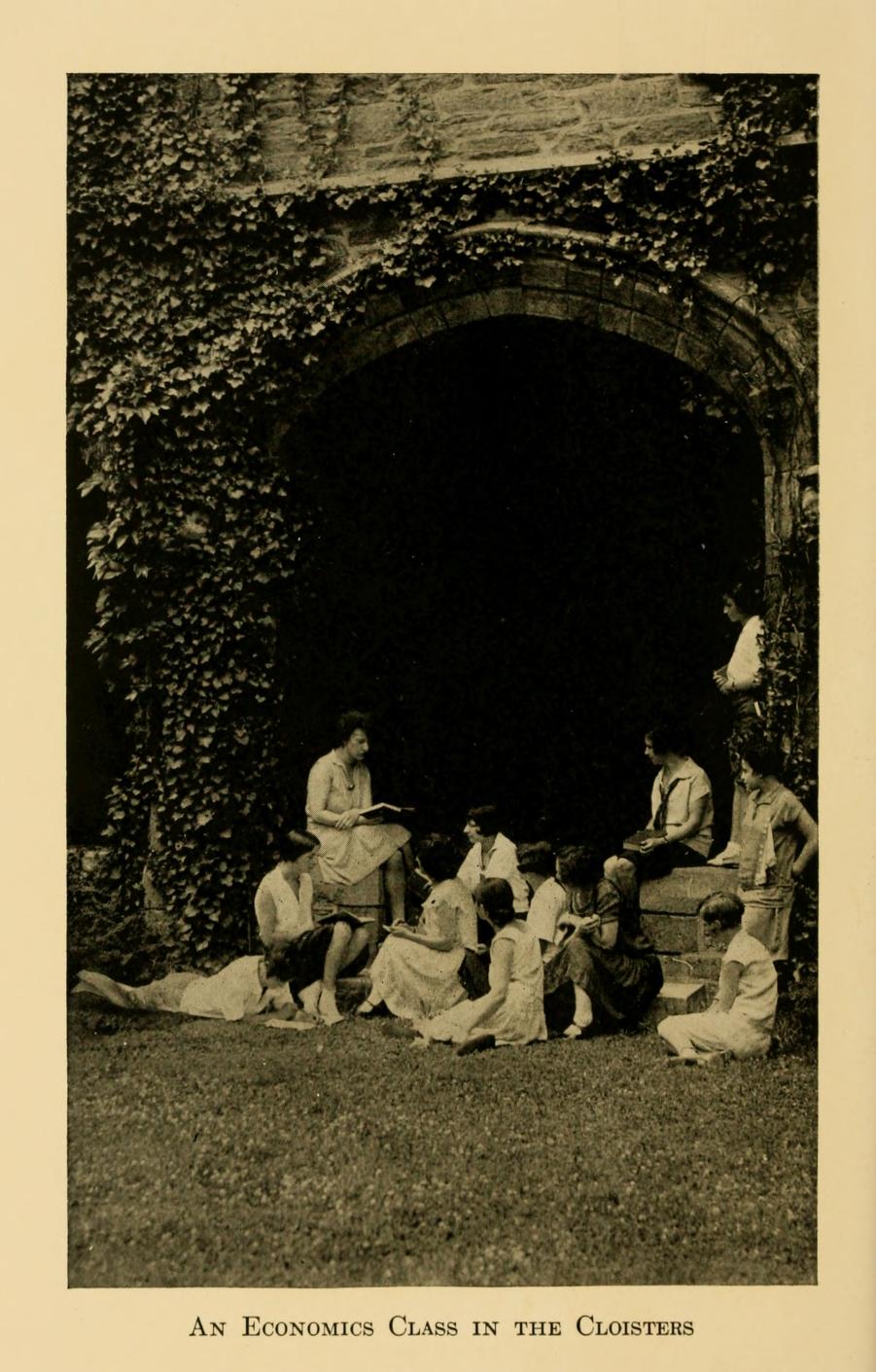
Women Workers at the Bryn Mawr Summer School – Smith, H.W. 1929 Public Domain
Irene Pickup and Seebohm Rowntree
Irene Pickup had a lot of affection for Seebohm, even if she was not as close to him as Hawksby became. In the obituary she wrote following his death in 1954, she said “we who worked with him not only glimpsed his ideals but saw them put into practice here at the Cocoa Works. But it is not only those employed here who have benefited from his life and work —his influence has been felt throughout the world. When I went to America…, I found that the people I met there knew far more about Seebohm Rowntree than some of his own employees, and I felt very proud to be a member of his staff”.[22]
Pickup’s own contribution received national recognition when she received the British Empire Medal in 1953. On her retirement in 1952, she was given a half page column in the Cocoa Works Magazine which states that her “departure has left a gap in many Cocoa Works activities”.[23] However, her death in 1969 – 17 years later – sadly only warranted a single line noting her passing.[24]
This is the end of Part 4 of “Come, Let Us Reason Together”: Trade Unions at Rowntree & Co. in the 1920s. Parts 1, 2 & 3 can be found here.
We presented this research at our 2025 York Festival of Ideas event as part of the Joseph Rowntree Centenary. You can see the recording of the event here:
Researched and written by Nick Smith, Executive Director of The Rowntree Society.
Additional research by The Rowntree Society’s research volunteers, Maisie Brenchley & James Heathfield.
“Come, Let Us Reason Together”: Trade Unions at Rowntree & Co. in the 1920s Part 3: Fred Hawksby
This is part 3 of The Rowntree Society’s research into the relationship between the Rowntree family and trade unions in the 1920s. In parts 1 and 2 we explored Seebohm Rowntree’s approach to industrial relations at Rowntree & Co. and how the General Strike of 1926 impacted the company. You can find them here. This part will tell the story of Fred Hawksby, trade union leader at Rowntree’s and their first Chief Shop Steward.
Chief Shop Steward
One of the innovations Rowntree’s made in their relationship with their unions was in establishing the position of Chief Shop Steward. This was a role paid for by the company and provided their own office in the Cocoa Works’ Employment Department. After negotiations with the Executive of National Union of General Workers (NUGW, later became NUGMW), Fred Hawksby was appointed to this role in the summer of 1920.[1] Hawksby had been working in the Extract Block, and he was the vice-chair of the Central Works Council, as well as the President of the York Branch of the NUGW (making him the main trade union leader at Rowntree’s Cocoa Works).
Seebohm noted “…it would be desirable to have on the staff in the Employment Department someone in close touch with the workers who would be able to voice their point of view, and F. Hawksby’s name had been suggested…”. Following his appointment as Chief Shop Steward, Hawksby was re-elected on the Central Works Council as a nominated member despite opposition from the more militant trade unionist Jack Baker.[2]
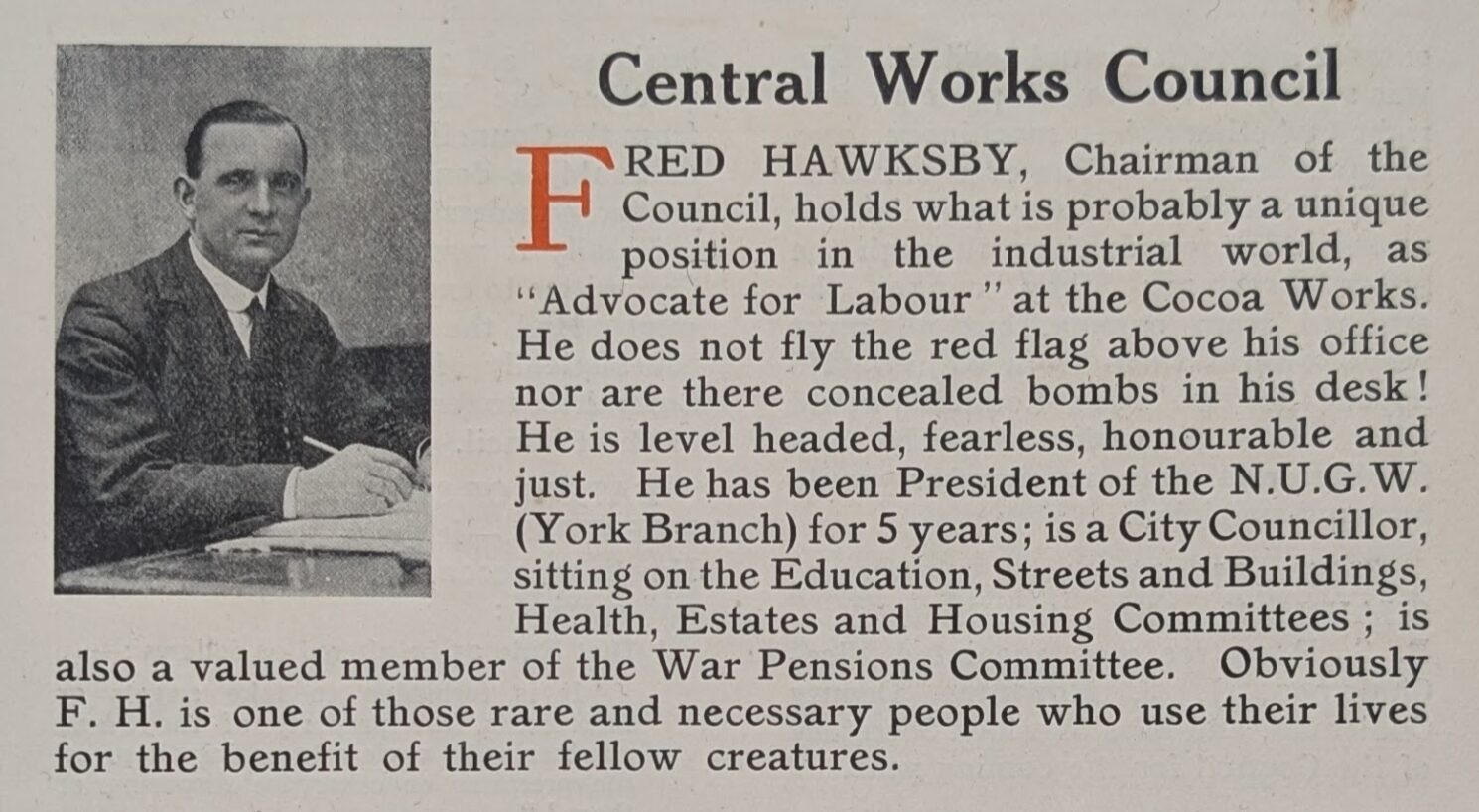
A focus on Fred Hawksby before the Central Works Council minutes in the June 1923 issue of The Cocoa Works Magazine
Researching Hawksby
The Rowntree Society were keen to find out more about who Fred Hawksby was. We used the kinds of evidence family historians often consult such as the census and military records. In addition, we investigated documents held in the Rowntree archives at the Borthwick Institute for Archives, issues of the Cocoa Works Magazine, and even citizen history by asking in York-based Facebook groups. Through this, we were able to piece together much of his life story.
Hawksby’s Early Years
Fred Hawksby was born in Asenby, between Boroughbridge and Thirsk, in 1884. His father, Thomas, did various low paid rural jobs including working as a gamekeeper and an agricultural labourer. However, by the time Hawksby was 6 his father had died. This left his 29-year-old mother, Susannah, as a single parent to three children and working as a charwoman – doing casual, low-paid domestic cleaning in other people’s homes.
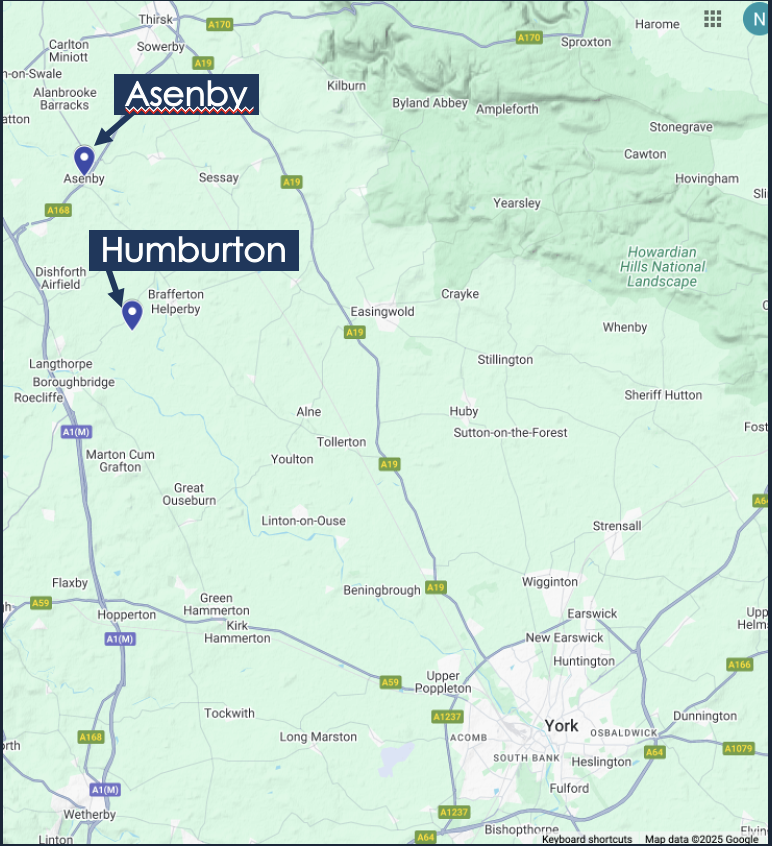
Asenby and Humburton in relation to York – Google Maps 8th May 2025
By 1901, when he was 16, Hawksby had left Asenby to work as a servant horseman on a farm at Humburton, about five miles south of Asenby. While working there, he joined the West Yorkshire Militia, a part-time army reserve force. From the autumn of 1901 to October 1902, the Militia, with Hawksby among them, were posted to active duty in Malta, protecting communication lines and prisoners-of-war from the Boer War. When not in Malta, the regiment was stationed in Chatham, Kent, alongside the 11th Hussars, which Hawksby enlisted with in August 1902, shortly after turning 18, continuing his work with horses.
On his enlistment paperwork, he is described as 5’4” tall, with a fresh complexion, grey eyes, brown hair, and a tattoo reading “Highland Soldier” on his left forearm. During his time with the 11th Hussars, he was attached to the 13th Hussars and posted to India for three years, returning in November 1909. The following year he moved to the Army Reserve, and it is likely that this is when he moved to York.
Fred Hawksby in York
The 1911 Census shows that 26-year-old Fred Hawksby was working at Rowntree’s as a general labourer and was boarding with his colleague Thomas Edward Watson’s family on Redeness Street, in the Layerthorpe area of York. At that time, the area was made up of terrace houses and dominated by the gasworks and power station. Much of this has since been demolished, and the neighbourhood now bears little resemblance to its early 20th-century appearance.
One street that does remain is Hawthorn Street, where Hawksby moved after marrying his wife, Harriet, in 1914. He continued to live there for the rest of his life. The terraced street was very close to the railway branch line connecting with the Cocoa Works, which must have made living conditions cramped. By 1921, the household included Fred and Harriet, Harriet’s sister Lydia, and a boarder, Ellen Thompson – both also Rowntree’s employees. Fred and Harriet Hawksby only had one child, a son called Walter who was born in 1927, who sadly died at the age of seven.
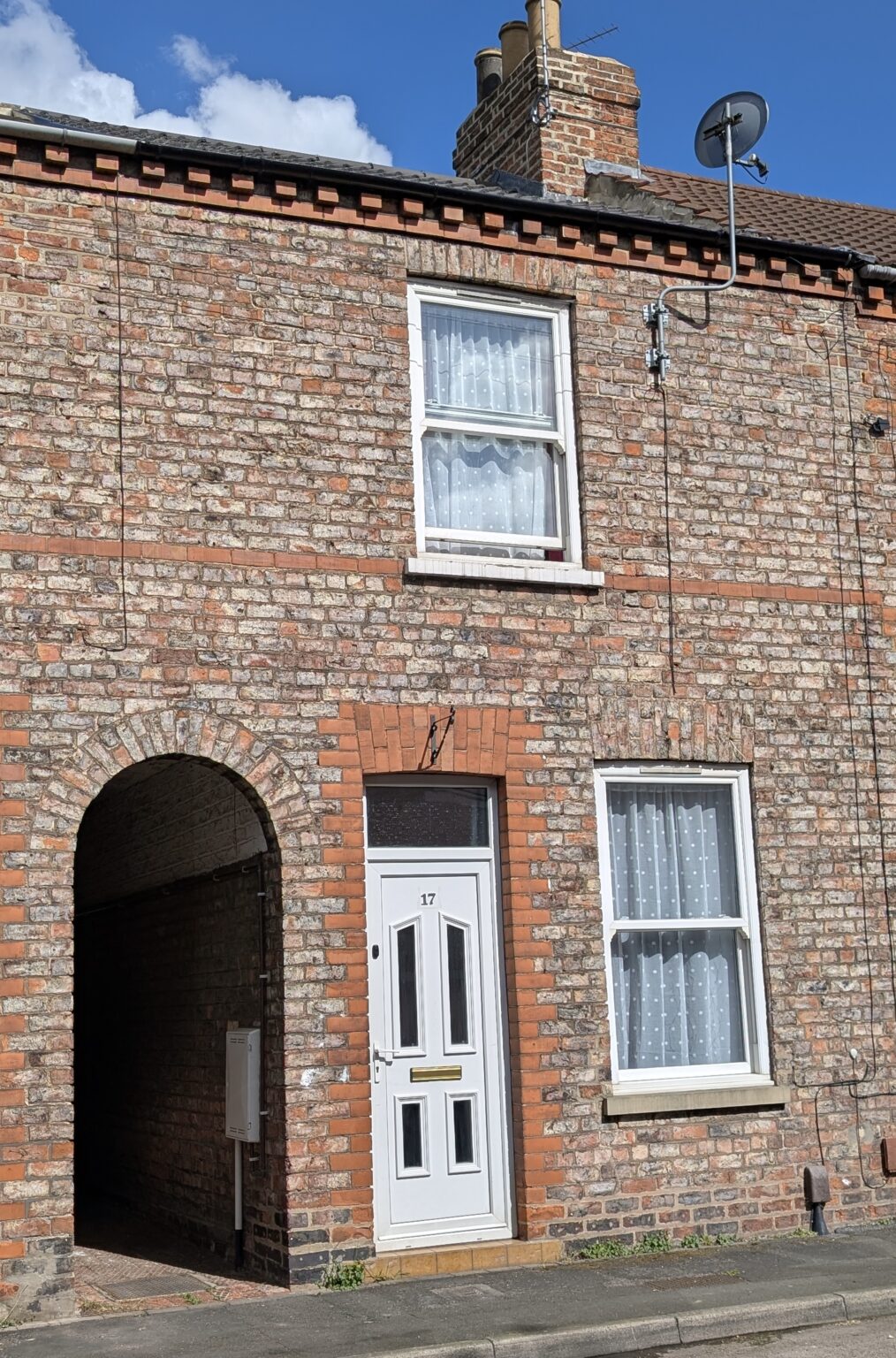
Hawksby’s home, 17 Hawthorn Street in 2025 – The Rowntree Society
In 1912, Hawksby injured his ankle which ruled him out of serving in the First World War. He became the President of the York branch of the NUGW in 1918 and in November 1921, was elected as a Labour councillor for Monk Ward in what was described as a surprise result.[3] During his time on the council, he served on committees for Streets and Buildings, Health, Estates, Public Libraries and Housing.[4] The latter alongside Alderman Oscar Rowntree, Seebohm’s youngest brother and a Rowntree & Co. director.
Fred Hawksby at the Cocoa Works
Something of how Hawksby conducted himself at work, certainly in the early days, can be gained from the minutes of a meeting held in November 1916.[5] A complaint was made to the factory manager, T.H. Appleton, and other management about Hawksby’s “bullying and domineering attitude” particularly towards the women workers. It seems like Hawksby had only recently gainer a promotion, likely to some grade of overlooker. A lower-level manager, only named by the initials G.T.L., asks why this issue was not brought to him first before going to Appleton. The reason given is that G.T.L. is Hawksby’s brother-in-law! After much discussion, it was agreed that the issue lay with Hawksby’s blunt manner and G.T.L. would speak to him about it.
It was in his role of Chief Shop Steward where Hawksby had the greatest impact at Rowntree’s. Seebohm Rowntree seems to have held real affection for him, as did both the Labour Manager, Clarence Northcott, and William Wallace. Any issues which might impact the workers were brought directly to Hawksby.[6] Seebohm would often arrange to meet him to discuss company issues at the Station hotel – both a neutral and private space where they could talk freely and Hawksby be shown confidential documents including the company accounts.[7] Northcott later recalled that before such meetings, Seebohm would declare “come, let us reason together”.[8] It is a Biblical quote from Isiah 1:18 that reflects Seebohm’s Quaker approach in dealing with issues through dialogue and understanding.
Hawksby was an ever-present member of the Central Works Council, holding leadership positions and serving on many of its sub-committees. In early 1923, he undertook a review of the workplace democracy structure below the Council and introduced significant changes.[9]
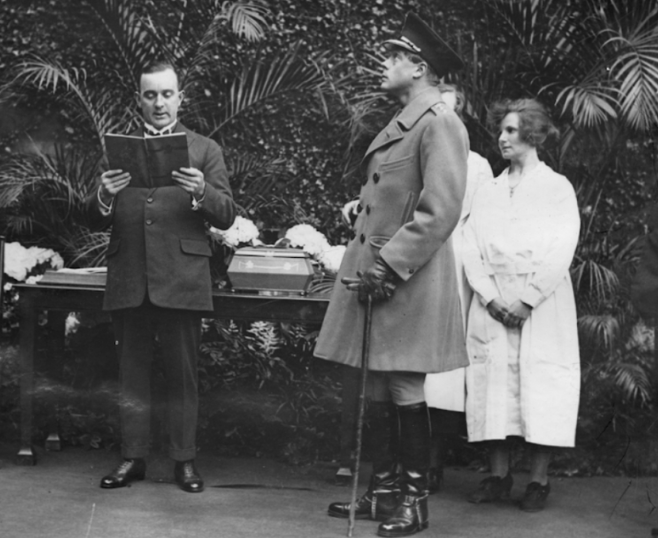
Hawksby presenting a casket of chocolates from Rowntree’s workers to the Prince of Wales in 1923 – City of York Council / Explore York Libraries and Archives Mutual Ltd Asset ID 1002833
Overseas Visits
In early 1925, Hawksby was struggling. This was just after Joseph Rowntree’s death and in addition to his usual work, Hawksby had been involved in arranging the Cocoa Works’ memorial activities. The Central Council minutes record that he was suffering from “overstrain”, and so Rowntree’s had arranged for him to visit South Africa for a break from April 1925. Another trade unionist at the Cocoa Works, Irene Pickup, was appointed Assistant Chief Shop Steward to support Hawksby and cover his duties whilst he was away.[10] The journey to South Africa was not relaxing though, as the following issue of the Cocoa Works Magazine reports that Hawksby suffered from neuritis during the rough sea crossing.[11]
Hawksby made another trip abroad in the 1920s, travelling with Northcott to the United States of America in September 1926. This was a Rowntree’s initiative to study American companies and what could be learnt from them. The full report of this visit is preserved in the Borthwick Institute for Archives[12], and the Cocoa Works Magazine printed what Hawksby and Northcott shared with a meeting of workers on their return.
Hawksby’s account conveys an almost giddy excitement about his experiences in the United States and the innovations he believed could be adopted at the Cocoa Works. He was particularly impressed by the high wages, the co-operation between workers and management, and the more advanced technology. At the meeting, however, both Northcott and Arnold Rowntree followed with a more cautious tone. Northcott stated that they had intentionally only visited “good firms”, and recalled that on an earlier visit American businesses “…regarded this factory as a sort of philanthropy, kept up by advertising. I find that to-day they regard Rowntree’s as an up-to-date efficiently managed place.” Arnold pointed out that not all problems had been solved in America, but that the company would learn from the report. He set out a more practical approach, saying “we want less vague talk. We must get down to practical questions”.[13]
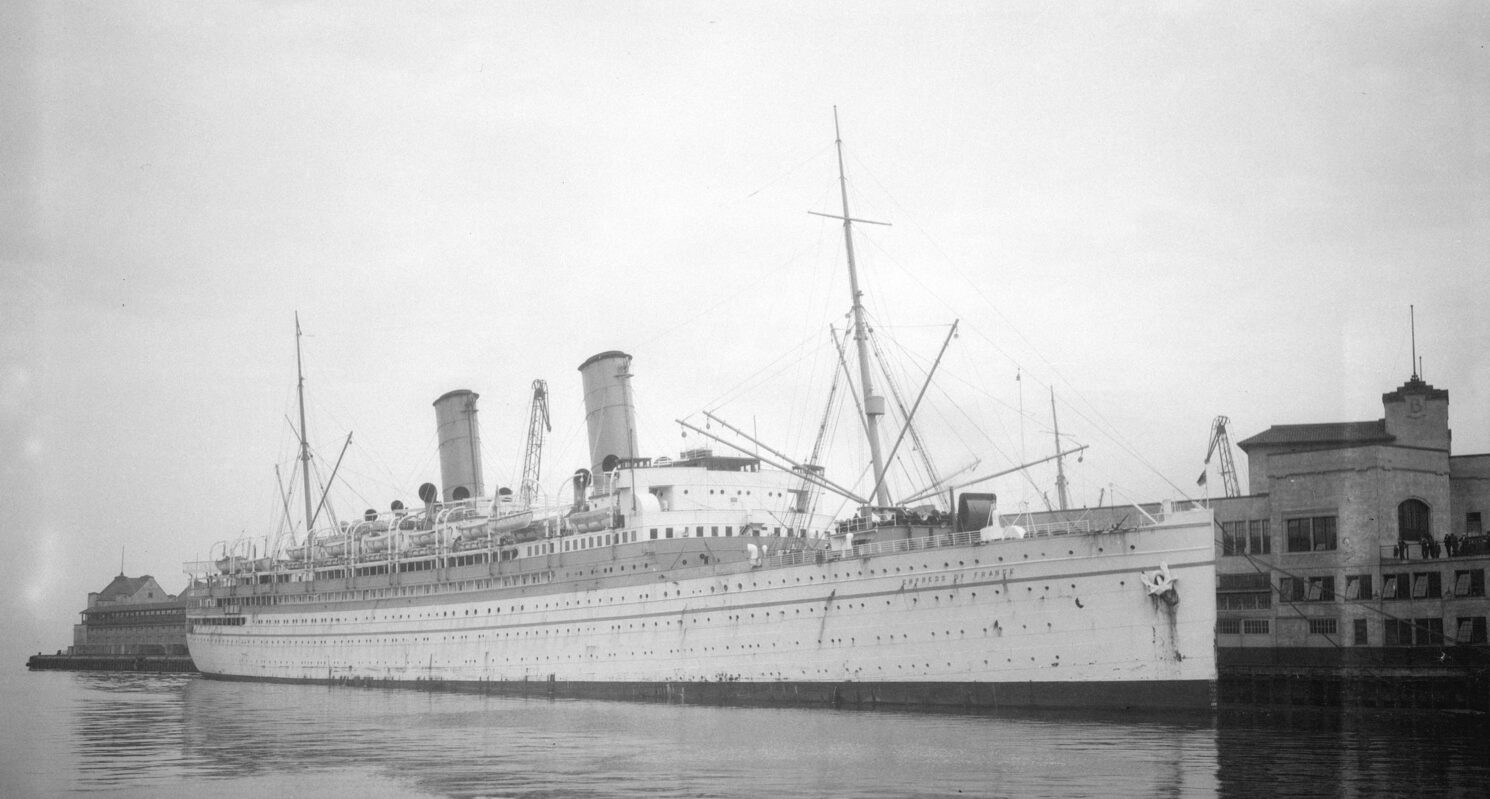
SS Empress of France, the ship Hawksby & Northcott sailed on to USA in 1926 – City of Vancouver Archives ref CVA 447-2191, Public Domain
Fred Hawksby after the 1920s
Hawksby continued as Chief Shop Steward right until his death in August 1946 at the age of 62. The Cocoa Works Magazines from the time gives the impression of the shock felt through the Cocoa Works at his passing. He seems to have suffered from bouts of poor health for many years beforehand with letters to him from both Seebohm and Seebohm’s assistant, F.D. Stuart, mentioning his health – Hawksby having been either in hospital or looking well on recovery.[14]
His relationship with Seebohm continued to deepen, and they remained in contact following Seebohm’s move away from York in 1936. When Seebohm’s wife, Lydia died in 1944, Hawksby wrote a poignant letter of condolence to Seebohm. In it he remembered that “Mrs Seebohm was indeed a lady who endeared herself with all whom she came in contact with, I well remember the kindly interest she took in the work of the Central Council and the many happy occasions when the members were invited to spend a social evening at the Homestead. Many who went for the first time told me that they went with a feeling of shyness but Mrs Seebohm by her charms and personality soon made them feel they were members of a happy family.”[15] Seebohm’s reply is signed off with “I am your friend sincerely”.[16]
Hawksby was awarded the British Empire Medal shortly before his death. After he died, a memorial was held for him at the Cocoa Works.[17] Seebohm’s son, Peter Rowntree, sent a letter of condolence to Harriet Hawksby on behalf of his father who was in Norway. In it he noted how far Rowntree & Co.’s reputation had travelled, saying, “many years ago I remember in Pennsylvania seeing a notice of an evening service outside a Methodist Church. The text that was advertised for the evening was “why do the Rowntree girls… sing at their work?” … I am sure that my father would be the very first person to say that these remarkable achievements [at Rowntree’s] would not have been possible had it not been for the energetic and loyal co-operation of Fred Hawksby. Wherever these achievements are appreciated the name of Fred Hawksby will be associated with them, and they will be for him a worthy memorial”.[18]
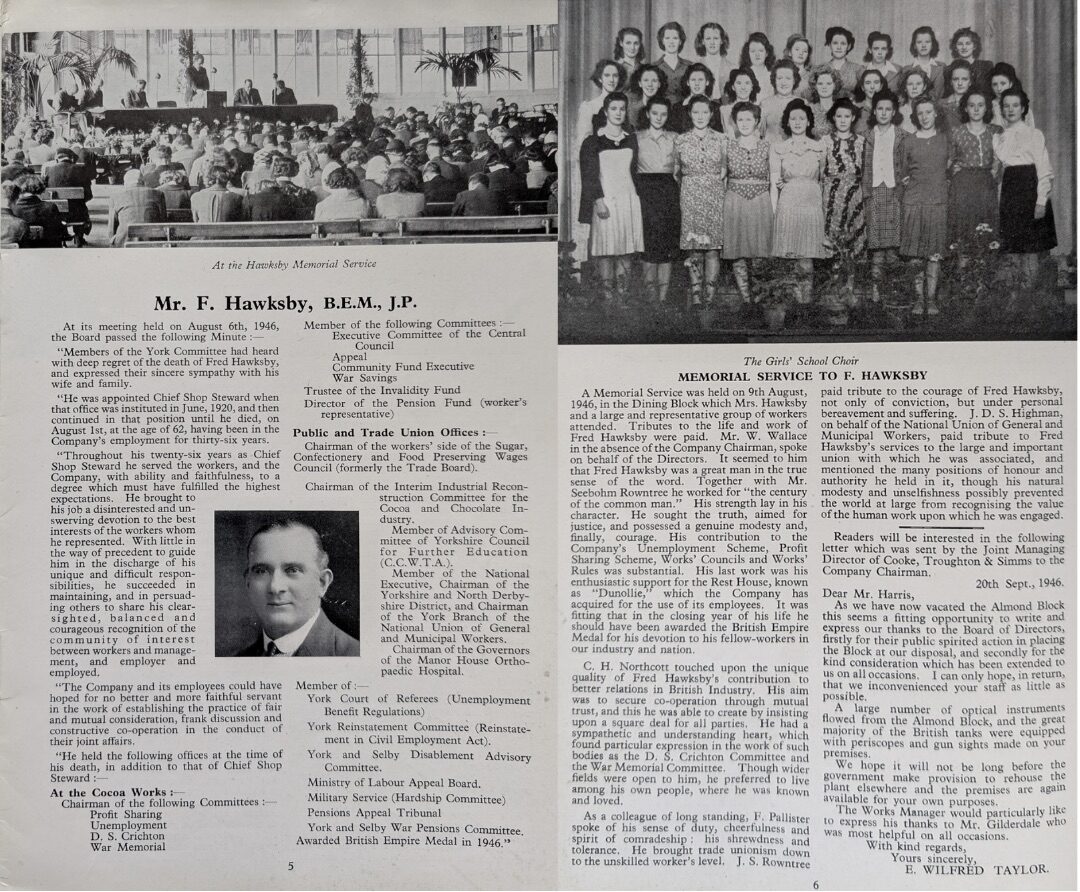
Hawksby’s memorial in the Cocoa Works Magazine Autumn 1946
This is the end of Part 3 of “Come, Let Us Reason Together”: Trade Unions at Rowntree & Co. in the 1920s. Parts 1, 2 & 4 can be found here.
We presented this research at our 2025 York Festival of Ideas event as part of the Joseph Rowntree Centenary. You can see the recording of the event here:
Researched and written by Nick Smith, Executive Director of The Rowntree Society.
Additional research by The Rowntree Society’s research volunteers, Maisie Brenchley & James Heathfield.
“Come, Let Us Reason Together”: Trade Unions at Rowntree & Co. in the 1920s Part 2: The 1926 General Strike
This is part 2 of The Rowntree Society’s research into the relationship between the Rowntree family and trade unions in the 1920s. In part 1 we explored Seebohm Rowntree’s approach to industrial relations at Rowntree & Co. You can read it here. This part will examine how the 1926 General Strike impacted Rowntree & Co. as well as Seebohm’s attempts at industrial conciliation in its aftermath.
The General Strike at the Cocoa Works
“Class warfare threatens us today – not because we hate on another, but because we love ourselves – because groups and individuals, bent on their own private ends, forget the common good” – Seebohm Rowntree, 1914[1]
The General Strike which began on 4th May 1926, grew out of a dispute by mining unions who were striking to prevent wage reduction for mine workers. The TUC called a general strike of all workers whose industries benefited from coal – this particularly impacted transport and heavy industry which used coal for electricity. Seebohm Rowntree had little sympathy for the mine owners and disagreed with doing away with the minimum wages for miners. He thought that the miners were paid less than those who worked less hazardous and more pleasant occupations. However, he was also against the idea of a general strike as he saw it as revolutionary and had little sympathy with A.J. Cook, the General Secretary of the Miners Federation of Great Britain.[2]
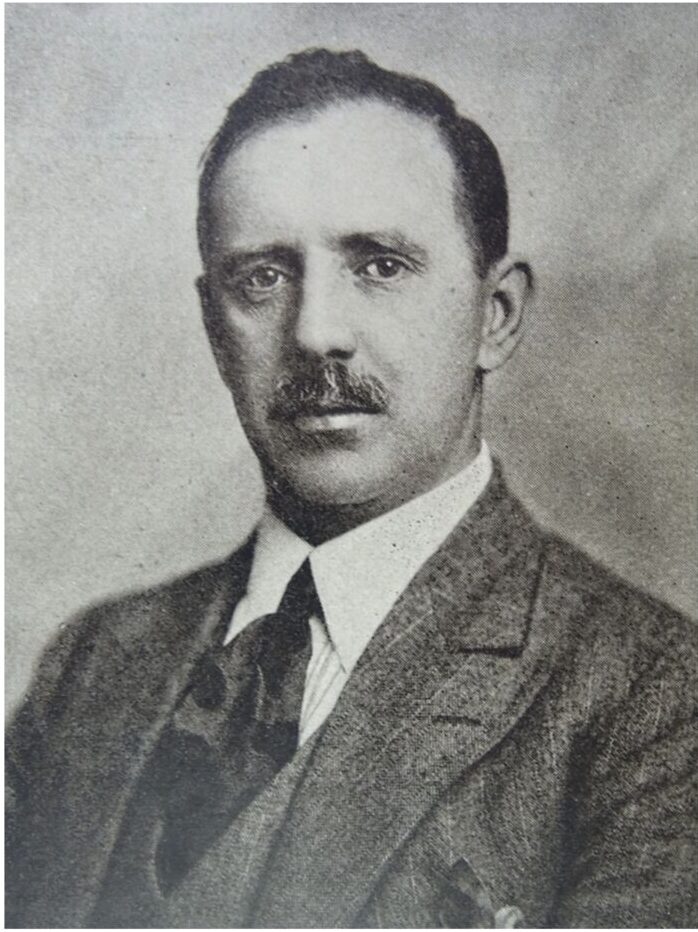
A.J. Cook in 1926 – Degwards CC BY-SA 4.0 via Wikimedia Commons
During the General Strike, there were some exceptions where trade unionists were given exemptions from striking – including those involved in food manufacture. Seebohm and the Rowntree’s board thought their company would therefore be exempt from the strike and that the impact on their Cocoa Works factory would be minimised. However, some of Rowntree’s transport and maintenance engineers were called out on strike by their unions.[3] Another issue facing the company was the disruption to coal supplies. Seebohm had been making sure to stockpile additional coal since the Railway strike of 1919.[4] However, coal shortages would disrupt the electrical supply to the factory, which led to the board taking the decision to put the Cocoa Works on short time. This was presented to a Central Works Council meeting on Monday 3rd May 1926, where Seebohm explained they would only work Mondays, Tuesdays, and Wednesdays during the upcoming strike.[5]
On Wednesday 5th May, Fred Hawksby – Rowntree’s Chief Shop Steward and the president of the York branch of the National Union of General and Municipal Workers (NUGMW) – reported to an emergency meeting of the Central Works Council that his union considered Rowntree’s to be a food factory meaning its members could continue to work. However, despite this, the Transport & General Workers Union considered what Rowntree’s produced to be luxury goods, and so they did not qualify for the food manufacturers’ exemption.[6] This meant that the factory would have to close as transport workers would not carry their goods.
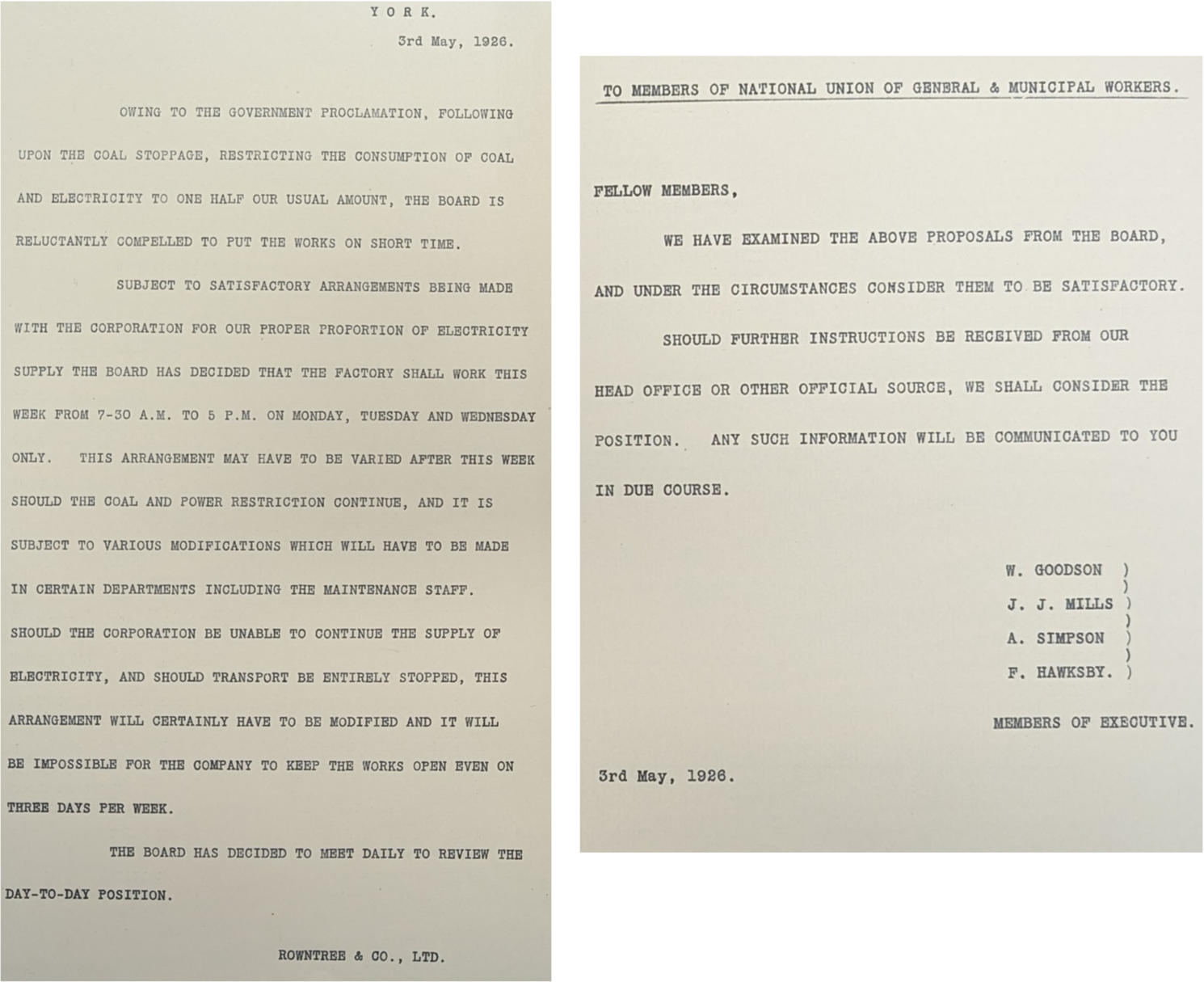
Notices to staff from Rowntree & Co. and their branch of the National Union of General Worker about the Cocoa Works being put on short time during the General Strike – Borthwick Institute for Archives R/DH/OO/20/8
The impact of the General Strike on Rowntree & Co. having to close the Cocoa Works was, therefore, forced on them not by masses of their own workers striking but instead due to a decrease in the electricity supplied from the York Corporation, and striking transport workers. Some of these transport strikers were Rowntree’s employees, and another group of Rowntree’s workers who were called to strike were the maintenance engineers. However, mitigations were agreed with the Cocoa Works maintenance engineers so that they could strike without major disruption to the factory.
William Wallace, an assistant to Seebohm, recalls in his unpublished autobiography that he was approached by the maintenance engineers before the strike. They said they were reluctant to strike due to having no grievance with Rowntree’s, but they were anxious to serve the best interests of their union. Wallace took them to see Seebohm. According to his account, Seebohm “…smiled his friendly smile and said it was a little quaint that he was asked to advise whether they should strike, but if they didn’t this might leave an unhappy relationship with their fellow trade unionists outside. So, his advice was that they should do their utmost to leave important factory machinery so that it would run for days without skilled maintenance and just strike!”.[7]
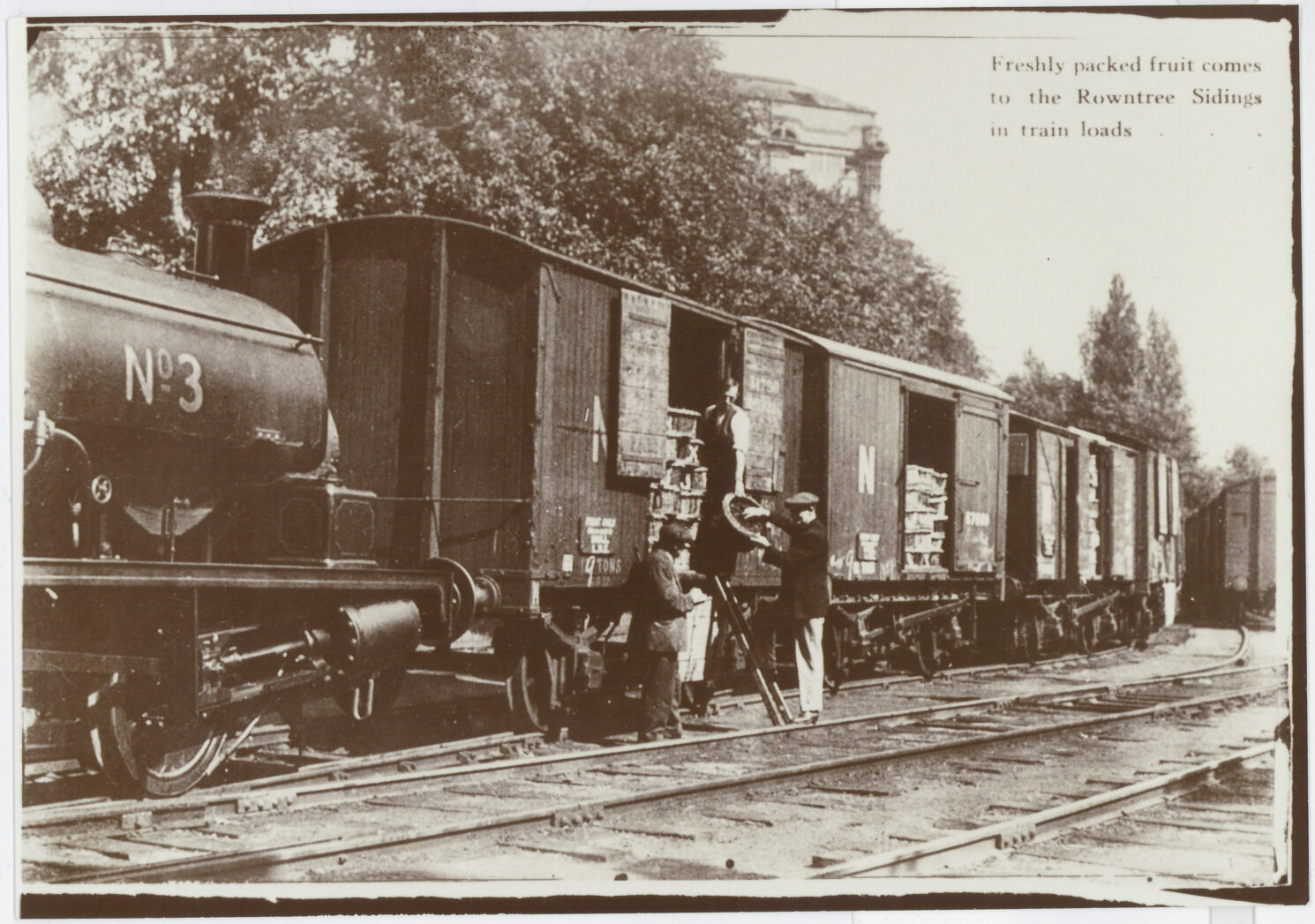
Transport workers at the Cocoa Works unloading fruit in 1920 – Borthwick Institute for Archives Rowntree Photo 6/456
Clarence Northcott, Rowntree’s Labour Manager, recalls that Hawksby was also reluctant to strike but was told by F.G. Fryer, one of the directors, that it would be his duty as a trade unionist to strike should he be called to.[8] When the General Strike was called off by the TUC the following week, Hawksby told the board of directors that his union branch had voted overwhelmingly not to join the strike had it continued.[9] This inversion of industrial relations at Rowntree’s, with management telling workers to strike, is typified by an event on 13th May. The strike had been called off the day before, but this did not stop a Rowntree’s assistant manager turning away lorries accusing the drivers of being “black legs” – strikebreakers.[10]
Industrial Conciliation and Secret Deals
In the years just before and during the 1920s, Seebohm Rowntree got involved in attempts to mediate industrial disputes outside of his own company, particularly those with a national impact and involving the government. He would form a team, usually including some of his assistants who were working on his sociological research and others from the Cocoa Works, to examine the dispute and develop potential resolutions. They would then organise secret meetings with both sides in the dispute to see where they would be willing to compromise and how much of his proposals they would accept. He insisted that these meetings were kept secret so as not to prejudice the negotiations but also, he did not want credit, believing it was more powerful for the unions and the government/employers to be seen to have reached an agreement between them than by his outside influence. In addition, there is something of Seebohm’s Quakerism in wanting to be in the background – letting the outcome of the negotiations, the industrial “peace” which followed speak for itself. He called these methods “industrial conciliation”.[11]
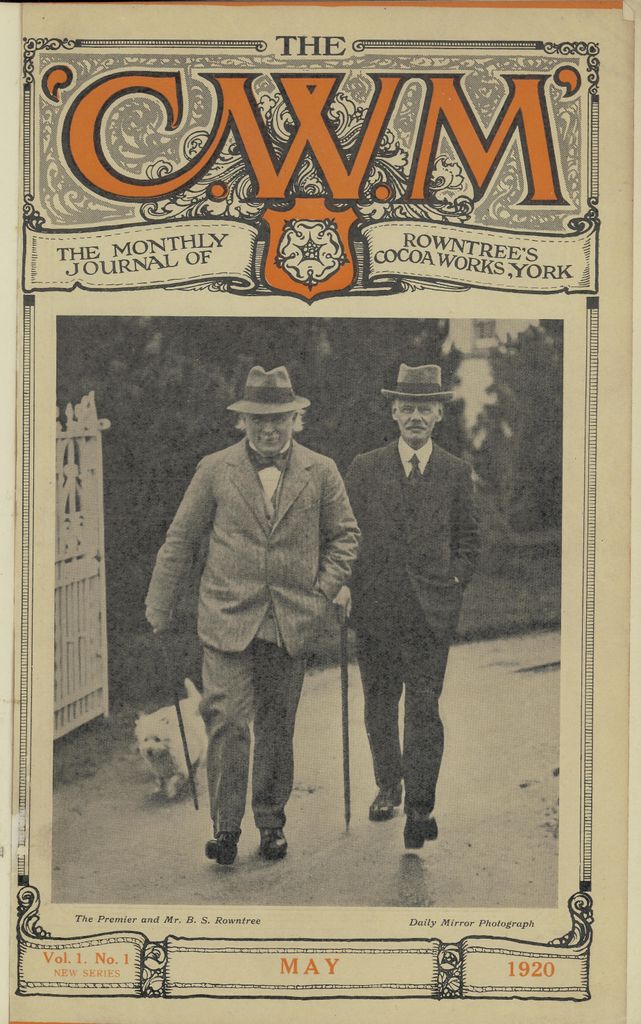
Seebohm with David Lloyd George – front cover of May 1920 issue of the Cocoa Works Magazine
Seebohm could be inventive in how he managed to meet trade unionists, particularly those who would not agree to meet through the usual ways. This would involve asking his assistants to find out where union leaders were going to be and then doorstop them. Once even going as far as climbing the back stairs of the headquarters of the National Union of Railwaymen to approach their General Secretary, Jimmy Thomas, during the 1919 Railway Strike with news of provisional agreement from the government for a deal. Seebohm was helped in getting the government to agree to his plan by his friendship with then Prime Minister, Lloyd George.[12]
Whilst Seebohm’s industrial conciliation was successful in the Railway Strike and earlier coal disputes, it didn’t go as well after the 1926 General Strike. On its eve, Seebohm sent Wallace to London on the last train out of York, to talk to people in parliament and trade union leaders. Wallace says he met J.R. Clynes, MP and President of the N.U.G.M.W, and Jimmy Thomas – who as well as a union leader was also an MP – at the House of Commons. He also visited other trade unionists elsewhere in the capital. He relates that “every trade unionist I met was friendly to me and to Rowntree’s, but nobody seemed in a position to give the necessary authority”. Although he does report that Thomas “quite literally wept”.[13] This is not the only report of one of Seebohm’s team making Thomas cry![14]
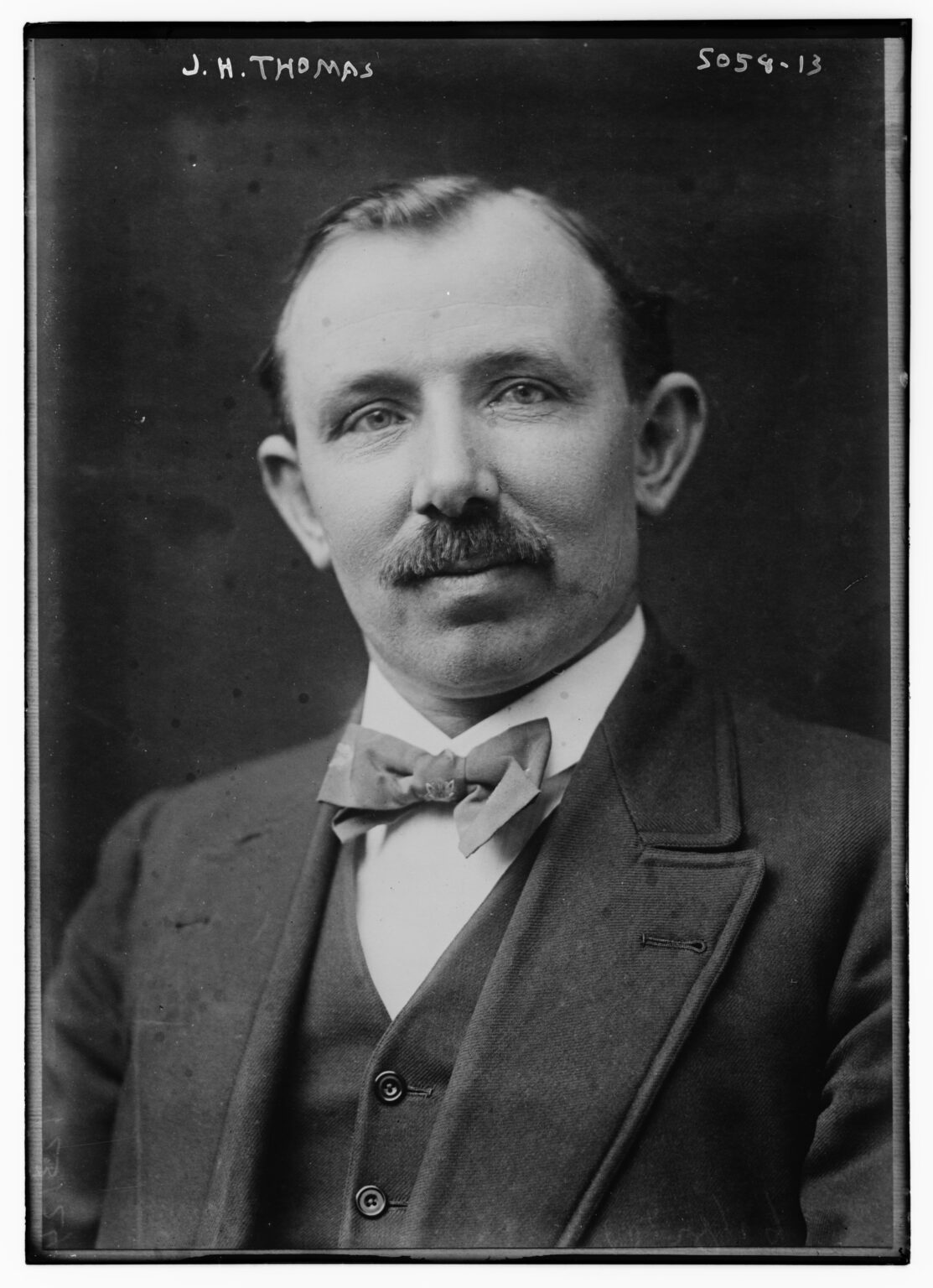
Jimmy Thomas c.1920 – Library of Congress Prints & Photographs Division LC-DIG-ggbain-29625
After the General Strike was called off, Seebohm was concerned for the impact it would have on the miners’ unions who were still on strike, particularly as the government was working on Trade Disputes and Trade Unions Act which banned sympathy strikes, general strikes, and mass picketing as well as diminished the unions political impact. Seebohm felt that the mine owners’ attitude was uncooperative and that the, by then, Conservative government was too hardline. This time, Seebohm turned to his assistant, F.D. Stuart and Liberal politician and editor of The Economist, Walter Lawton. Together they drew up possible terms of a settlement and began work to convince the unions and government to agree to it. The main difficulty lay in persuading A.J. Cook, the General Secretary of the Miners Federation, even to meet with them. This led Stuart to tracking Cook down at a public meeting in the Midlands and eventually got him to reluctantly sign their document to say he agreed with the proposals.[15] However, Cook went public, accused Seebohm of harassment and being the cause of his mental distress[16] – something that Seebohm continued to deny for the rest of his life.[17] The attempted conciliation subsequently failed.
Later, in 1928, Stuart mentioned to Joseph Jones, secretary of the Yorkshire Miners Association, that he could never understand why the Miners Federation had refused to accept the terms of Seebohm Rowntree’s proposals.[18] This led to an investigation by the Miners Federation into Cook’s role in making secret deals.[19] The difficulties Seebohm had dealing with Cook was one of the key reasons for his conciliation plan falling apart, although Seebohm put the blame fully on the concurrent attempt by Church of England bishops.[20]
The impact of this failure continued to be felt by both Seebohm and Stuart for years afterward. In 1935, a young sociologist Dennis Chapman came to York to work with Seebohm on this second Poverty study. He was left disappointed by the experience, and even more so when he was let go in September 1936 when Seebohm moved away from York (other research assistants were kept on). Later Chapman repeatedly made serious allegations about Seebohm’s involvement with trade unions, based on conversations he had had with Stuart and documents he saw in Seebohm’s personal archive. The core of these was that Seebohm’s industrial conciliation was working under Sir Alfred Mond, an industrialist and politician who moved away from Lloyd George’s Liberal Party to join the Conservative Party in 1926.[21] Mond had developed a movement which became known as “Mondism” which aimed to curtail the power of the trade unions by enforcing collaboration with employers and banning strikes. Chapman’s most serious allegation is that Mond gave Stuart a cheque of £70,000 to pass to Jimmy Thomas so that he could clear his stock market debts. This was a bribe to end the General Strike.[22] Chapman alleges he saw a receipt for this cheque in Seebohm’s papers.[23]
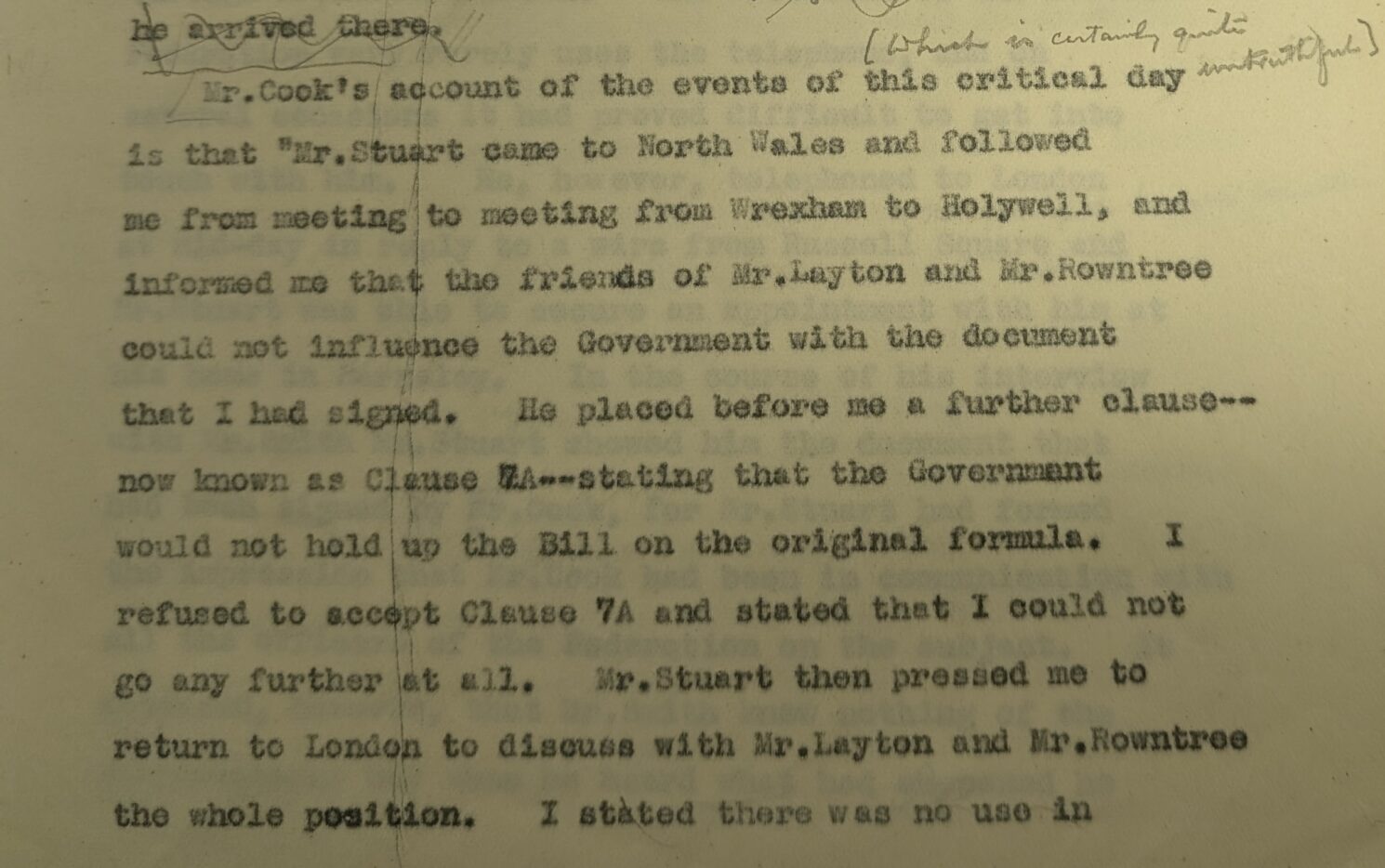
Excerpt from final draft of a report by W.T. Layton on the Rowntree led attempted mediation of the coal dispute in July 1926. Annotation in Seebohm’s handwriting referring to A.J. Cook’s account as “certainly quite untruthful” – Borthwick Institute for Archives RFAM/BSR/JRF/8/5/4/5
While there is some truth in Chapman’s allegations, notably that Seebohm did try to exert influence over union leaders – although not to the extent alleged. Superficially, there are also similarities between Seebohm’s approach to trade unions and Mondism. Both emphasised co-operation between workers and employers, and that improved efficiency would lead to better pay for workers.[24] However, as we have seen, Seebohm tended to side much more with the workers and their trade unions, and in his own business encouraged more radical and dissenting voices to be heard through the Central Works Council and Cocoa Works Magazines.[25] His approach to conciliation seems to have been more grounded in Quakerism than in any plan to curtail the power of the unions, despite his dislike of industrial action such as strikes. That Chapman seems to have genuinely believed his allegations to be true, is supported by his accounts remaining consistent over several decades. The first record of them is from 1956[26], and he recounted that Seebohm and Mond bribed Thomas to call off the General Strike in an interview Chapman gave to the BBC in the early 1980s.[27] The latter was for a documentary about Seebohm Rowntree which was pulled due to the BBC being unable to confirm or deny Chapman’s allegations.[28]
Our research has not been able to find any evidence to link Seebohm with Mond. We went through the list of people invited by Mond to his talks with the TUC,[29] but they did not include any Rowntree connections. In addition, Mond publicly proposed the ideas which became known as Mondism in December 1927 with the first Mond-Turner talks in 1928, whereas Seebohm was doing his industrial conciliation from at least 1919. It is known that Thomas had debts[30] and was involved in various efforts to end the General Strike.[31] However, aside from Chapman’s claims, there has yet to be discovered any evidence of him receiving money from either Mond or Seebohm.[32]
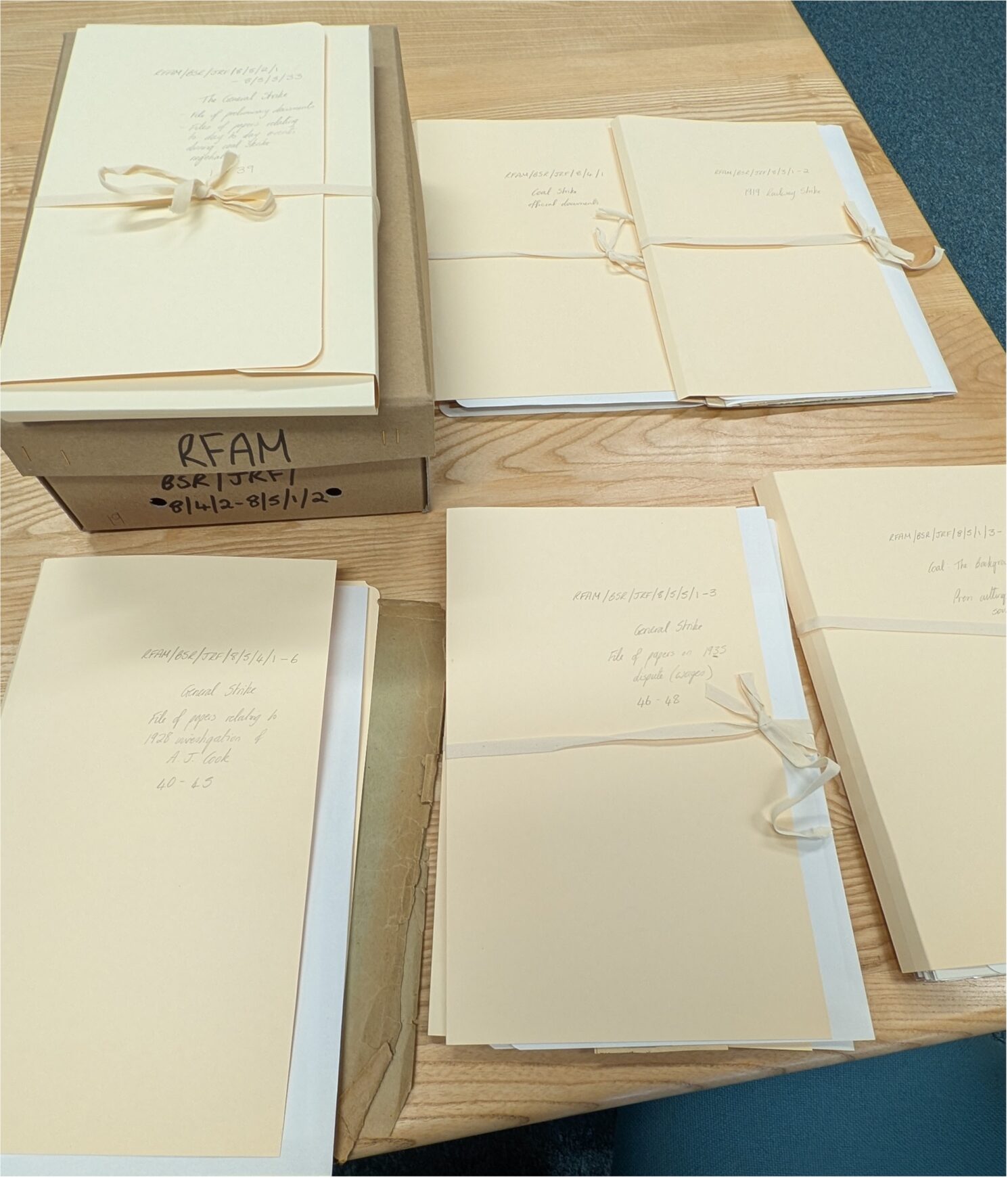
Files from Seebohm Rowntree’s archive relating to ‘Industrial Conciliation’ and the General Strike – Borthwick Institute for Archives RFAM/BSR/JRF/8/3-5
When Seebohm Rowntree moved to Hughenden, near High Wycombe in 1936, he asked his assistants to help him destroy parts of his archive by burning. Chapman was involved in this and stated in 1956 that “it was in this holicaust (sic) that all papers relating to the General Strike in 1926 vanished. BSR (Seebohm) also destroyed the files, such as they were, relating to Industrial Conciliation…”[33]. He specifically states the receipt for the cheque to Thomas was destroyed as part of this.[34] However, not all of these papers were burned as there remain many documents relating to both the General Strike and industrial conciliation in Seebohm’s archive at the Borthwick Institute for Archives in York.[35] Seebohm continued to add to them up until at least the 1940s, and they contain several letters to associates asking for their recollections and for copies of related documents which he remembers but does not have.[36] They contain no mention of Mond or anything relating to money paid to Thomas, but do use phrases such as “industrial conciliation” and other accounts which were subsequently repeated by Chapman, suggesting that these are the files he was referring to.
This is the end of Part 2 of “Come, Let Us Reason Together”: Trade Unions at Rowntree & Co. in the 1920s. Parts 1, 3 & 4 can be found here.
We presented this research at our 2025 York Festival of Ideas event as part of the Joseph Rowntree Centenary. You can see the recording of the event here:
Researched and written by Nick Smith, Executive Director of The Rowntree Society.
Additional research by The Rowntree Society’s research volunteers, Maisie Brenchley & James Heathfield.
“Come, Let Us Reason Together”: Trade Unions at Rowntree & Co. in the 1920s Part 1
Introduction
As part of our Rowntree Political Connections and Influences Project, The Rowntree Society carried out research into the trade unions at Rowntree’s & Co. in the 1920s. We discovered a story which took us from York to the village of Asenby, and as far afield as Pennsylvania in the USA! It also showed how the management at the Rowntree company involved their workers in the running of their Cocoa Works factory, the wider involvement the family had in trade union politics, and how some employees who struggled with poverty to become key changemakers with national (and even international) acknowledgement.
To tell this story, we focused on three people:
- Benjamin Seebohm Rowntree, usually known as just Seebohm, the son of Joseph Rowntree and the company’s first Labour Director. He became company Chairman in 1923 following the retirement of his father but significantly also kept the role of Labour Director.
- Fred Hawksby, president of the York Branch of the National Union of General and Municipal Workers (NUGMW for short) and the main union leader at Rowntree’s.
- Irene Pickup, another member of the NUGMW and became a leading trade union leader playing a significant role in representing women workers.
As the research was carried out in 2025, we chose to focus on the 1920s to make the connection to the Joseph Rowntree Centenary, as it was the decade of Joseph’s death. This decade also marked a period of transition for the Quaker Rowntree family – as a family where one generation succeeded the previous, with Seebohm and his cousin Arnold primarily taking over from the leadership of Joseph. Each had different roles and responsibilities across the many Rowntree interests and initiatives.
There were also changes within the company where Seebohm became Chairman amid a political climate with the decline of the Liberal Party, which many of the Rowntrees were involved, and the rise of the Labour Party. Most relevant to our focus, it was a decade of increased trade union activism and breakdowns in industrial relations. 1920, 1921 and 1926 saw the most labour disputes than in any other of the years between the two world wars. For Rowntree & Co. the 1920s marked the first time growth had slowed for a sustained period since Fruit Pastilles became popular in the early 1880s. Some years there were losses, and others growth, leading to lay-offs or increased employment from year to year.[1]
We’re going to tell this Rowntree history over four parts. This first section will focus on Seebohm, Rowntree & Co. and their trade unions. Subsequent parts will focus on the 1926 General Strike, Fred Hawksby and Irene Pickup.
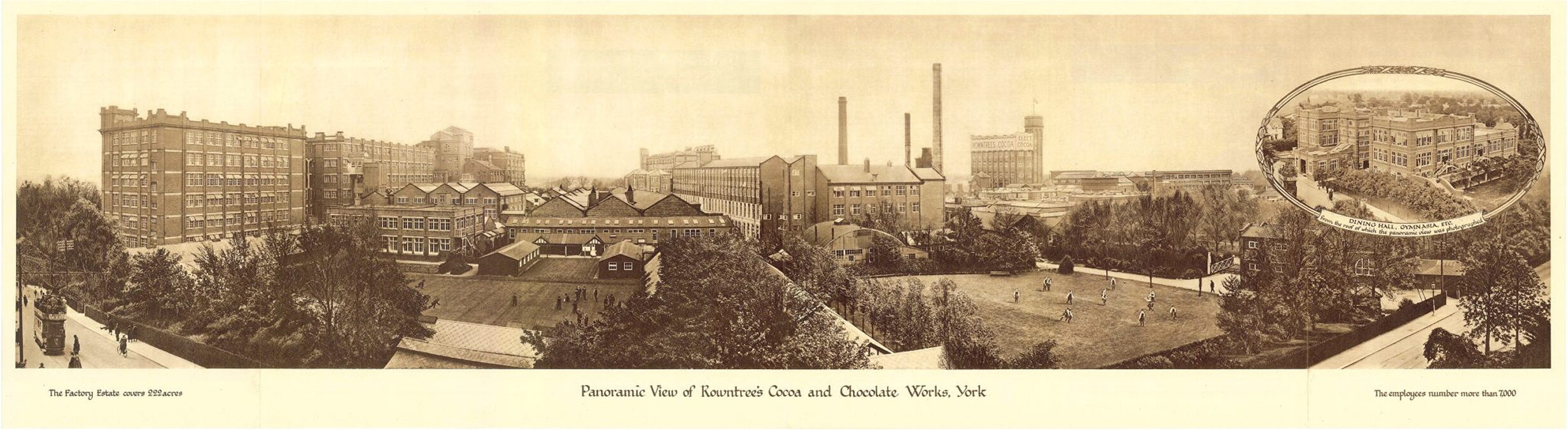
Panoramic View of the Cocoa Works, Haxby Road – Borthwick Institute for Archives: JRF/RCO/11/4/1
Joseph’s concerns about wealth inequality and how Rowntree & Co. could work towards a more just distribution were set out in a memorandum he wrote to his children in 1907. This also included his views relating to workers’ control of business and their entitlement to an increased share of the profits:
“…the enormous increase of wealth which has come to the country since the introduction of machinery has not been at all evenly distributed over the population, and that the share of the great body of workers has been inadequate. I suppose almost all social reformers would admit that the problem of the distribution of wealth is, in this country, much more urgent than the problem of its creation; and I have no doubt, as the intelligence and self-control of the workers increase, that claims of a reasonable kind will be made under which, in one way or another, the share of profit which comes to labour will be increased, while the share which comes to capital will be lessened. Now the temptation to the Directors of the Cocoa Works, both in their position as Directors and as well-to-do Politicians, will be to take a merely capitalistic view of these demands, and not to look at them from the true Christian standpoint. I believe we have been right so far in creating a Pension Fund and establishing a minimum rate of wages as first steps towards meeting this problem of a juster distribution of wealth. Whether in the future, any profit-sharing scheme (already in force in a few of our most responsive positions) or anything in the nature of a co-operative scheme, should be entered upon I cannot say. What I wish to urge, however, is, that the steps we have hitherto take are, I think, probably only the first steps which it will be right for the Company to take, and I hope that those upon whom its direction rests will be prepared, as new problems present, to deal with them with large-hearted and unselfish intelligence.”[2]
One of Joseph’s key initiatives to further these aims was the establishment of the company’s first Labour Department in and the appointment of his son, Seebohm Rowntree, as the first Labour Director in 1897.
However, Rowntree & Co. were initially not welcoming to trade unions; despite the first departments becoming unionised in 1913 [3], requests by workers for trade union recognition were still being refused in 1916. This did not deter the unions as by 1919, 90% of workers were union members and this high membership remained throughout the 1920s.[4] The vast majority belonged to the National Union of General Workers, which became National Union of General and Municipal Workers (NUGMW) in 1924. It is now the GMB Union which still represents workers at the factory on Haxby Road run by Nestlé.
Such high union membership led to a change in approach at Rowntree’s, although the company maintained its opposition to becoming a “closed shop” which would have meant compulsory trade union membership. In 1926, Fred Hawksby stated that, “no objection was or has been offered by the firm to their employees joining a Trade Union. On the other hand, they feel that it is desirable that the employees should be members of a Trade Union…” and “I have been making inquiries with regard to the Shop Steward movement in other factories and have not been able to find one where the Shop Stewards enjoy such privileges as they do in this factory”. [5]
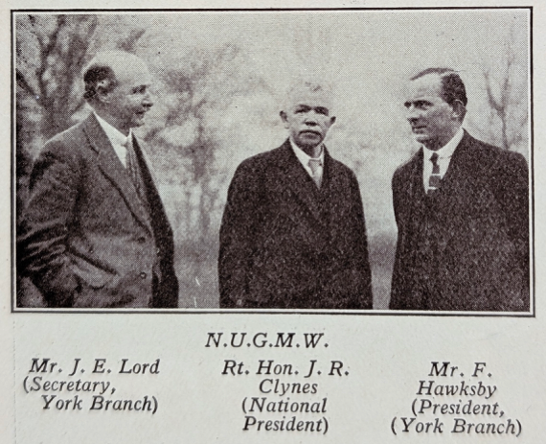
Three Members of the NUGMW – Cocoa Works Magazine Easter 1926
However, there were a couple of aspects of the trade union movement where both Joseph and Seebohm remained opposed:
- Industrial Action: both compared trade unions taking industrial action to warfare which is a particularly strong comparison for Quaker pacifists such as themselves. [6] However ethical in their business practices, the Rowntrees were still business owners who benefitted more from the success of the company than the thousands of workers they employed. They did, however, insist that education was the way to avoid industrial action – both for workers and employers with Seebohm writing in 1926 that “…on both sides, goodwill must be reinforced by education.” [7]
- Socialism: the Rowntree family had a long association with the Liberal Party, not just as members but also as Liberal councillors and MPs. Seebohm had a close relationship with Lloyd George who, as Prime Minister, invited Seebohm to be an advisor and sit on many of his government committees. In an Adult School class of 1897, Seebohm spoke out against socialism saying that he agreed with its aims of equality of opportunity but did not believe it presented practical ways of achieving it.[8] However, his biographer, Asa Briggs, thought that Seebohm did not really understand socialism and he also had strong connections, sometimes friendships with notable socialists and even anarchists.[9] J.R. Clynes, the National President of the N.U.G.M.W. and Labour Party leader 1921-22, once referred to Seebohm by saying, “here comes the greatest socialist of us all – he does the things we talk about”.[10]
Seebohm Rowntree’s ‘Human Factor’
Seebohm Rowntree was Rowntree & Co.’s Labour Director from 1897 to 1936 and Company Chairman from 1923 to 1941. Although he held the same Quaker beliefs in ethical business practices as his father, Joseph, he was in many ways a different kind of person.
He was described by Clarence Northcott – a colleague who will be introduced more fully below – as having inherited his mother, Tonie’s, precision and realistic attention to detail. He was described as being precise in all things; very punctual, intensely ordered, he got through a remarkable volume of work, and had exacting standards which he expected others to match.[11]
Northcott also commented on Seebohm’s management style saying, “I’ve met many men, but never one with the same knack of handling men”. However, he noted that he was much better at dealing with groups of people than individuals and was not the best judge of character.[12] Despite this, Seebohm seems to have had his father’s knack for finding and bringing in people to help him with his work; several would become loyal and trusted assistants and advisors.
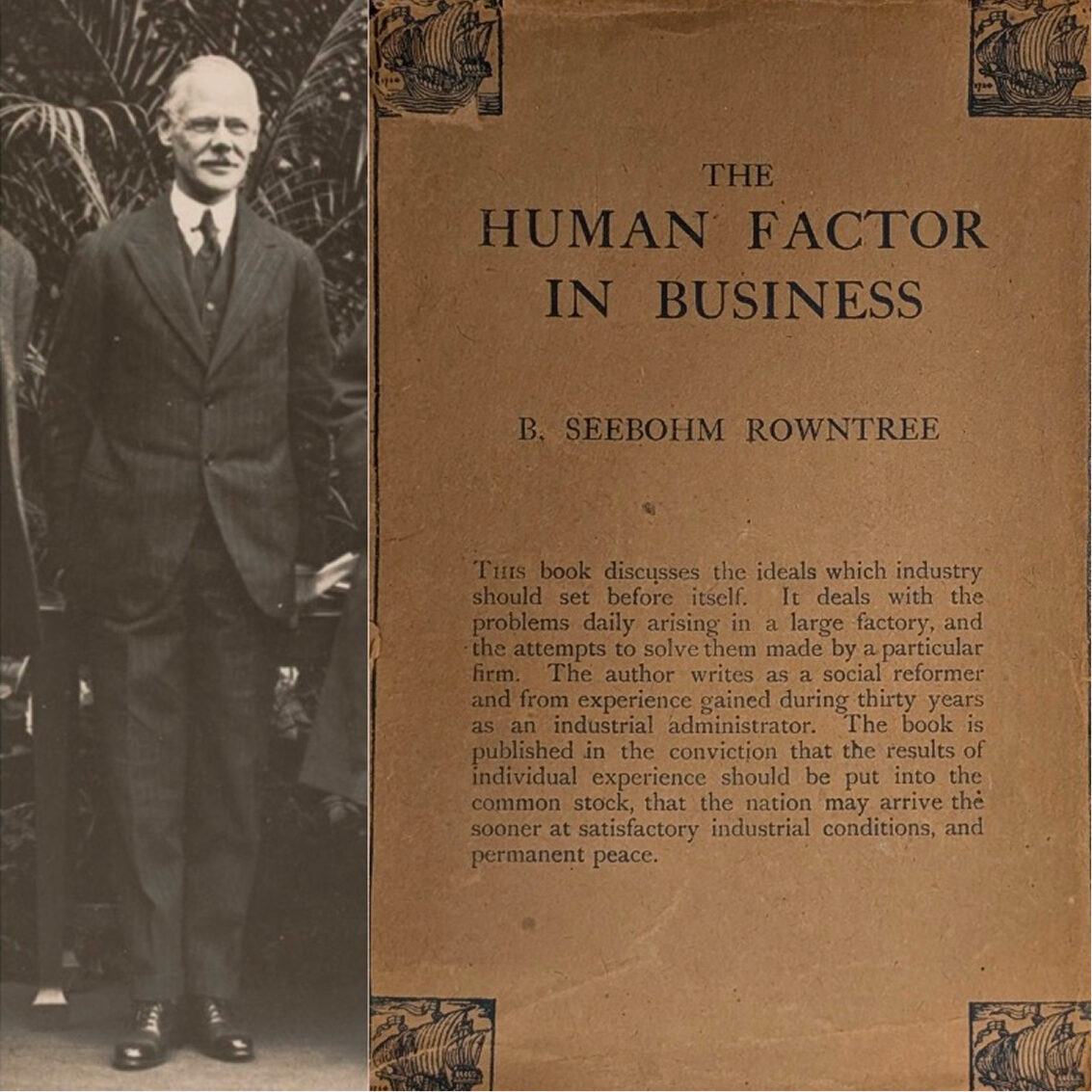
Seebohm Rowntree in 1923 & front cover of The Human Factor in Business (pub. 1921) – Seebohm photo: Borthwick Institute for Archives Rowntree Photo 4/053
Seebohm had published his influential work, Poverty: a study of town life, in 1901 with one of its key assertions being that a leading cause of poverty was workers receiving pay that was insufficient for a decent standard of living.[13] He continued with his sociological research outside of his work in the Rowntree company, which was funded mainly through the Joseph Rowntree Charitable Trust (JRCT),[14] but also occasionally by both the Joseph Rowntree Social Services Trust (now the Joseph Rowntree Reform Trust) and the Joseph Rowntree Village Trust (now the Joseph Rowntree Foundation). There was overlap between these two roles in what Seebohm was advocating – the company becoming the practical expression of his theory, with an added element of having to protect his reputation; how could he argue nationally for better wages and working conditions if this wasn’t being attempted at the Cocoa Works? There was also an overlap in the people he employed which blurred the distinction between Charitable Trust funded research and company employees with several people moving between them.
Two people who were key to Seebohm’s dealing with trade unions in the 1920s:
- In 1919, he brought the Australian sociologist, Clarence Northcott to work with him at Rowntree’s. Northcott was a Methodist and had similar views regarding industrial democracy and that co-operation would produce an ethical society.[15] He was given the role of Labour Manager in 1924 – and took over the day-to-day work that Seebohm had been doing as Labour Director once he became Company Chairman.[16]
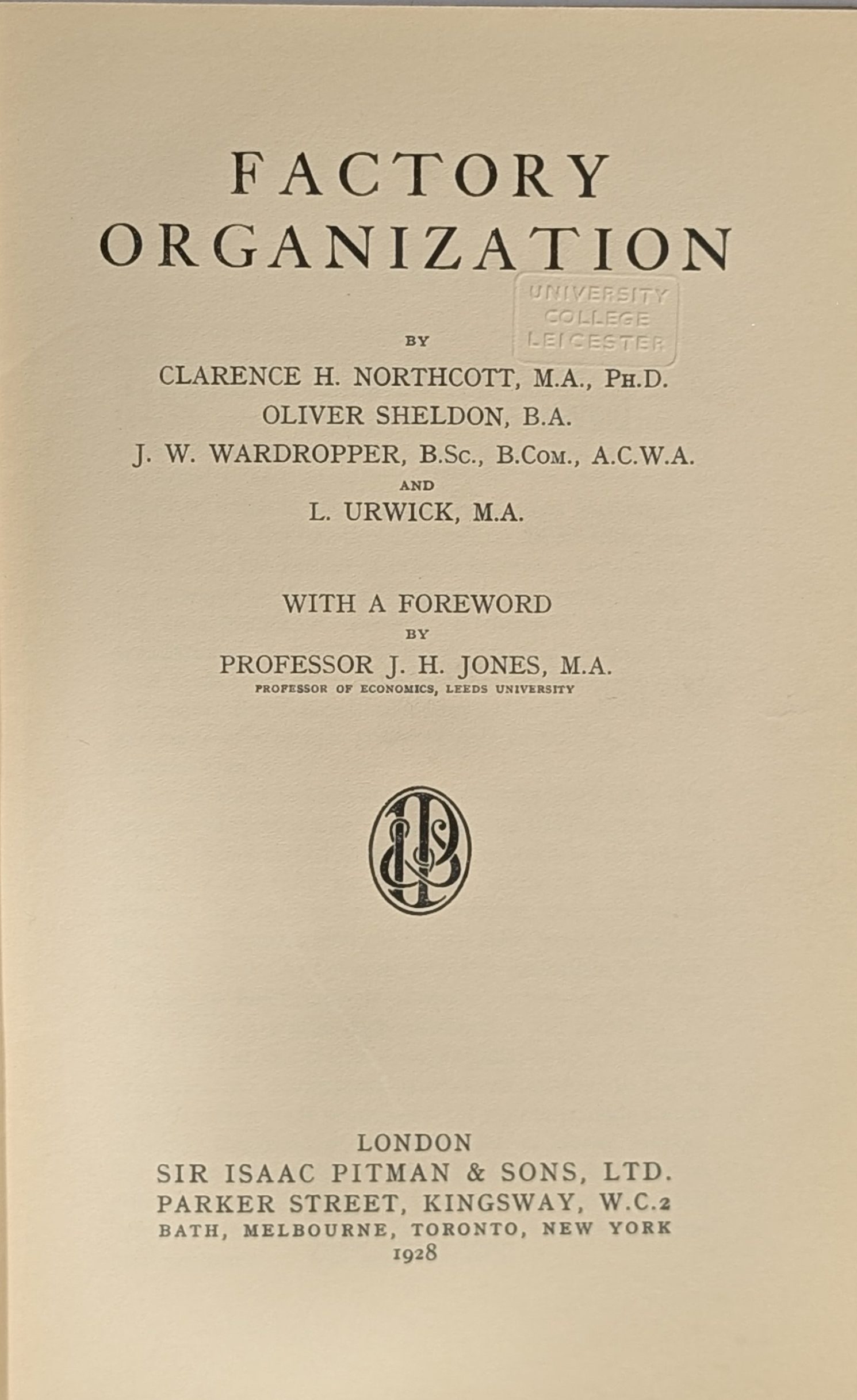
Factory Organisation by Clarence H. Northcott et al Title Page (pub. 1928)
- William Wallace: trained as a solicitor and first met Seebohm in 1914, after he writing to him praising his work on social reform and asking to help him with a “lead” which could get 23-year-old Wallace a job.[17] Wallace could not enlist to fight in the First World War due to poor eyesight, so Seebohm got Wallace a job working in government on the Reconstruction Committees.[18] In 1919, Wallace moved to York to live in New Earswick and was given work by Seebohm to do investigations into the viability of profit-sharing schemes and unemployment insurance. Although employed by Rowntree & Co., Wallace seems used as an independent advisor and as Seebohm’s ‘private secretary’ – sometimes working on company business as well as on other initiatives funded by the JRCT.[19] Even after Seebohm’s retirement in the 1940s, Wallace remained employed by Rowntree’s and eventually became Chairman in 1952.
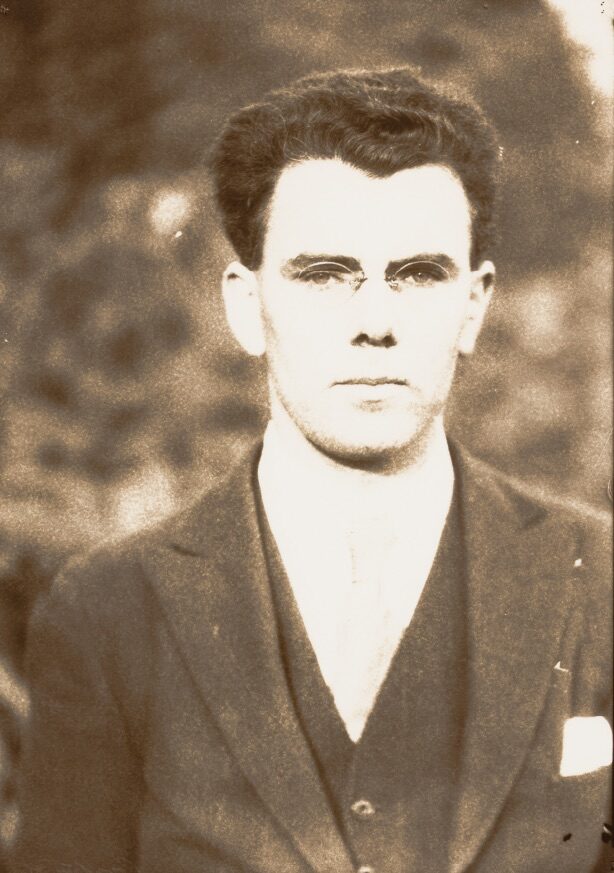
William Wallace in 1929 – Bortwick Institute for Archives Rowntree Photo 6/261
But there were others too, including F.D. Stuart. He became one of Seebohm’s most loyal assistants who helped him with much of his sociological studies, but was also sometimes asked to talk to trade unionists outside of Rowntree & Co.
Seebohm and his team advocated for his vision of ethical management through publications such as The Human Needs of Labour in 1919, The Human Factor in Business in 1921, and Industrial Unrest: a way out in 1922. They attended and organised business conferences to encourage other businesses to take up their ideas; most notably establishing the Management Research Groups, and what are now known as the Rowntree Business Lectures. These can be found online here, and include several talks and other contributions from Fred Hawksby.
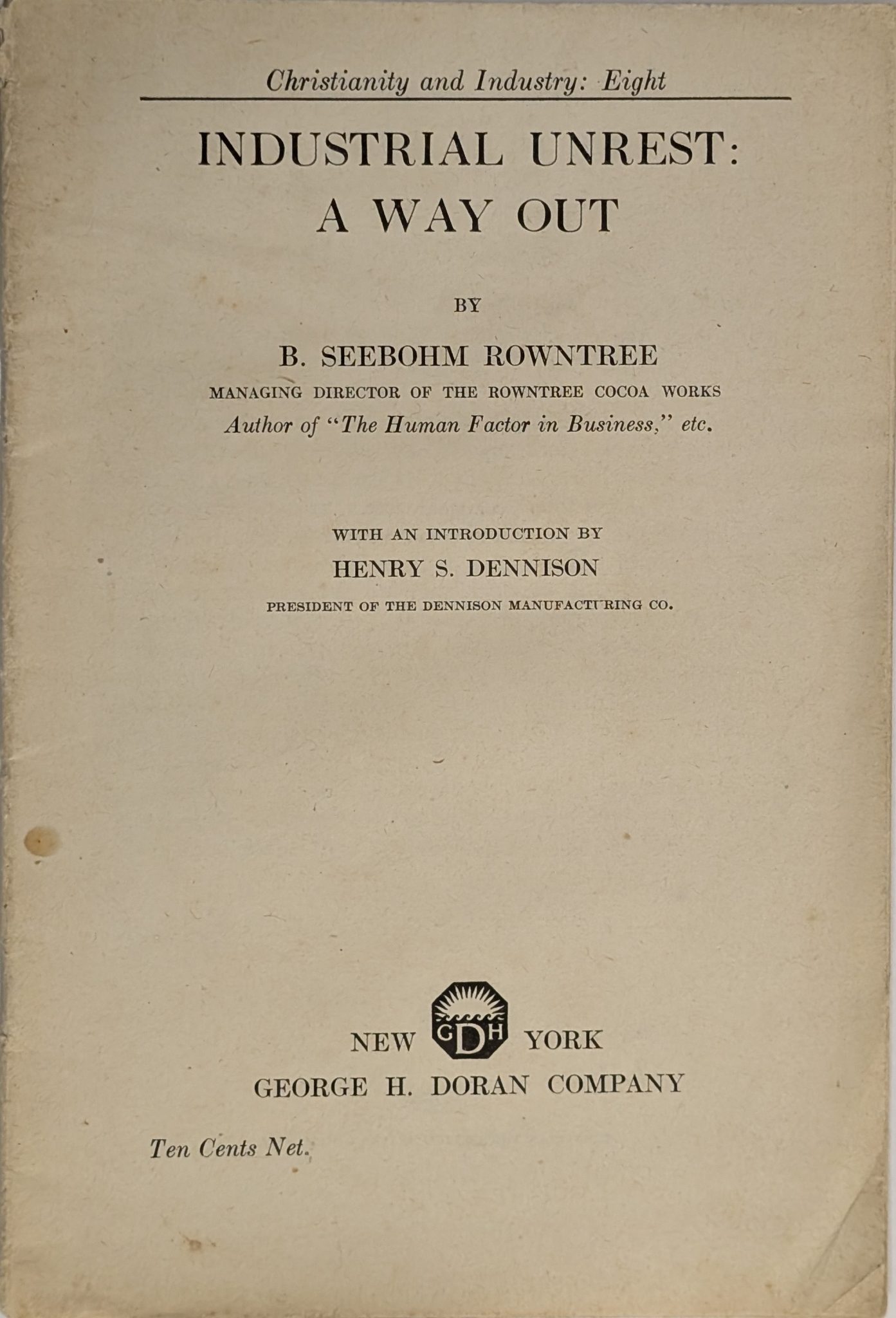
Industrial Unrest: A Way Out by Benjamin Seebohm Rowntree (pub. 1922)
Rowntree’s Central Works Council
One of the Seebohm’s key initiatives was the establishing workplace democracy in the company through the system of works’ councils. This was first set up in 1919, and each department had its own council. Workers were elected to their departmental council by members of their department, with at least one position reserved for a trade union shop steward.[20] From its inception, it included women workers – meaning that up to 1928 they were able to vote in their workplace before they could in Parliamentary elections.
The members of the departmental councils then elected who would represent them in the Central Works Council. This body had real power within the company with only the topics of wages and working conditions outside its remit[21]; although, as will be explained below, even these were challenged. The trade unions could raise their own concerns separately from the Works Council[22] but in practice it seems that most, if not all, of the worker representatives elected were either Shop Stewards or actively involved with the union.
Seebohm states in The Human Factor in Business that although “neither membership of the council nor voting is confined to trade unionists, but, as a non-unionist would stand but little chance of election, it may be said that the committees are substantially trade union bodies so far as the representation of workers is concerned”.[23] Although we have not been able to find direct evidence to prove that this, it is likely that union meetings would agree on proposals to bring to the Works Council. In addition to Seebohm, Northcott, Wallace, Hawksby, and Pickup all in different documents state the strong union involvement.[24] Elected workers were given time away from their usual duties to attend meetings and carry out other Works Council activities.
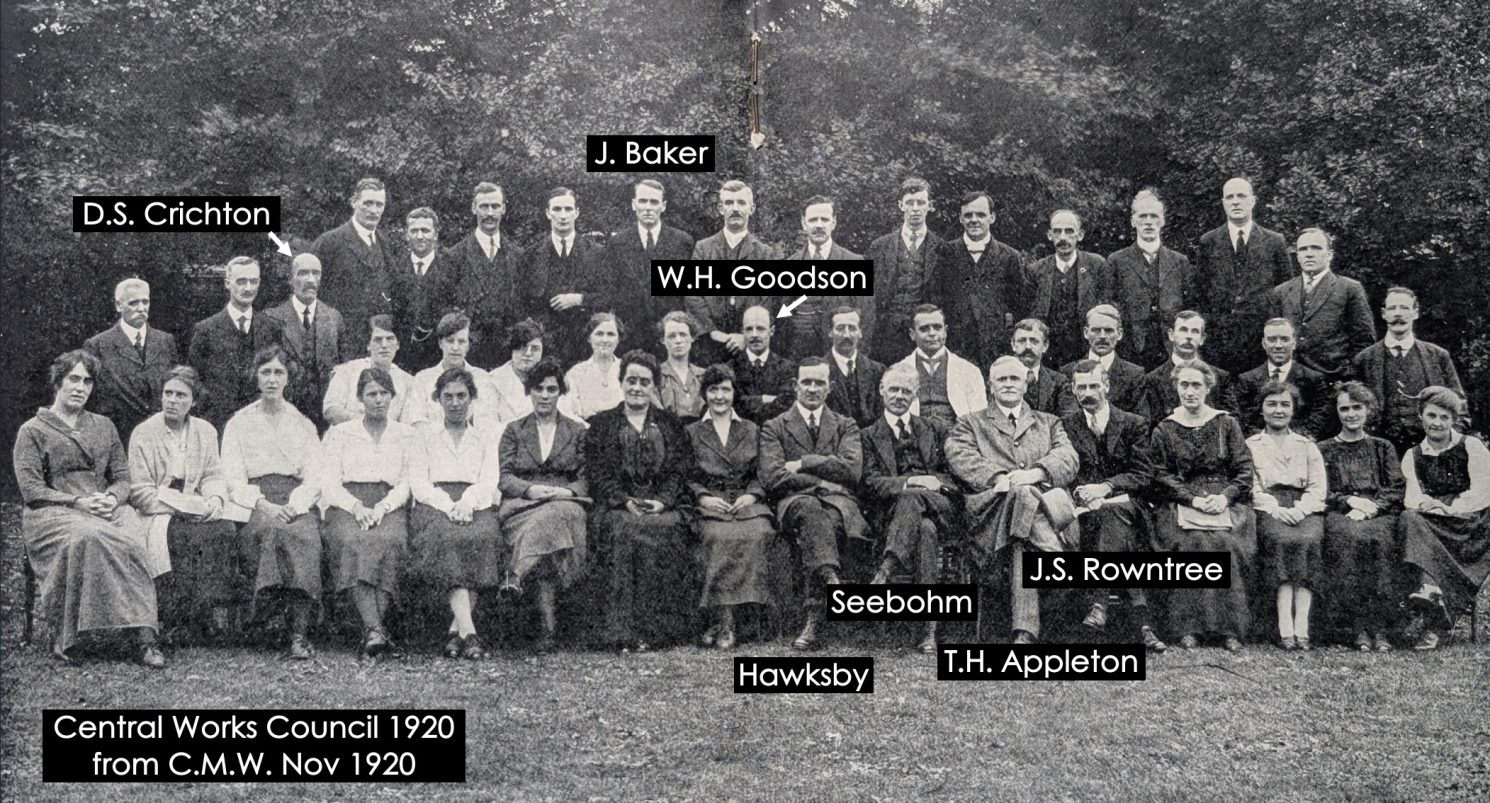
Rowntree & Co.’s Central Works Council 1920 – annotated from original in Cocoa Works Magazine November 1920
The Central Council was divided into different committees, each responsible for various aspects of life at the Cocoa Works. In 1920, the Executive Committee consisted of Seebohm as the Chairman, with his brother Stephen Rowntree representing the directors, T.H. Appleton – the factory manager and also a director was Deputy Chairman, and Fred Hawksby was Vice-Chairman.[25] There were some changes to its members through the 1920s, with Irene Pickup and Jack Baker being elected to it in 1922, but Seebohm, Appleton and Hawksby were constants.
Other committees included the Joseph Rowntree Memorial Committee which organised Joseph’s memorial service at the factory following his death in 1925. A spin off from this was responsible for building the Joseph Rowntree Memorial Library at the front of the factory – money was raised from the workers to pay for its interior.
Appeals Committee
The Appeals Committee was established so that workers who felt they had been unfairly disciplined could challenge it. It consisted of an equal number of workers and management and had the power to overturn or reduce disciplinary decisions. A case from 1922 involved a worker who had punched his overlooker. He had support of many colleagues and was represented at the Appeals Board hearing by both a shop steward and another council member. His punishment of dismissal was reduced to a 4-week suspension since he had been provoked by the overlooker and there was a consensus that this overlooker was quite irritating. Seebohm was informed as well as Hawksby. Hawksby confirmed that the overlooker was someone who the men found challenging to work under.[26]
William Wallace was sometimes part of the Appeals Committee and in his unpublished autobiography, he recollects his discomfort at overturning decisions made by Seebohm and the other directors. Years later he spoke to Seebohm about a specific case and Seebohm responded by telling him that he originally thought the punishment was too severe but was outvoted by the board, so all Wallace had done was reinstate Seebohm’s original intent.[27]
Works Rules
Starting in 1921, the new Works Rules for the running of the Cocoa Works were drawn up in collaboration between workers and management through the Central Council.[28] Irene Pickup is credited with playing a key role in this.[29] The new Works Rules were implemented in early 1922, and Seebohm declared that they are an agreed code, not one implemented on the workforce.[30]
Psychology Department
A committee was also established to set up the Psychology Department which employed first industrial psychologist in a British company. It took years to get this appointment right, not just finding the best person but also the terms of the role.[31] The role wasn’t just to look after what we would now call the mental health of the workers, but there was more of an emphasis in working out how to get the most work from people. A key part was the “time and motion” studies which would ascertain how fast factory tasks could be achieved and then implement that as the expectation. Overlookers were responsible for making sure workers met this as a minimum.[32] An aspect negotiated for the Psychology Department was that no time and motion study could be carried out without prior agreement from the trade union.[33]
Profit Sharing Scheme
Profit Sharing Scheme was finally implemented in 1923 and had been drawn up by a committee which included J.B. Morrell, Wallace, Pickup and had Hawksby as its chairman.[34] This divided profits made above a set threshold between workers who earned below a certain wage. Both Seebohm and the union had been sceptical about this at first and Joesph was the driving force behind it.[35] Reaching an agreement with the union via the Central Council was essential to its implementation, a key aspect being that everyone got the same amount. This meant lower paid workers received a bonus of a higher percentage of their earnings than higher paid colleagues.[36]
Jack Baker and Trade Union Militancy
During our research, Jack Baker was a name that kept coming up – particularly in relation to more militant union requests and positions. He worked in the Melange Department; he was likely a Shop Steward and was a member of the Central Council and served on its Unemployment and Executive Committees – so played an influential and important role. Examples of his demands recorded in the minutes of the Central Council include a call for the union to request Rowntree’s becoming a “closed shop”, and that a workers’ representative should sit on the committee which decided the wage structure.[37] His positions were often supported by other trade unionists including both Hawksby and Pickup,[38] but he seems to have been a constant thorn in management’s side – he had an ability to really get to Seebohm.
Northcott relayed an incident where redundancies were being made, and he had divided the workforce into several meetings where Seebohm would explain what was happening and why. In one, Baker stood up and attacked management in what Northcott describes as “fierce terms” and was applauded by many of the women workers. Despite Hawksby standing up and asserting that Baker’s views were not representative of the general workforce, after the meeting Seebohm was furious – not at Baker who he expected this from but because of the women who supported him! Seebohm’s wife, Lydia, said that that evening he had “sunk into a complete melancholia” and she had to persuade him not to give everything up.[39]
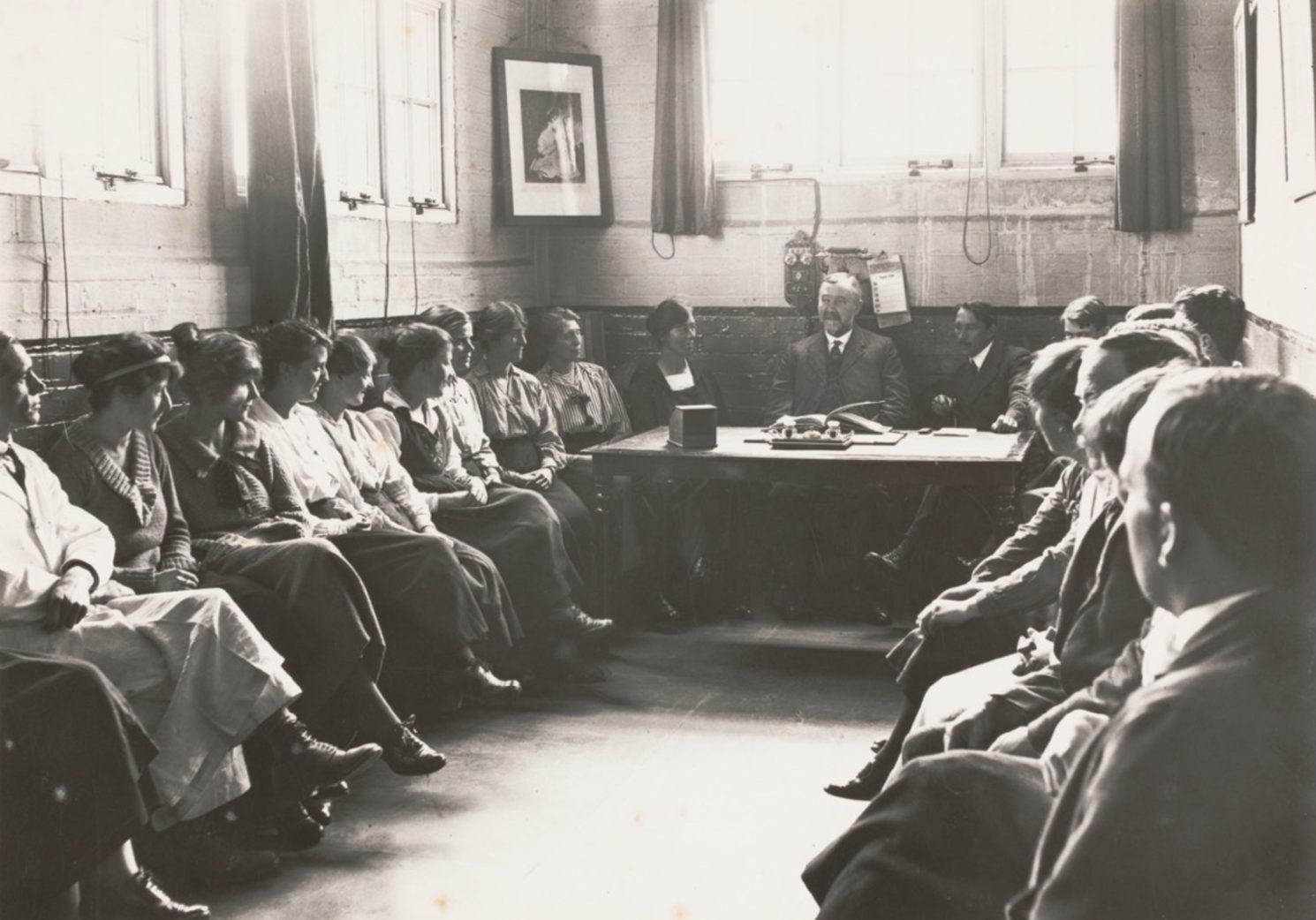
A Central Works Council Meeting 1920 – Borthwick Institute for Archives Rowntree Photo 25/045
Baker was not the only one who was more militant. An important flash point in a Central Council meeting came in August 1921, when W.H. Goodson of the Cream Department asserted that the workers wanted control of the company, not just to be consulted. The minutes of this meeting record Goodson using phrases such as “tackling the root causes” and “the evils” of the present industrial system which are reminiscent of the language used by Joseph Rowntree in his 1904 Memorandum setting up his three Trusts.[40]
Often Seebohm responded to these demands by reaffirming the status quo reminding them that the Board of Directors were appointed by shareholders and had no power to entrust their responsibilities to others. He also regularly asserts the need for co-operation based on shared aims – the success of the business and welfare of its staff, and that dissatisfied staff have the right to go to their union who will raise it with management and the board.[41]
Fred Hawksby, as the leader of the union, could also demonstrate militancy. Northcott describes an incident where Seebohm’s oldest son, Joseph Seebohm Rowntree, who oversaw the Psychology Department, sent someone to undertake a Time and Motion study without first agreeing it with the union. As soon as Hawksby learned of this, he went straight to Seebohm and said, “either you get your man out of that department by this afternoon, or I bring this whole factory out on strike”. Hawksby got his way, and I’m sure Seebohm would have also had strong words with his son![42]
It is, however, repeatedly noted how few and far between these incidents were. Rowntree’s generally had good relations with their unions – this is noted widely by both management and trade unionists.
Cocoa Works Magazine
First started in the early 1900s by Joseph Rowntree as a way of staying in touch with the growing number of workers, the Cocoa Works Magazine is an incredible source of evidence with the whole life of the company and factory reflected in its pages. It allowed management to communicate with the work force.
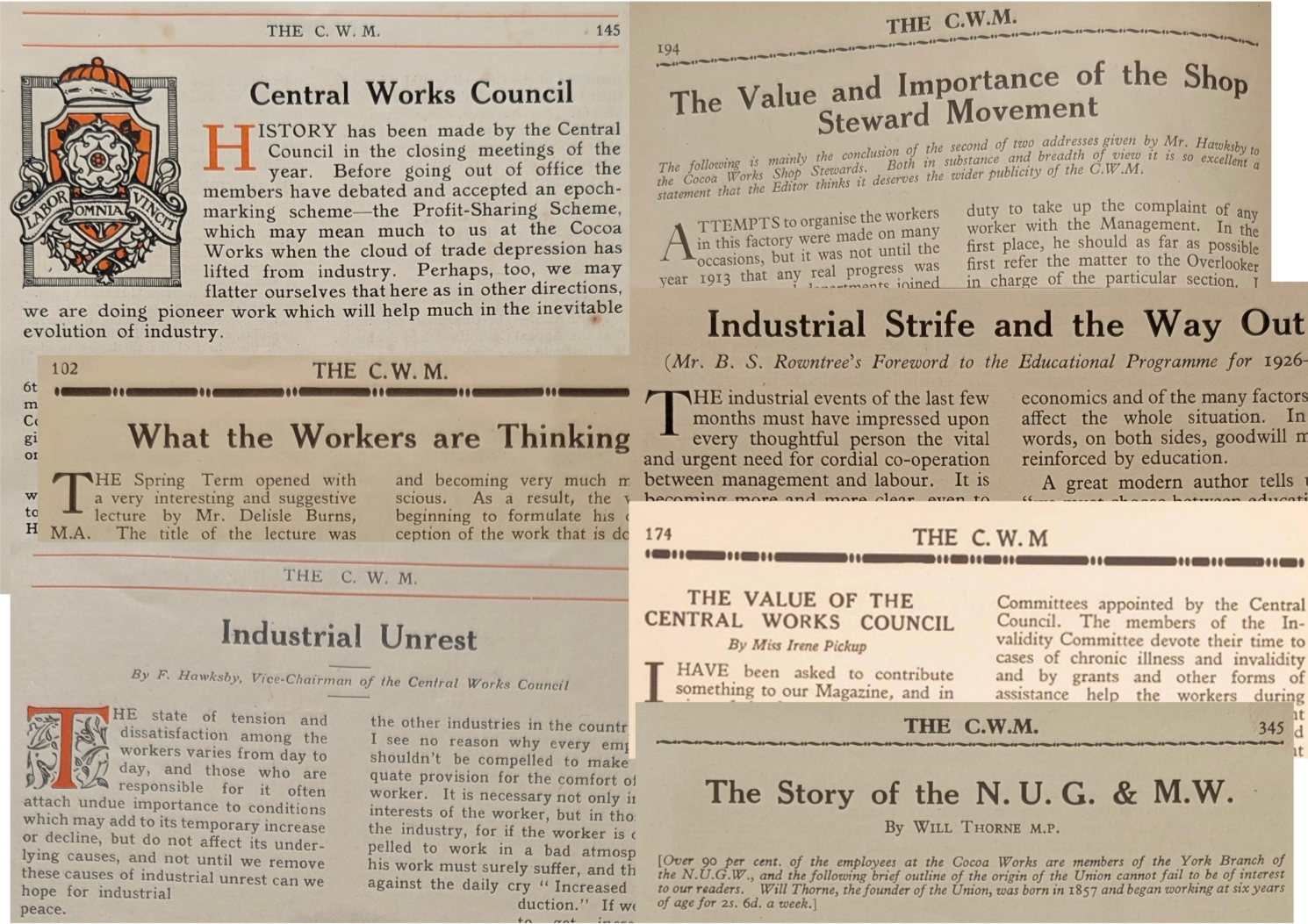
Excerpts of Cocoa Works Magazines from the 1920s
Throughout the 1920s, there were repeated articles and references to trade unions and industrial relations. Debates were played out with both workers and management able to set out their views through editorials, articles and records of speeches given at the Cocoa Works. It also contained the Central Works Council minutes including details of the debates and who said what. Guest writers from outside the factory were invited to contribute and these included those high up in the N.U.G.M.W. such as Will Thorne (one of its founders) and J.R. Clynes. Such openness is remarkable in a company magazine that generally reflected management’s stance, particularly when it allowed space for more militant perspectives.
This is the end of Part 1 of “Come, Let Us Reason Together”: Trade Unions at Rowntree & Co. in the 1920s. Parts 2, 3 & 4 will be coming soon – keep an eye out for them. Sign up to our email Newsletter here so you don’t miss them.–
We presented this research at our 2025 York Festival of Ideas event as part of the Joseph Rowntree Centenary. You can see the recording of the event here:
Researched and written by Nick Smith, Executive Director of The Rowntree Society.
Additional research by The Rowntree Society’s research volunteers, Maisie Brenchley & James Heathfield.
Newspapers as a political tool: The Rowntree family and the problem of the Liberal Press
As part of our Rowntree Political Connections and Influences project, we wanted to undertake research exploring the Rowntrees’ ownership of newspapers in the early 20th century. We collaborated with the University of York’s Institute for Public Understanding of the Past to offer an internship to undertake this project. Charlotte Vallis completed this internship in the summer of 2025 and wrote this piece for our website based on her findings.
The Rowntree family are not widely known for their ownership of newspapers, but it forms an interesting chapter of the family’s political engagement. In 1903, Joseph Rowntree was convinced to purchase papers in Darlington, by Charles Starmer who was secretary of the Darlington Liberal Association.[2] The fear was that, although Darlington’s Northern Echo was running at a loss, if Rowntree didn’t step in, it would likely be bought up by a Conservative supporter and become part of the conservative “gutter press”.[3] This was the start of the Rowntree’s involvement in the provincial press and it came from the desire to strengthen the Liberal Party through the press. In 1904, Joseph Rowntree formed the Joseph Rowntree Social Services Trust (JRSST) to manage his growing newspaper interests. JRSST, now the Joseph Rowntree Reform Trust, was given a specific directive to focus on political aims, including managing the finances of the newspaper companies being purchased.[4] The quotation used in the title is from Joseph Rowntree’s memorandum on establishing the JRSST and makes clear his intent.
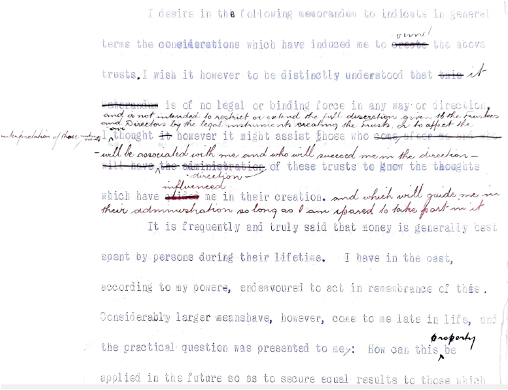
Joseph Rowntree’s Memorandum founding the three Trusts Source: Borthwick Institute for Archives RFAM/BSR/JRF/9/1/1/20
Arnold S. Rowntree, nephew of Joseph Rowntree, was appointed Director of this Trust. Known for his friendly and approachable character, “Chocolate Jumbo”, as the children of Bootham School and The Mount affectionately called him, worked advertising for the Rowntree’s chocolate company.[5] This may well have been why he was given oversight for the newspaper sector. In addition, however, Arnold aspired to emulate Joseph Rowntree’s beliefs and actions in his work. In 1917 Arnold made a speech on the importance of newspapers for society. He echoed his uncle’s thoughts of a decade and a half before:
“A good newspaper expresses the thoughts, wishes, troubles, aspirations, and just complaints of the public… nothing should be done to endanger the freedom of the Press…because Dr Johnson was truly right when he said “nothing adds so much to the glory of a country as a free and independent Press.”[6]
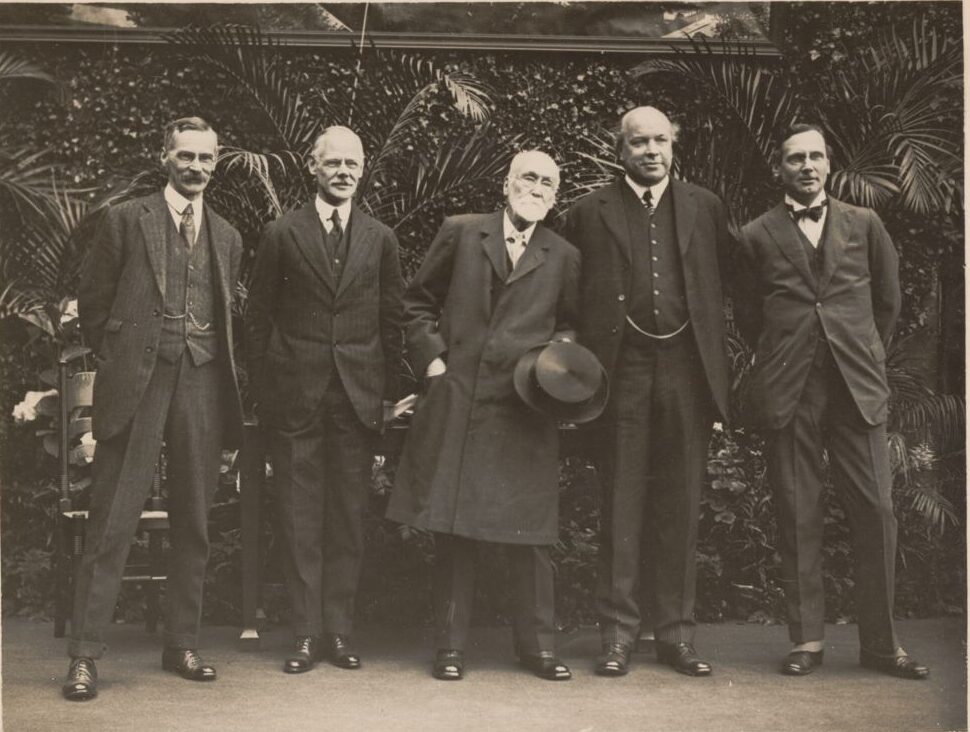
L-R: Stephen, Seebohm, Joseph, Arnold, Oscar Rowntree in 1923 Source: Borthwick Institute for Archives: Rowntree Photo Archive 44/053
Arnold took pride in this speech. In scrapbooks that focused on his career and wider works, two copies of this speech appear.[7]
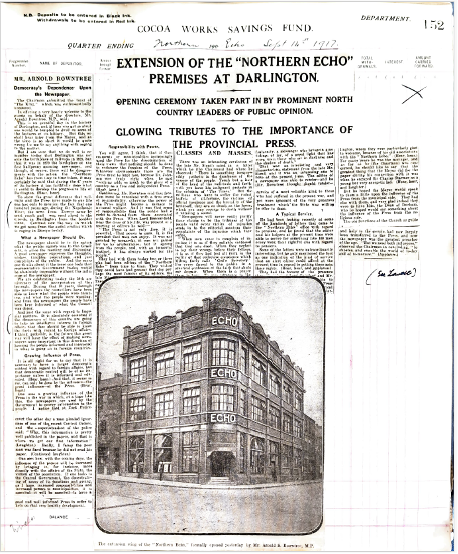
Northern Echo 14th September 1917 from Arnold’s scrapbook
Source: Borthwick Institute for Archives RFAM/ASR/JRF/3/3
Other issues quickly arose. Records show most of the Rowntree’s papers continually running at a loss. The Minute books regularly record requests for loans from the newspapers, which were typically granted and then written off.[10] This was only worsened by WW1, which led to a scarcity of paper and subsequent increases in running costs.[11] Furthermore, reading the Minute books, as time goes on, there is a growing sense that those who are leading the newspaper interests, Arnold Rowntree included, are increasingly overstretched by what newspapers required. In 1919, Seebohm Rowntree raised concerns about expanding size of newspaper interests, “in relation to the available time and the health of the three or four men bearing the main burden of the work”.[12] Almost two years later, Arnold Rowntree and J.B. Morrell would echo the weight of the “heavy burden” of newspaper ownership.[13] At this same meeting, Lord Cowdray was mentioned for the first time. Cowdray ultimately established the Westminster Press, the company that took on the financial burden for most the Rowntree’s provincial papers by 1922, alleviating the pressure on Arnold and others.[14]
Nor would efforts in the national press prove straightforward. In 1907, the JRSST purchased the paper that would become The Nation. H. W. Massingham led the paper as editor until 1923. Massingham was “perhaps the ablest journalist of his time”.[15] Initially, Massingham’s appointment was greeted very positively amongst the Rowntrees and broader Liberal Press.[16] Massingham set high standards, holding weekly Nation Lunches, where he encouraged open discussion in order to create a more thoughtful range of ideas for the paper.[17] Arnold Rowntree was a regular attendee of these lunches when in London. In 1913, Arnold wrote to his wife that at a Nation lunch, he “was glad to find Massingham much happier than…expected”, highlighting the extent to which Massingham dominated the paper despite his encouragement of open discussion.[18] Under Massingham, The Nation was well-regarded: Ian Packer has described Massingham as successfully establishing “the house journal of the New Liberal intellectuals”.[19] Famous names were attracted to write in the paper: in October 1907, discussions were held on reimbursing Winston Churchill, and from 1913, “arrangements” were made to bring A. A. Milne to the paper.[20] However, Massingham continually ran The Nation at a loss, with the JRSST losing £50,332 throughout its time as owner.[21] Circulation remained small. This seemed to be manageable for a time, but other problems arose that meant financial concerns could no longer be ignored.
Although The Nation received significant funding from the JRSST and was technically under its control, Massingham very much viewed the paper as his. People recognised that, overall, the paper represented his views. Massingham was not afraid to court controversy: one of his employees at The Nation was H. W. Nevinson. Nevinson was also researching the issue of slavery on cocoa plantations, with Massingham’s encouragement, leading to a scandal for the Rowntrees and Cadburys.[22] Massingham personally challenged the Rowntree’s political views during WW1. In December 1916, Seebohm Rowntree raised new prime minister, David Lloyd George’s, concerns, that The Nation, a paper “owned by those friendly to him” was attacking him personally. Seebohm further said “things stated as fact by H. W. Massingham were not true” and that Seebohm was thus being put “in a false position”.[23] Seebohm, and the Rowntrees more widely, were supporters of Lloyd George. Seebohm’s frustration is evident. Arnold Rowntree, as peacemaker, replied to his complaint. He acknowledged Seebohm’s concerns, saying “he had already suggested to H.W.M the elimination of personalities from The Nation”.[24] Seebohm pushed the point and a resolution was taken to monitor Massingham and exclude personal attacks from The Nation, although policy criticisms were acceptable.[25] This became an ongoing concern.[26] At this stage, Massingham was moving away from supporting the Liberal Party and was becoming, instead a Labour supporter. His change in political focus coloured his attitude in the paper and undermined the original intent of the Rowntree’s.
Within a few years, the Rowntrees decided to sell The Nation. At the time, it was “widely regarded” that this decision came from Massingham’s continual criticisms of Lloyd George, although this was not entirely true.[27] On 3rd June 1921, Arnold raised concerns over the losses at the Nation, highlighting an anticipated loss for the year of £6,240. He felt “careful consideration” was needed regarding keeping the paper open. However, Joseph Rowntree intervened, saying “the Nation must be kept going at all costs.”[28] The resulting need for significant cost-cutting was communicated to Massingham by Arnold, but to little avail. Massingham would not take responsibility for the financial problems and things worsened throughout 1922.[29] In December, Massingham wrote to Arnold, offering his resignation. He referred to no financial concerns, instead giving his reasons for resignation as the “inevitable” re-election of Lloyd George, as well as Massingham being “tired of Editorship”. He then said that “Seebohm’s [opinion] may be quite right” on the direction for The Nation but that he couldn’t agree.[30] Massingham certainly emphasised political division as the main problem.
Although his resignation was duly accepted, Massingham attempted to backtrack when he discovered that overtures had been made to another Liberal group, the “Oxford Summer School Group”, to buy out the Nation, thus resolving financial issues.[31] Clearly concerned, Massingham then wrote to Joseph Rowntree, complaining of his mistreatment. Massingham felt that the only reason The Nation had financial problems was because the JRSST had stopped given it as much money because of “Seebohm’s strong objection to the policy of the paper in regard to Lloyd George”. Joseph Rowntree’s reply is clear:
“To myself, it has been a great disappointment that the “Nation” could not be continued on the old lines. You speak of Seebohm’s strong objection to the policy of the paper in relation to Lloyd George, and of the resulting financial difficulties. But the “financial difficulties” are apart from this.”[32]
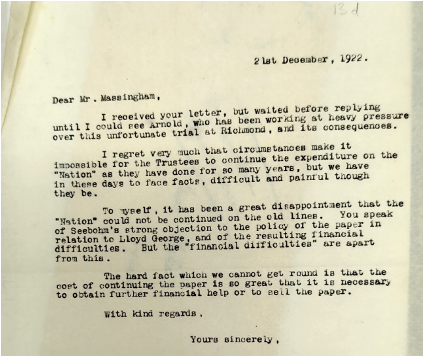
Letter to H.W. Massingham from Joseph Rowntree
Source: Borthwick Institute for Archives: RFAM/JR/JRF/7/1
By directing his complaint against Seebohm, Massingham pushed too far.
Massingham offered to try to raise capital to buy the paper himself throughout early 1923. However, by April he had failed to raise even half of the amount needed. He also had a heart-attack but would not acknowledge the limitations his health placed on his venture. Instead, he still complained of poor treatment, stating that “turnip-headed Arnold” was refusing to discuss matters fairly.[33] Ultimately, The Nation was sold as planned, the JRSST unable to justify absorbing the financial losses any further. Contemporaries believed Massingham’s version of events, that “the paper was sold over” his head and he was forced out for political reasons.[34] This belief was so widespread that Arnold was forced to write an official reply to the claims. In the late 1930s, the trust was still refuting the claim that Massingham was “forced out of his position…as has been stated in print by his son, the late H. W. Nevinson, and other writers.”[35]
Arnold’s official reply repeatedly cited financial reasons as being the main cause of the sale of The Nation, not political disagreements. If you consider that, much of the provincial press had been sold for the same reason, this does not seem an unfair claim on Arnold’s part. However, Massingham’s stubborn refusal to compromise his own political beliefs in running the newspaper had certainly created tensions that were difficult to overcome. For the Rowntrees, by the early 1920s, it was clear that newspapers were not the easily controlled political tool they had hoped for.
Charlotte presented this research at our event held at Bootham School in November 2025 as part of the Joseph Rowntree Centenary. You can see the recording of the full event, including contributions from Dr. David Vessey (University of Sheffield) and Jim Waterson (London Centric), here:
If you would like to learn more about Rowntree Newspaper Ownership, Professor Sue Mendus gave a lecture as part of Festival of Ideas, which you can watch below.
Charlotte Vallis Biography
Charlotte Vallis is a part-time PhD student at the University of York. Her own research focuses on Russia in the 18th century, particularly considering the confluence of gender and power. She completed an IPUP internship in Summer 2025 with The Rowntree Society for the Joseph Rowntree Centenary, exploring the Rowntree family’s newspaper ownership.
All images from originals held at the Borthwick Institute for Archives, University of York
Joseph Rowntree’s Funeral
Introduction
The importance of Joseph Rowntree’s (1836–1925) life and the impact he had during his lifetime, both in York and beyond, was demonstrated by the extraordinary funerary and memorial events held over the weekend of Saturday 27th and Sunday 28th February 1925. Thousands of people were involved, whether through attending one or more of the 5 funerary or memorial events held over the weekend or lining the streets of York to pay their respects as his cortege passed them.
J.B. Morrell, one of the most influential figures in late 19th and 20th century York, described Joseph Rowntree as “…a Victorian radical, and upholder of peace, retrenchment and reform”.[1] In doing so was referencing one of Joseph’s influences, the Quaker politician and campaigner John Bright, who often used the early 19th century liberal and radical phrase, “peace, retrenchment and reform”. In addition, he also seems to be suggesting that Joseph was someone maybe out of time, upholding earlier and more idealistic values.
Joseph wasn’t just idealistic, he was pragmatic and someone who made things happen. His Quaker faith meant that it was important to him for outcomes of his actions, and that people benefitted from them, spoke for themselves and not as a testament to him as the person who made them happen. This led to the Quaker theologian and academic, H. G. Wood, to state that Joseph was a “…master the art of doing good by stealth” in his tribute to him following his death.[2]
Joseph’s Last Days
Joseph had retired from his Chairmanship of Rowntree & Co. in 1923, when his son Seebohm Rowntree took over. This, however, did not stop him coming to work each day. He kept his office at Rowntree’s Cocoa Works on Haxby Road and continued to enjoy being part of the community at the factory.
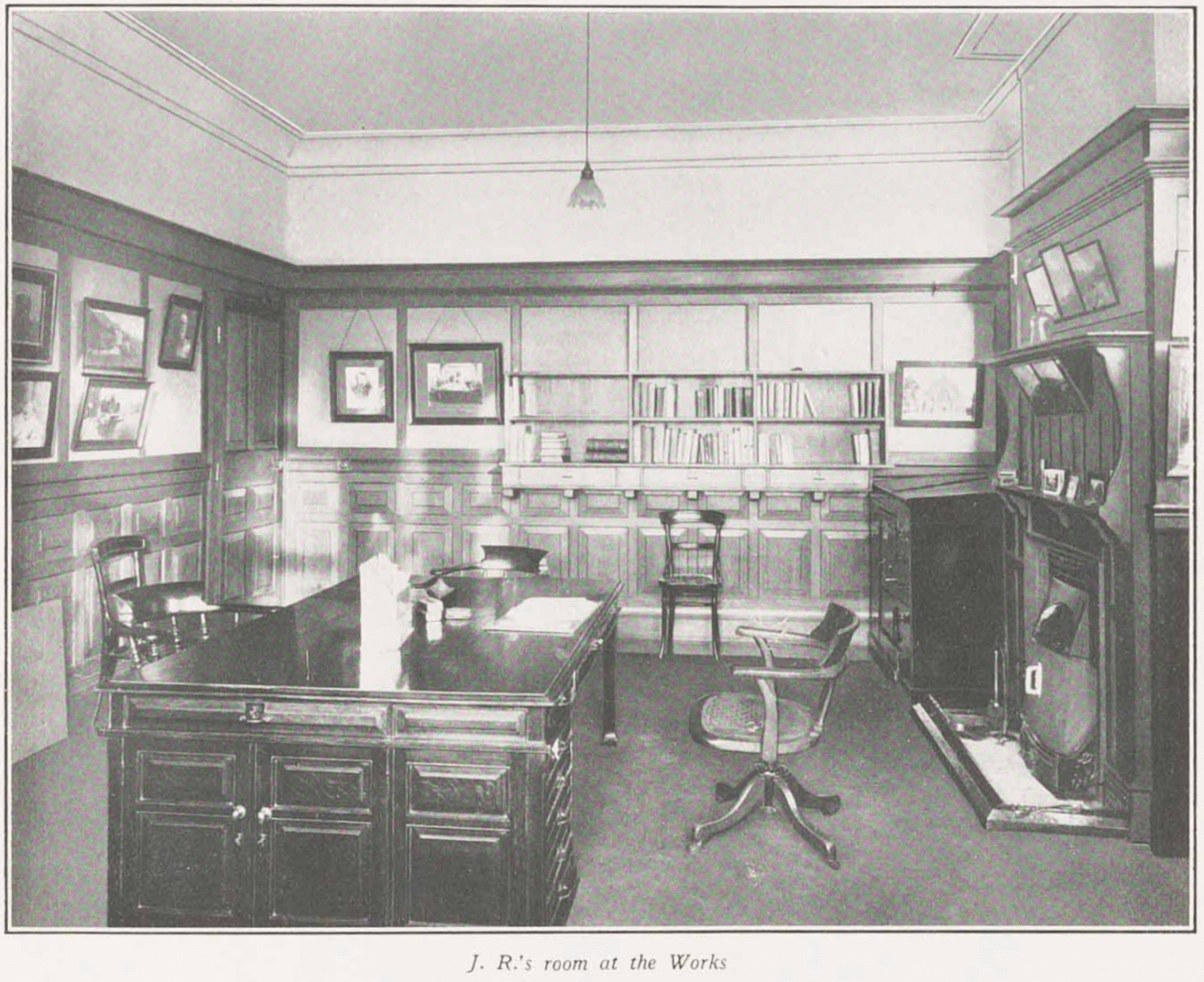
Joseph Rowntree’s office at the Cocoa Works
Source: CWM Memorial Issue – Borthwick Institute for Archives RFAM/JR/JRF/1/7/6
On Thursday 19th February 1925, Joseph was at the Cocoa Works, working on a biography of the aforementioned John Bright, when he complained of feeling cold. He was reluctant to leave, and staff had to persuade him to go home. Over the next few days, he was cared for at his home, Clifton Lodge. His only surviving daughter, Agnes Julia MacDonald (née Rowntree) recalled that he didn’t complain or show irritability. Each morning, he asked if the birds were singing and if they could be seen on the lawn – a testament to his love of nature. Joseph also talked about his regular Saturday trips to Scarborough when he would often invite a member of Cocoa Works staff to join him to watch the birds on the coast.[3]
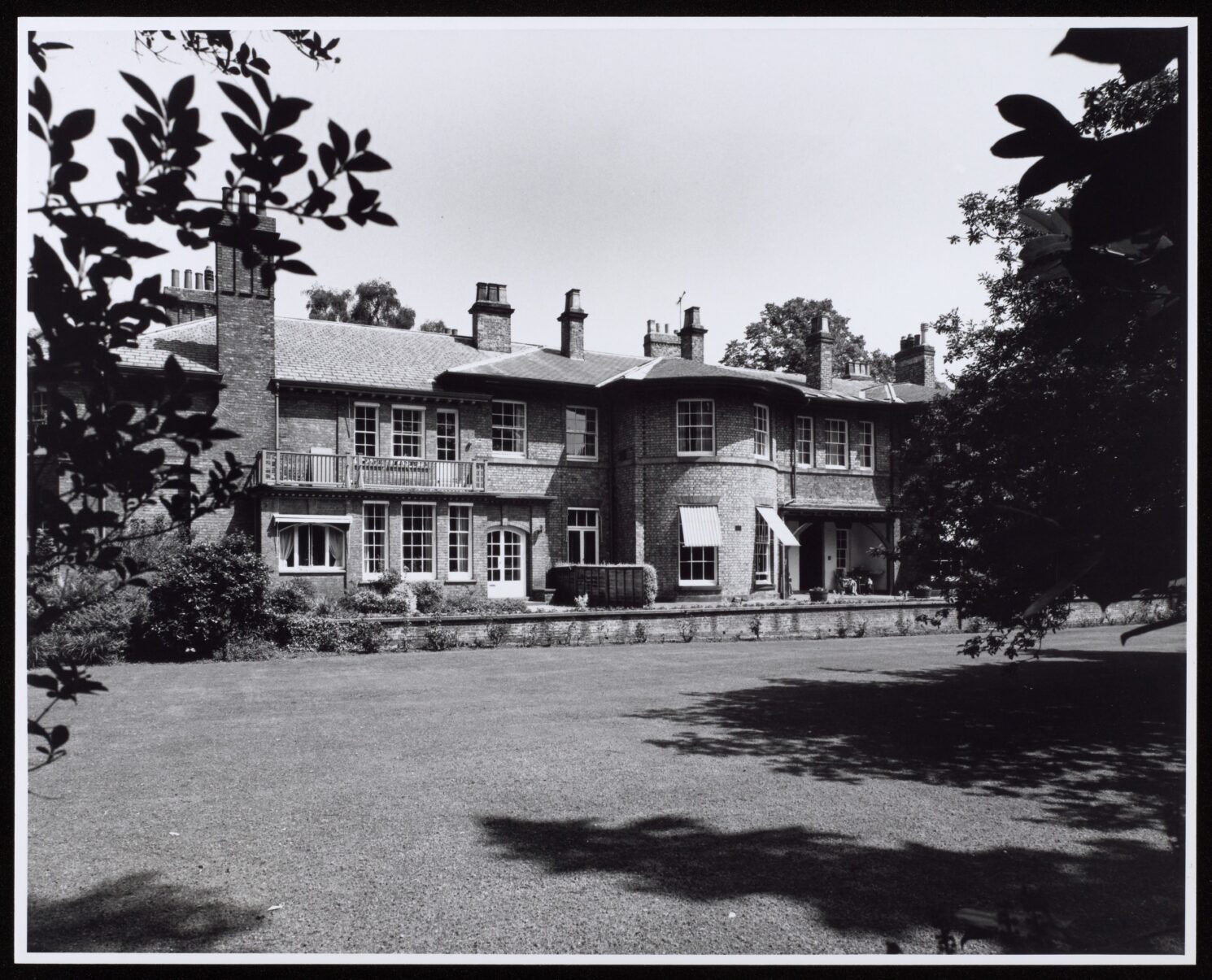
Clifton Lodge and Rawcliffe Holt
Source: Borthwick Institute for Archives – JRF Photographic Archive: Clifton Lodge and Rawcliffe Holt 2019/031 105.1 0684
Joseph Rowntree died at home in early afternoon of Tuesday 24th February, aged 88.
Newspaper Coverage
The news of Joseph’s death was quickly reported, making the evening editions of many newspapers on 24th February. It was widely and internationally reported, showing how well known and respected he was. Coverage of his passing recognised his work on social welfare as much as his business achievements.[4] Reports of his funeral commented on the large number of people involved, and also that there was something of a strangeness about it. This included that it was a “simple ceremony”, with the Daily Mirror’s subheadings including “Quaker Ceremony Without Morning Clothes” and that people wore “Coloured Ties”.[5]
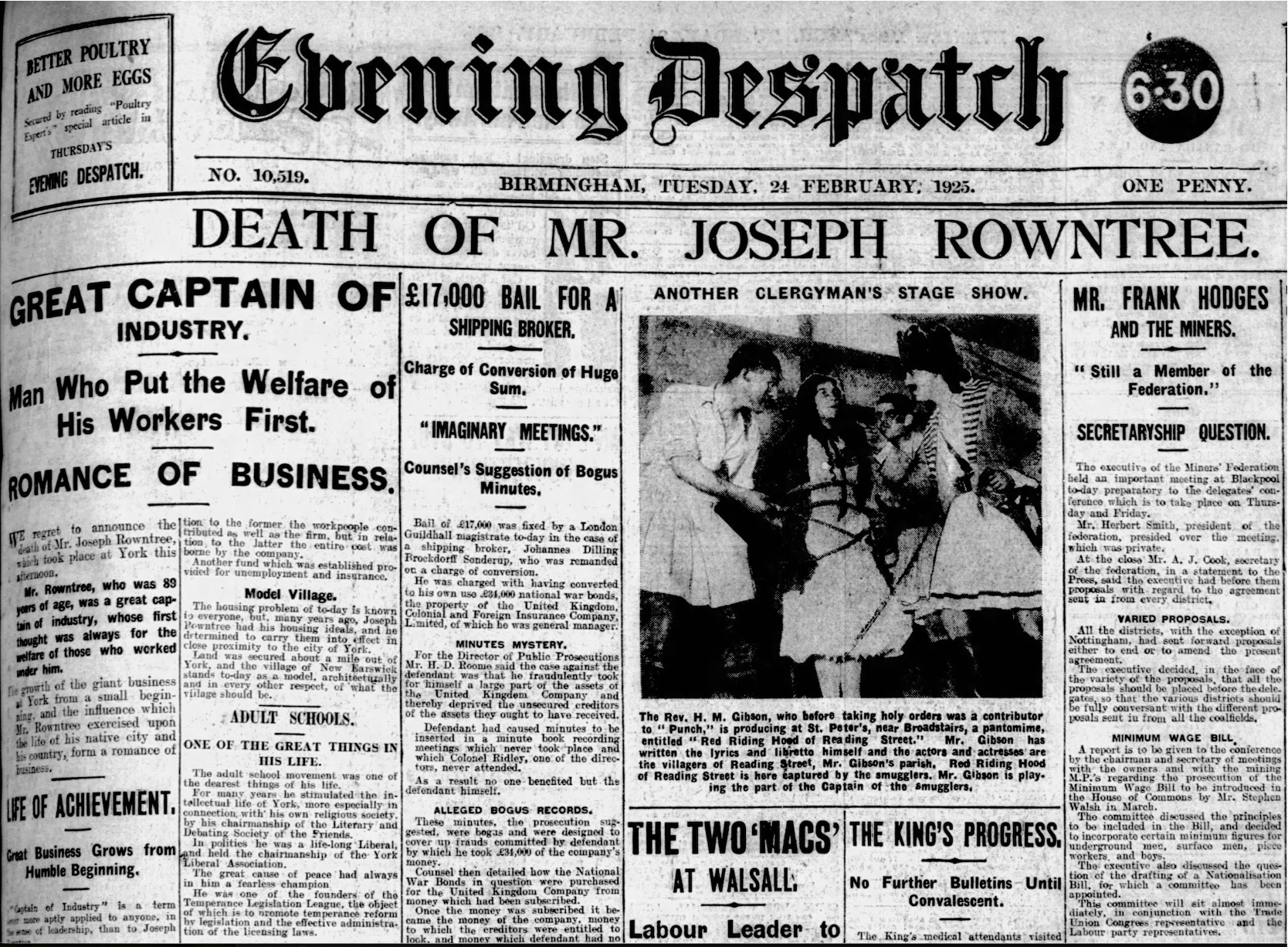
Birmingham Evening Dispatch Tuesday 24th February 1925
Funeral and Memorial Events
Joseph Rowntree’s funeral was not just one event; over the weekend of Saturday 28th February and Sunday 1st March 1925, there were five funerary and memorial events held for him. He was cremated at Lawnswood Crematorium, Leeds on Friday 27th February,[6] and his ashes were brought to Clifton Lodge, ready for the weekend.
The weekend’s events:
Saturday 28th March:
- 10:30am: the Cocoa Works Memorial
- 2:30pm: Clifford Street Friends Meeting House
- 3:30pm: burial at The Retreat Quaker Burial Ground
Sunday 1st March:
- 6:30pm: Education memorial at Clifford Street Meeting House
- 8pm: New Earswick Memorial at New Earswick Folk Hall
These times are when the events were planned for, not necessarily when they happened. One hour seems very short for both the memorial at the Clifford Street Meeting House and to travel the roughly one mile to The Retreat for the burial.
Saturday 28th March
10:30am: Cocoa Works Memorial
The first event of the weekend took place on the Saturday morning in the Girls Dining Room at the Cocoa Works’ Dining Block. The memorial service was held there as this was the largest space they had at the Cocoa Works, and this was needed as up to 3000 people are reported to have attended.[7] It was organised by the Central Works Council – the highest level of workplace democracy in the company – not by Rowntree & Co. management.
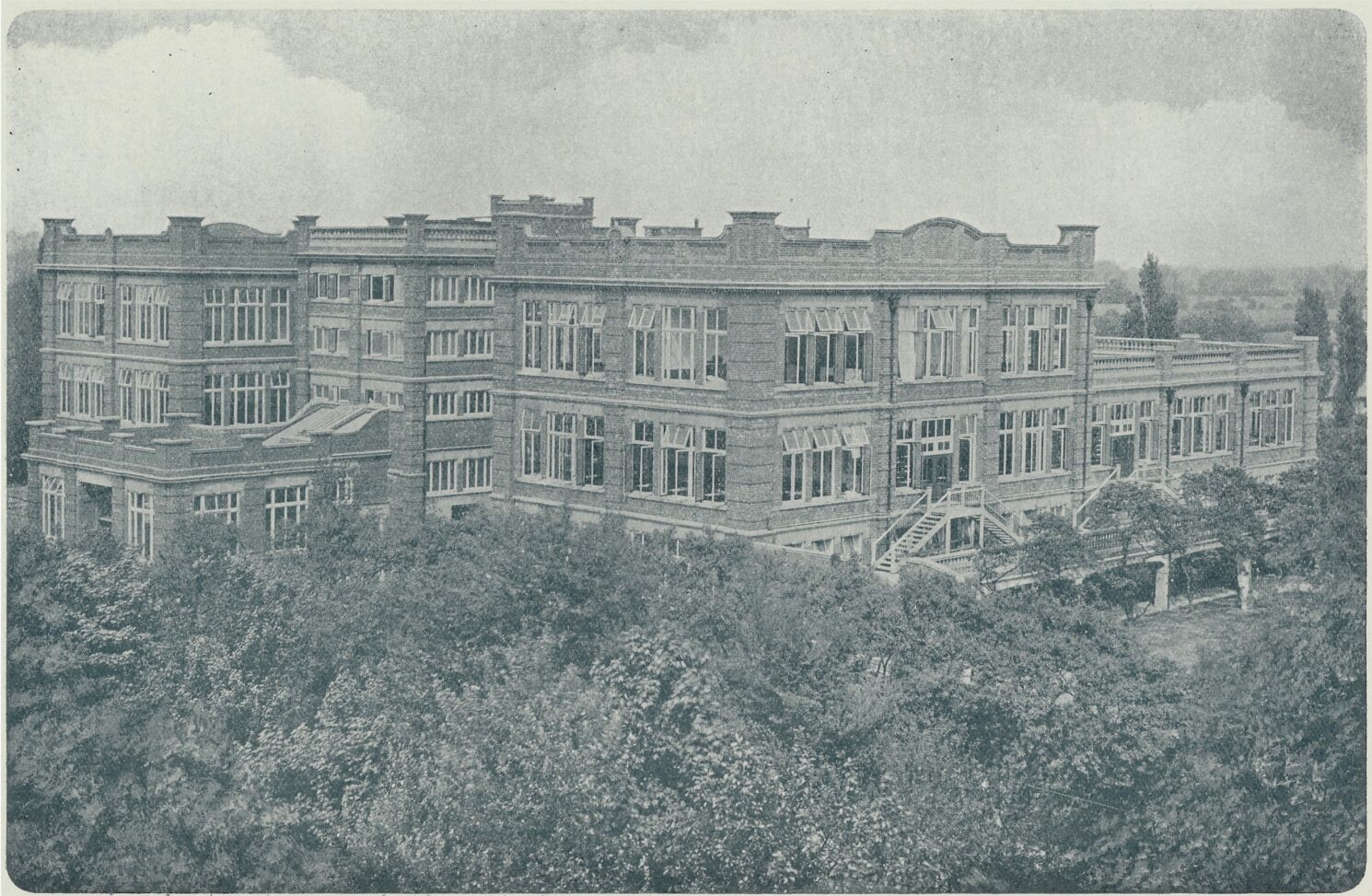
The Cocoa Works Dining Block Source: CWM June 1913 pp.1499 – Borthwick Institute for Archives R/DL/CMW
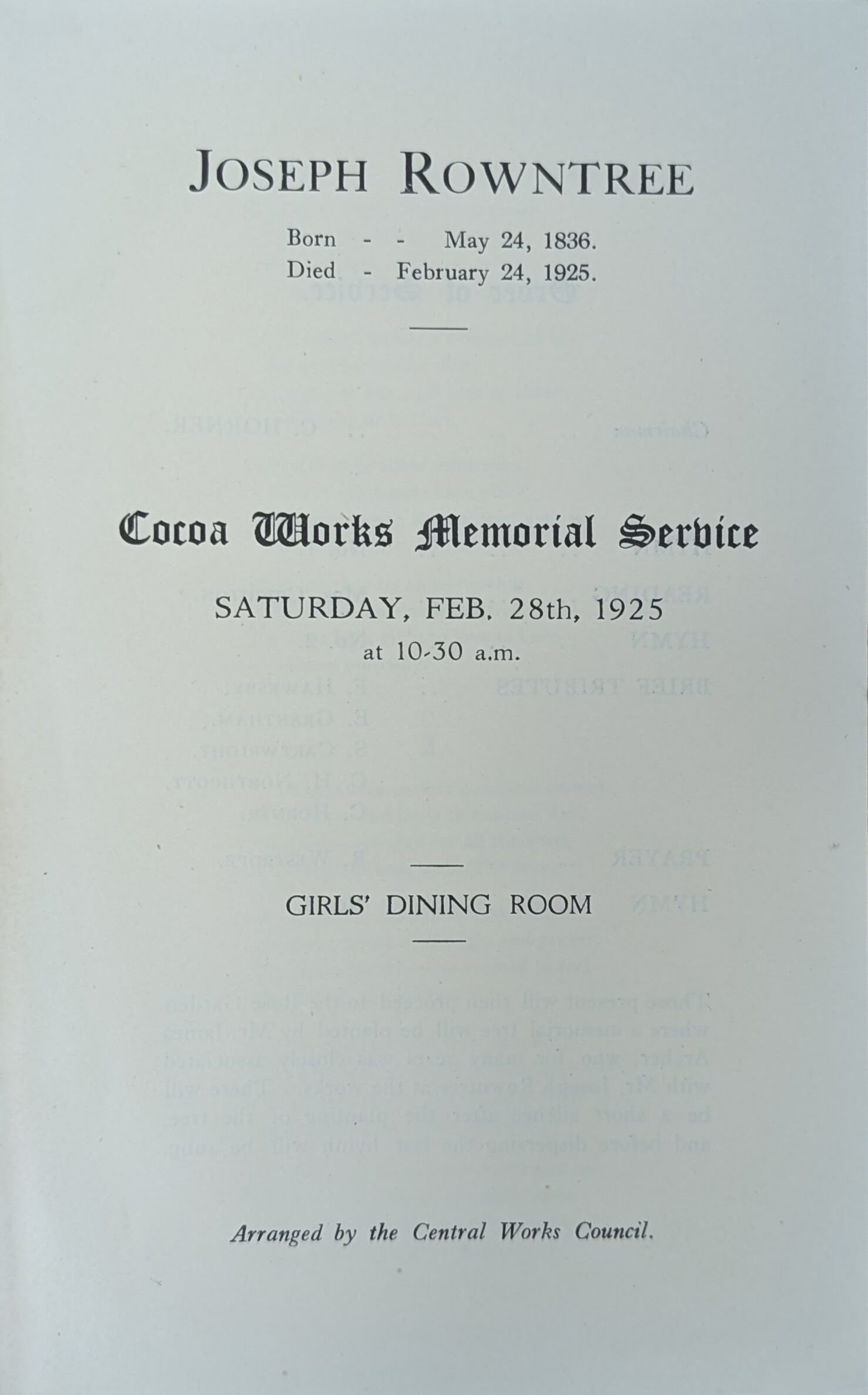
Cocoa Works Memorial Service
Source: Borthwick Institute for Archives RFAM/JR/JRF/1/7/4
The order of service lists three hymns; ‘We Cannot Think of Them as Dead’, ‘O Thou Whose Perfect Goodness Crowns’, ‘He Liveth Long Who Liveth Well’. Mr. C. Horner, who was employed in the Employment Department and the editor of the Cocoa Works Magazine, presided.[8] Other notable speakers included:
- Mrs. Edna Annie Crichton: a notable York Quaker, who in the 1940s would become the first woman Lord Mayor of York and first woman Alderman of York. In 1925 she had already been a City Councillor for 6 years. Her husband, David S. Crichton, Rowntree’s first Welfare Officer, had died a few years earlier and the workers setting up a memorial fund in his name for educational scholarships and sporting activities. One of the readings delivered by Mrs. Crichton was John Wilhelm Rowntree’s ‘Love and Death’ (part of which is quoted in the current edition of Quaker Faith & Practice). John Wilhelm was Joseph’s oldest son who had passed away in 1905, aged only 37.
- Fred Hawksby: the main trade union leader at Rowntree’s who had been given the paid position of Chief Shop Steward and a key member of the Central Works Council. He noted the improvements that Joseph had made to the workers’ lives and that he had set an example to others in industry.
- Dr. Clarence Northcott: Rowntree & Co.’s Australian Labour Manager, spoke of Joseph’s faith in both the individual and society.
- Richard Westrope: Non-conformist and Quaker preacher who was the first warden of St. Mary’s Educational Settlement funded by the Joseph Rowntree Charitable Trust. He led the service in prayer followed by a long period of silence – described a “impressive in its solemnity”.[9]
Following the service, the memorial continued in the Rose Garden at the factory where a lime tree was planted in memory of Joseph by James Archer.[10] Archer was 82 years old, and a retired Rowntree’s engineer who had worked closely with Joseph from 1882 onwards.[11] The ceremony ended with the singing of the hymn, ‘O Life That Maketh All Things New’.[12]
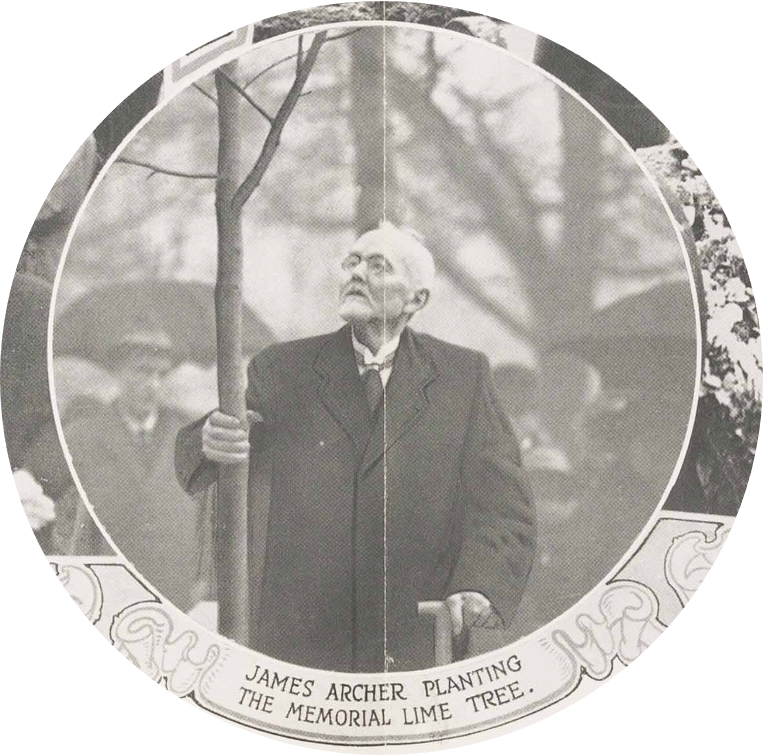
Archer planting the lime tree
Source: CWM Memorial Issue – Borthwick Institute for Archives RFAM/JR/JRF/1/7/6
2:30pm Clifford Street Friends Meeting House Memorial Service
In the afternoon, family, close friends and associates gathered at Joseph’s house, Clifton Lodge in the Clifton area of York. They formed a funeral cortege which took his casket to the Clifford Street Friends Meeting House. At the same time, a civic procession made its way from the Mansion House led by the Lord Mayor, Sir Robert Newbald Key. The streets along both routes were lined with people – described as “densely packed”, “thronged” and silent. Flags were flown at half-mast, shops were closed, blinds pulled down at the Mansion House, businesses and houses.[13]
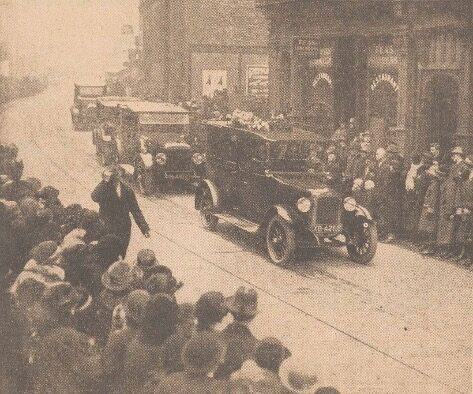
The funeral cortege
Source: Daily Mirror 2nd March 1925 – Borthwick Institute for Archives RFAM/JR/JRF/1/7/8
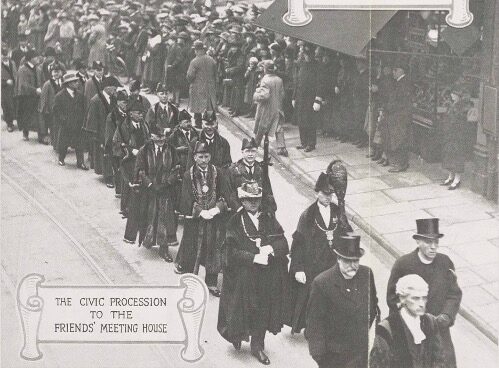
The civic procession
Source: CWM Memorial Issue – Borthwick Institute for Archives RFAM/JR/JRF/1/7/6
At the Friends Meeting House, the service was held in the main meeting room which had a capacity of up to 1200 people.[14] However, this was not enough for all the attendees, so an overflow service was held nearby at Peckitt Street Primitive Methodist Church.[15] Over 50 organisations were represented with around a quarter of them associated with education.[16] The order of service lists three hymns; ‘Now Have We Met That We May Ask’, ‘The God of Love My Shepherd Is’, and ‘God of the Living, in Whose Eyes’.[17] The singing was led by choirs from the York Quaker schools, Bootham and The Mount.[18] All the recorded speakers were Quakers and included:
- Arthur Rowntree: headmaster of Bootham School and Joseph’s first cousin once removed.
- Sir George Newman: Bootham School alumni and the country’s first Chief Medical Officer.
- T. Edmund Harvey: another Bootham School alumni, MP and social reformer.
- H. I. Waller: a prominent local Quaker who offered a prayer.
It was reported that the service concluded with a short period of silence and the final hymn. William Foxley Norris, the Dean of York in 1925 wrote the next day that the service had “…representatives of every section of the community and I suppose of every religious body, gathered together in the Friends’ Meeting House, a place where a great many had never been before”.[20]
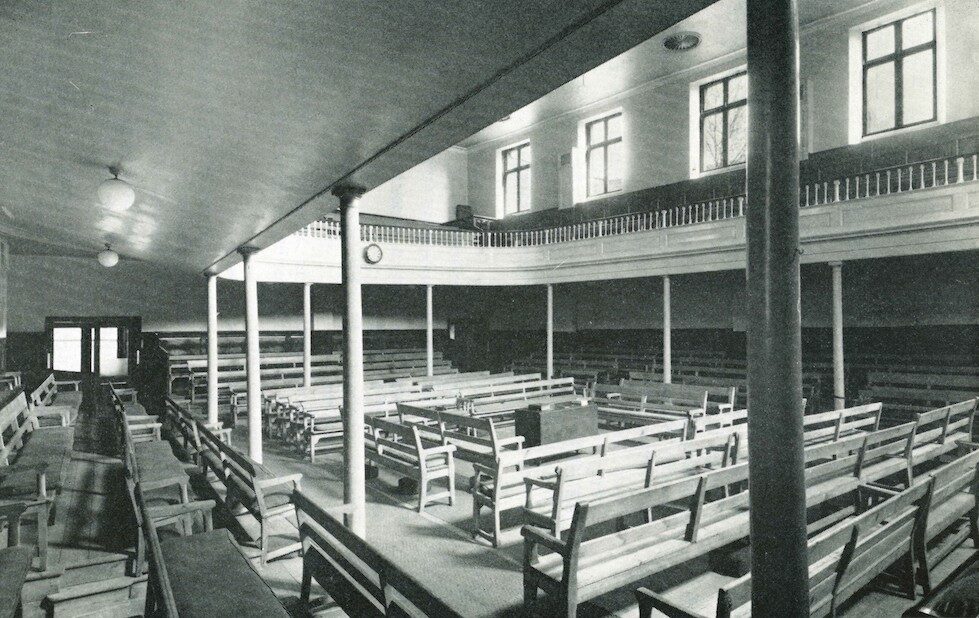
Main meeting room of Clifford Street Friends Meeting House
Source: Friargate Meeting House
3:30pm The Retreat Quaker Burial Ground
Following the service at Clifford Street Meeting House, the family cortege made its way to the Quaker burial ground at The Retreat. The route was again lined with people and when they arrived, the burial ground was already full of a crowd of hundreds.[21] Joseph’s casket was carried by William Fox, a long serving cashier at Rowntree & Co.
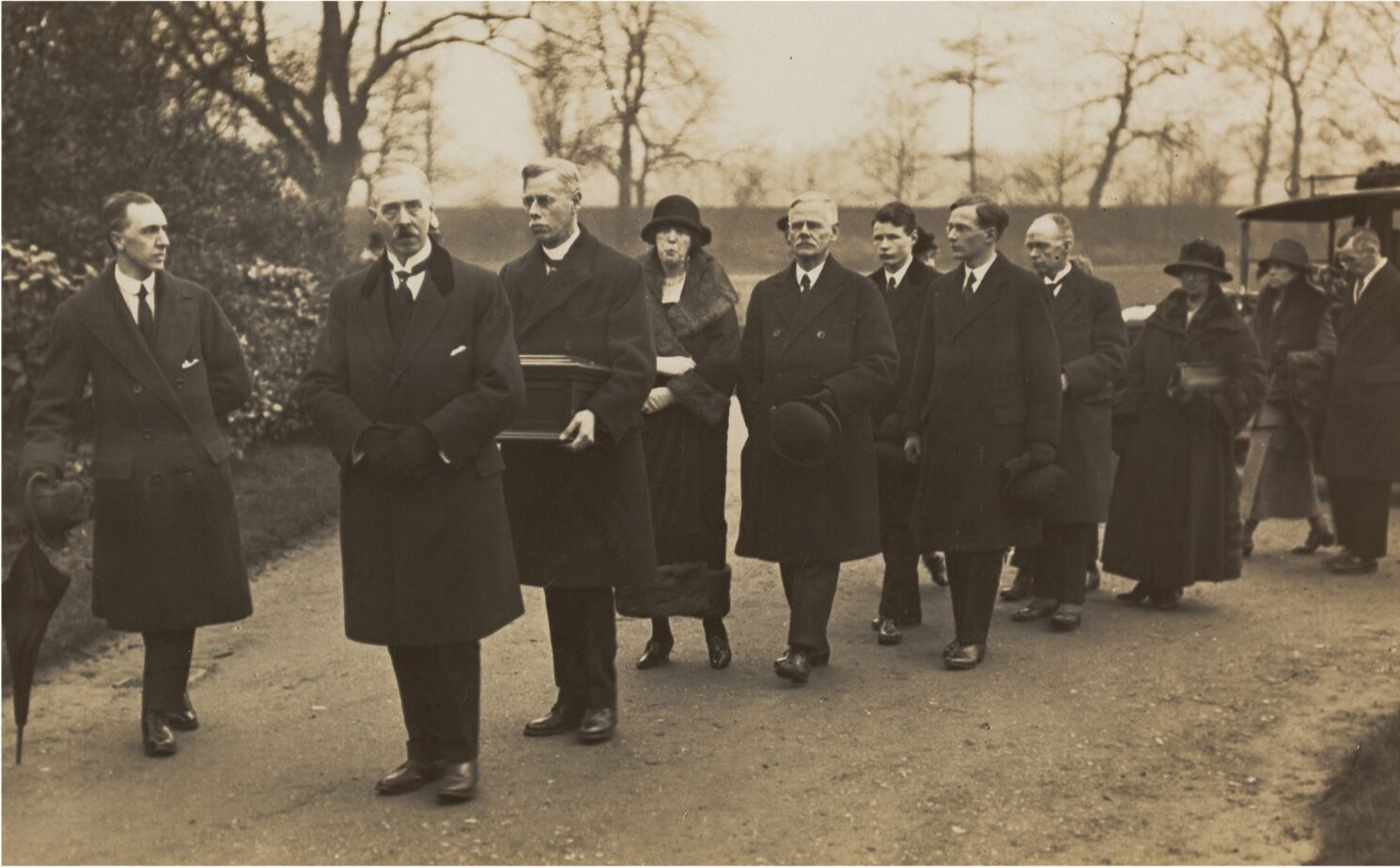
Family at burial ground
Source: JRF Heritage Library
A reading was given by J. Rowntree Gillet, Joseph’s nephew and namesake, who was also part of the Quaker banking family in which Barclays bank has its roots. Richard Westrope followed his role at the Cocoa Works in the morning, presided over the internment, and saying the final words.[22] The Daily Mirror reported that thousands of “townsfolk” then filed past Joseph’s grave to pay tribute, lay wreaths and flowers.[23]
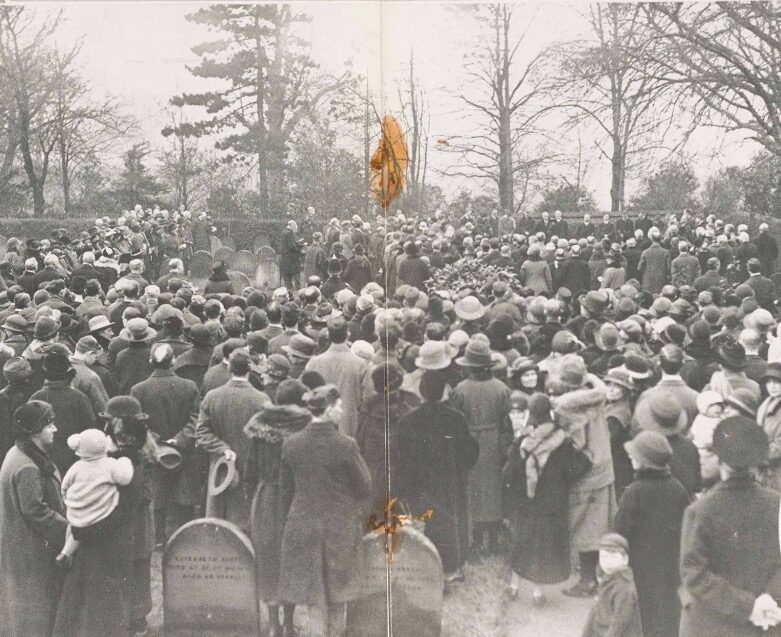
The Service at the burial
Source: Cocoa Works Memorial Issue – Borthwick Institute for Archives RFAM/JR/JRF/1/7/6
Sunday 1st March
The following day, on the Sunday, there were two more memorial events. They were both held in the evening.
The first was again held at Clifford Street Friends Meeting House and was for people involved with Joseph’s work in education including representatives from the National Adult Schools Union, the York Adult Schools, St. Mary’s Education Settlement and others. It was organised by the Adults Schools Association and held from 6:30pm. The order of service contains three hymns: ‘O God of Bethel, By Whose Hand’; How Happy is He Born and Taught’; ‘Abide With Me’.[25]
Order of Service Sunday evening
Source: Borthwick Institute for Archives RFAM/JR/JRF/1/7/4
Later that evening, at 8pm, another memorial service was held at New Earswick Folk Hall. This had been organised by the Village Council – made up of residents.[26]
Coverage of Joseph Rowntree’s Funeral
Joseph Rowntree’s funeral and other memorial events were given widely covered in newspapers at the time, highlighting its significance. The most extensive report was in Monday 2nd March 1925’s issue of the Daily Mirror. It was the front-page story and there was a double page spread of images covering the commemorations.
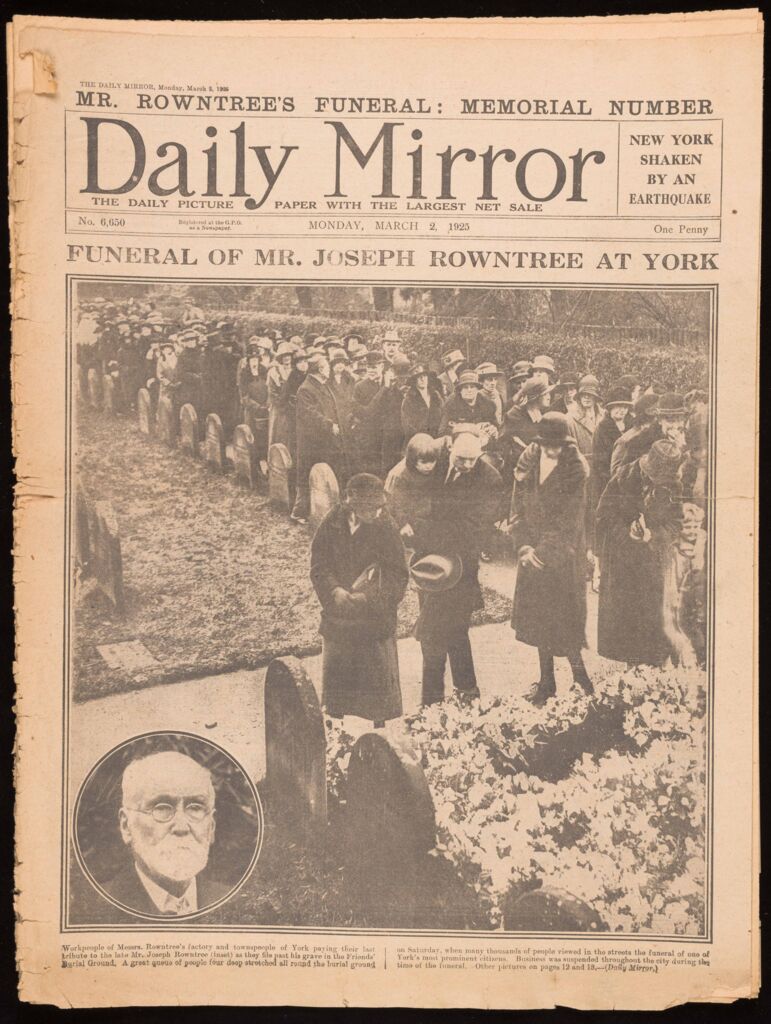
Daily Mirror 2nd March 1925
Source: Borthwick Institute for Archives RFAM/JR/JRF/1/7/8
Rowntree & Co. also produced a Special Memorial Number of the Cocoa Works Magazine which included a foldout centre page with more photos of Joseph’s funeral.
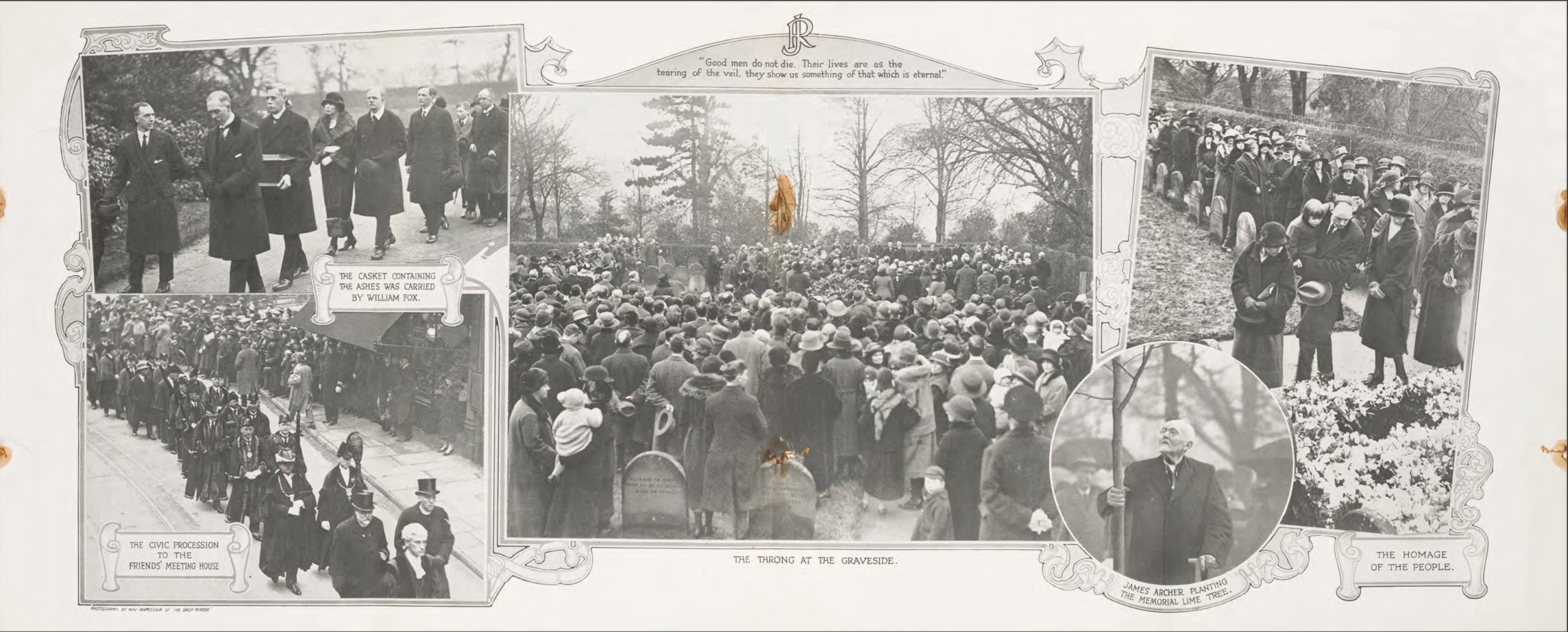
Fold-out pages of CWM memorial issue
Source: Borthwick Institute for Archives RFAM/JR/JRF/1/7/6
Remembering Rowntree in 2025
To commemorate Joseph Rowntree’s remarkable funeral, and to commence the centenary of his passing, The Rowntree Society held an event, “Remembering Rowntree: Why Joseph’s Funeral was so Remarkable?” on 1st March 2025, reflecting the funerary events which took place one hundred years earlier.
Held in York’s Friargate Quaker Meeting house (what used to be Clifford Street Meeting House), the event began with a talk by The Rowntree Society’s Executive Director, Nick Smith, on Joseph Rowntree’s funeral, followed by a talk on the traditions of Quaker Funerary practices from Barbara Windle. This and led to a series of five-minute talks given by people representing organisations who were represented and Joseph’s funeral 100 years earlier – they read out passages of what was said at the time as well as their own reflections on Joseph Rowntree’s legacy and influence on their own organisation over the century since his death.
You can see the recording of the event here:
You can also watch a summary of the event and interviews with attendees and participants:
Researched and written by Nick Smith, Executive Director of The Rowntree Society.
Additional research by Maisie Brenchley, Research Volunteer at The Rowntree Society.
Researching Joseph Rowntree: Quaker, Philanthropist, Industrialist, Social Innovator
This blog is part of the Joseph Rowntree Centenary and has been written by Fiona Grimshaw, a former Executive Director of The Rowntree Society, and researcher for the JR100 List. The JR100 List is one hundred notable stories and aspects curated from the archives we’re sharing on our social media and website throughout 2025. This list attempts to cover the wide ranging influence and legacy of Joseph Rowntree’s life, and will continuously be added to until we have shared all 100! You can find the list here.
As a former Executive Director of the Rowntree Society, it was both a pleasure and a privilege to be asked to contribute to the celebrations during 2025 to mark 100 years since Joseph Rowntree died. Sustained by his sincere Quaker faith, Joseph was a York confectionery businessman, philanthropist and social reformer. It is difficult to overestimate the impact that this unassuming personality and his descendants have had in York, nationally and globally. It is a considerable legacy. Their work lives on in the three Joseph Rowntree Trusts which were established by Joseph and who continue to work to influence social change today.
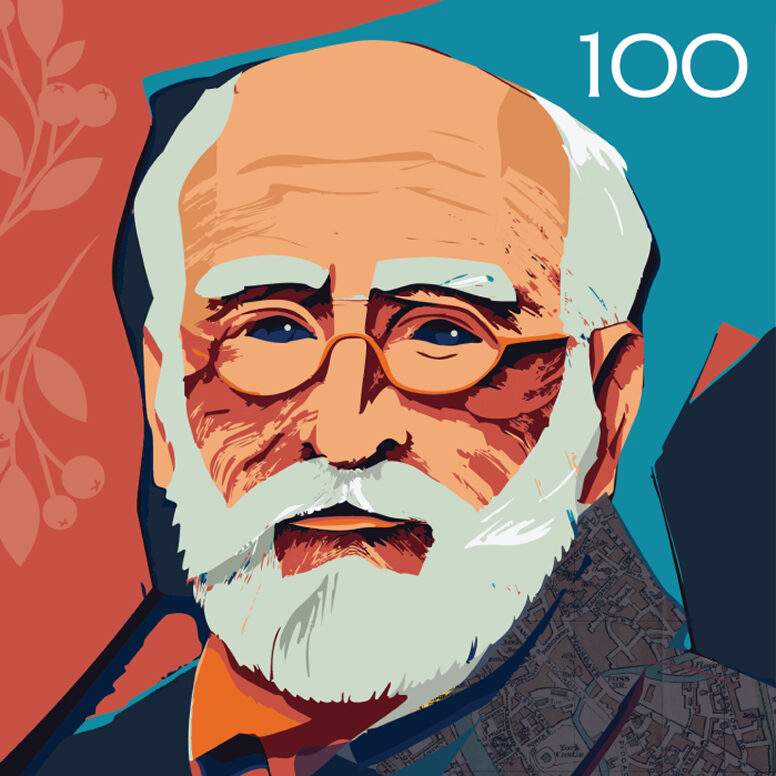
My brief was to curate one hundred stories about Joseph and his legacy using archival material and images. This would form a social media and website campaign running from the anniversary of Joseph’s funeral in February throughout 2025. At the start of the project there was some concern that a target of one hundred stories might be too ambitious but, given my knowledge of Rowntree archival material and other resources available, I was confident that this was not going to be a problem. And, indeed, as I immersed myself in Joseph’s life, family, social vision and legacy, it became clear that I was going to have to make some hard decisions as to what not to include. I became quite proficient at weaving themes together to include as much of Joseph’s story as possible.
During my tenure as Executive Director, The Rowntree Society’s programme of work was very much focused on women and factory workers (a personal interest of mine) and on the company’s role in colonial economies in Africa and the Caribbean which benefited from unfree and/or exploitative labour systems. This project was an opportunity to effectively go back to where the Rowntree story began and to utilise recent research to view events from different perspectives.
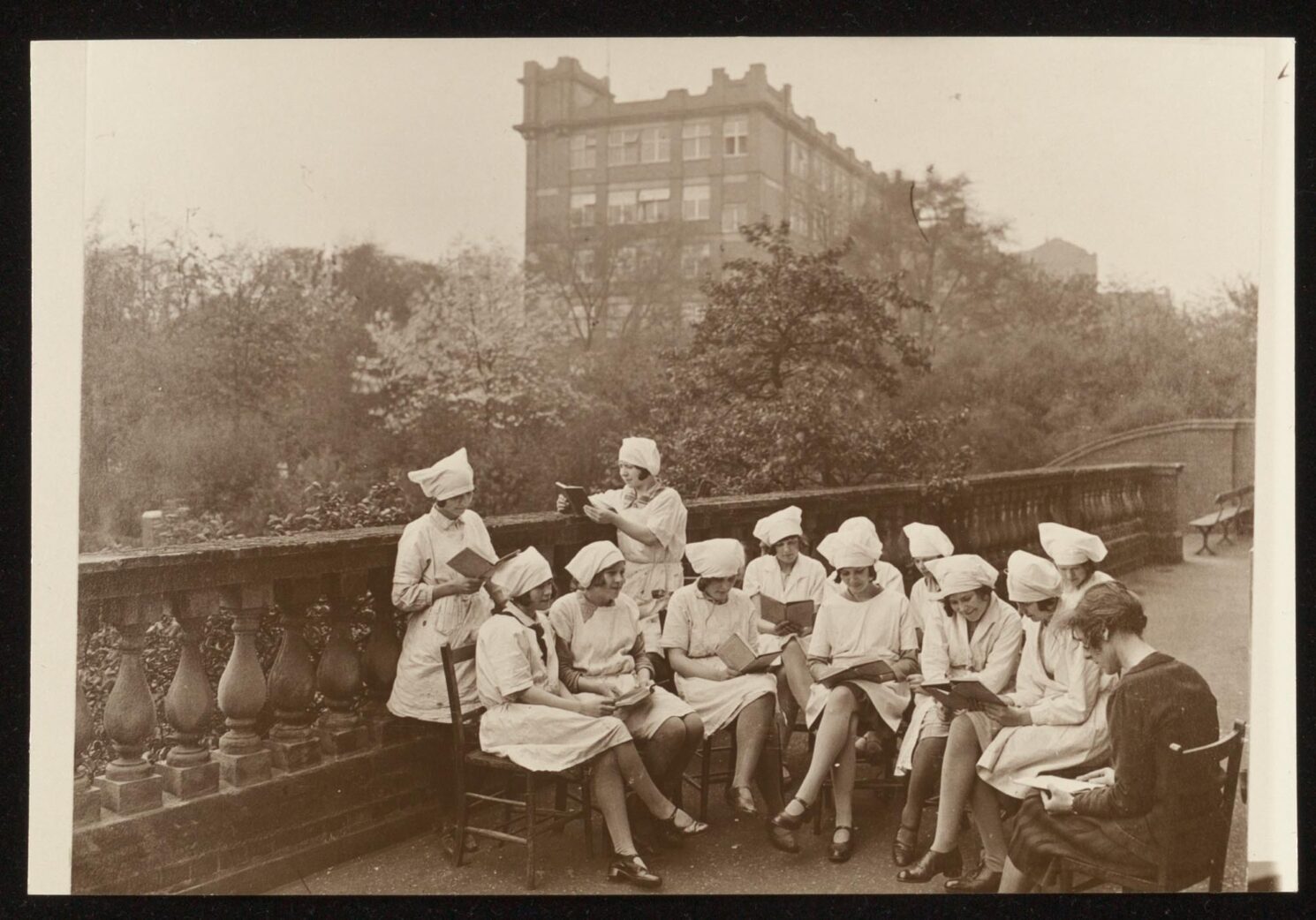
I quickly established that there were one hundred stories ready to be told. Assisted by the fact that the Borthwick Institute for Archives at the University of York has the largest deposits of Rowntree family, company and trust records anywhere in the world, I was ready to start developing each story. I originally organised my research into topic areas e.g. Quaker faith; family; company; trusts; philanthropic activities but it became clear that a more impactful approach would be to form the whole into a narrative loosely following Joseph’s life and linking the stories with the people, places and events which would really bring them to life.

It is very easy to form an image of Joseph as a elder statesman who appears in images as an affable grandfatherly figure – which by all accounts he was – but this masks the fact that he was a passionate campaigner for social justice throughout his life and that his early writing on subjects such as poverty and temperance was radical and to the point. I was keen that the younger Joseph in his earlier years should shine through and that, where possible, his own words from essays, books, memoranda and correspondence written by him should be used. His 1904 Founder’s Memorandum which established the Rowntree Trusts was written later in his life but is hugely significant in setting out his social vision so had to be included. I also wanted to make sure that much earlier essays, notably On Modern British Civilisation: In what it consists and in what it does not consist and Pauperism in England and Wales, both written in the 1860s, should get their fair share of the attention. However, these earlier writings proved difficult to track down. The Borthwick does not have copies of the originals. We made a joint approach to the Society of Friends Library in London and were excited to find that they did have copies that they could make available to us. It is a great day for a researcher when a success like this occurs – we had feared that On Modern British Civilisation may have been lost.
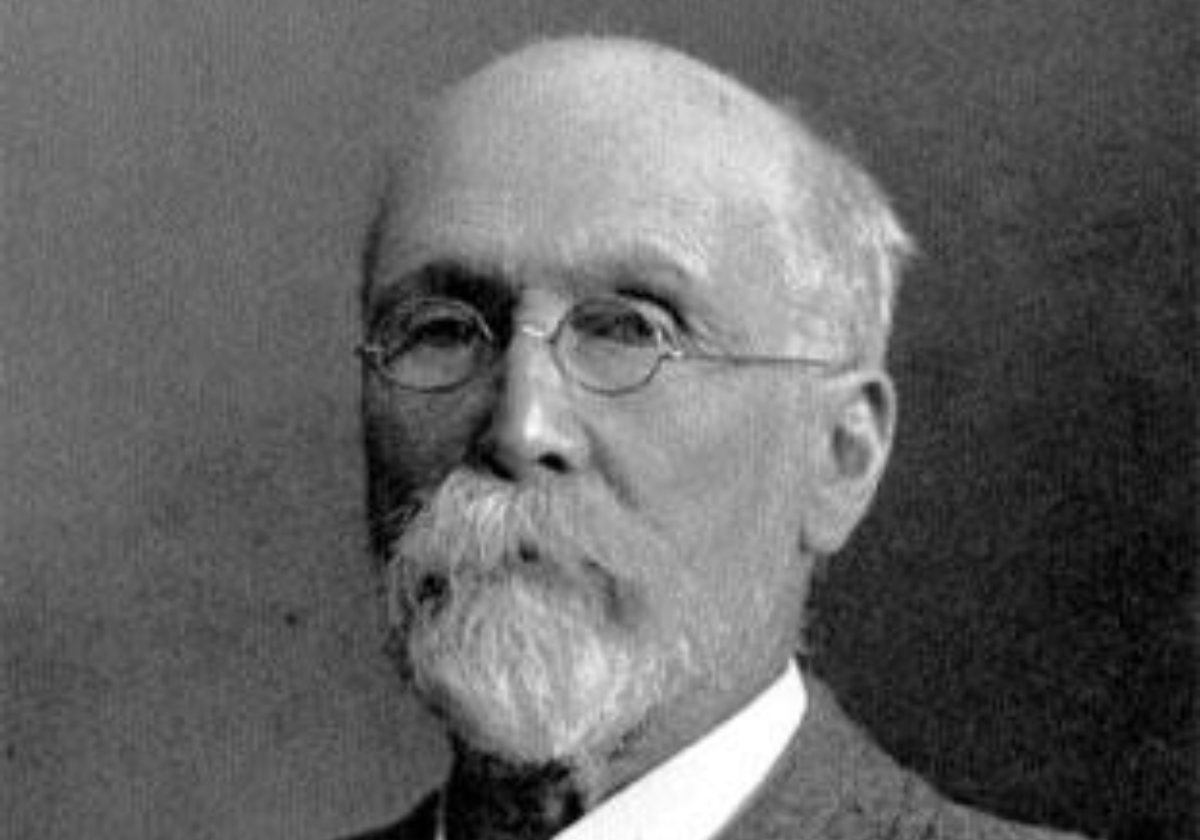
One of the joys of researching a subject that will appear digitally and on social media is the opportunity to undertake image research. Many images that I chose to include are already extant in the public domain through various media and form an important part of Joseph’s story but I set myself the challenge of finding others that are less well known. Working with an archivist with an encyclopaedic knowledge of the Rowntree archives meant that I could enquire about a particular person or subject and suggestions would magically appear by return email. Some of my personal favourites are: a younger Joseph in 1858; Joseph driving his car and the family at son John Wilhelm Rowntree’s wedding.
As I write this blog, the JR100 List – as it came to be known – has been running on social media for some months and it has been very pleasing to see the level of engagement with Joseph, his life and legacy. This makes all the research worthwhile. It has been a privilege to have the opportunity to revisit this remarkable man. Joseph’s legacy is still so relevant in our modern world – agencies still work to resolve poverty; provide affordable housing and improve educational opportunities. If Joseph were here today, it is likely that he would be disappointed that we are still wrestling with some of the issues for which he campaigned throughout his life.
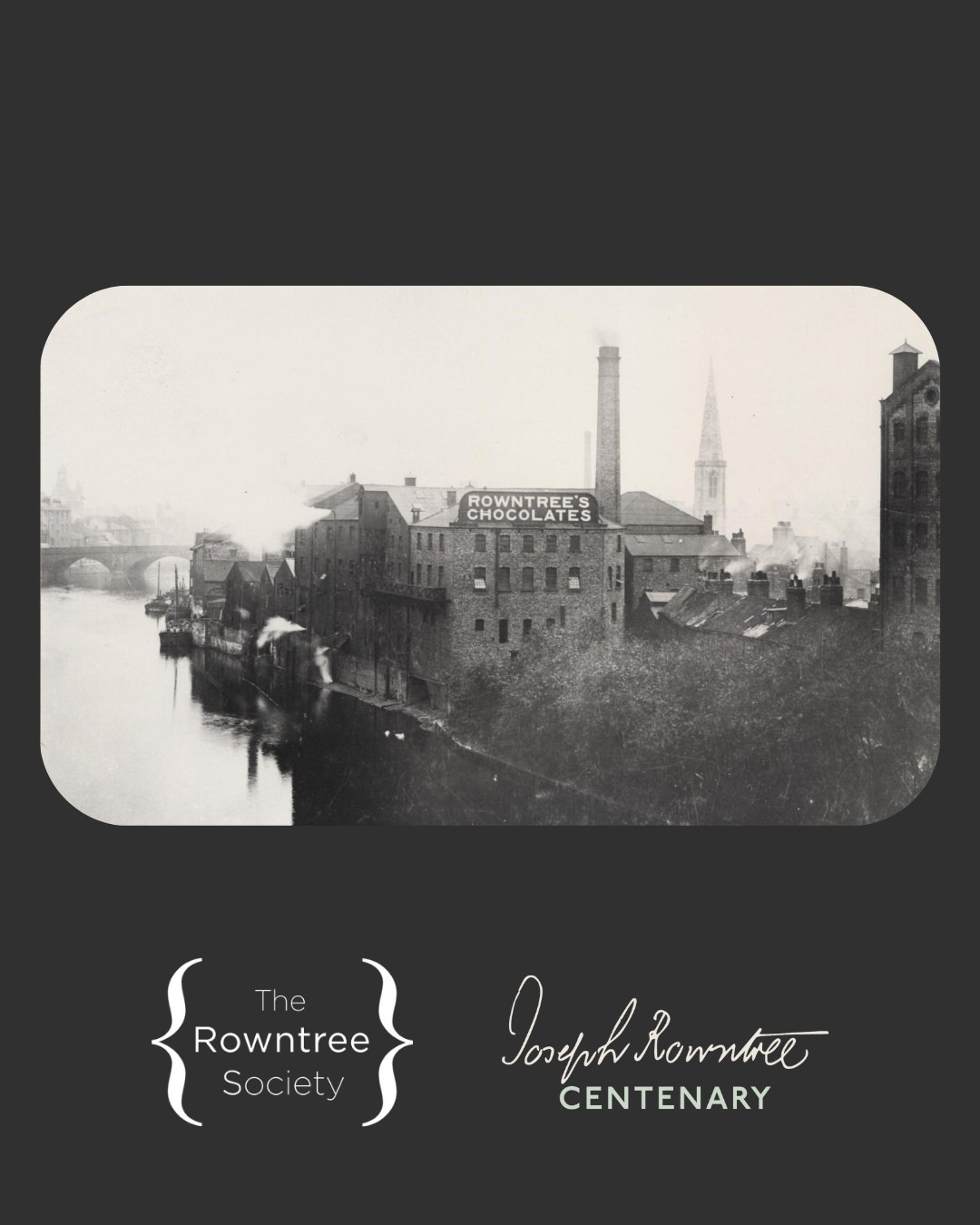
In conclusion, I would like to thank the trustees, staff and volunteers of the Rowntree Society; the Rowntree Trusts and the Borthwick Institute for Archives for their support and input into the JR 100 List and for the opportunity to come face to face with Joseph Rowntree a century after his death. When I first started undertaking historical research it was difficult to achieve very much without spending large amounts of time in a library or archive or both – and I love to spend hours in an archive really immersing myself in the people and stories. Thanks to our modern digital world, I was able to accomplish most of my research from my desk at home looking out over my lovely garden, which Joseph, with his love of nature, would have wholeheartedly appreciated.
You can find out more about Joseph Rowntree, his life and legacy here.
Fiona Grimshaw Biography
Fiona Grimshaw is a former Executive Director of the Rowntree Society with a lifelong interest in history and heritage which led to her obtaining an MA in History from Sheffield University. The first 25 years of her career were in commercial and business roles in the health and IT sectors. She moved to Yorkshire 15 years ago, working in York for 10 years at the National Railway Museum and the Rowntree Society – with brief stints in Haworth and Bradford. Fiona studied for and obtained an MA in Museum & Artefact Studies to kickstart her museum and heritage career. Fiona now works on freelance projects with both a heritage and business focus and is a visiting lecturer at Durham University.
Gulielma Harlock: ‘Private Secretary and Jack of all Trades’
Welcome to our second blog post researched and written by Catherine Hindson, Professor of Theatre History at the University of Bristol. Catherine’s research focuses on how theatre helps us understand societies past, and incorporates topics including celebrity, heritage, ghosts, and well-being. Catherine’s first blog post ‘Brynhild Benson: Star of the Cocoa Works Stage’ can be found here.
Miss Harlock of York
In 1906, Joseph Harlock – temperance campaigner, local Liberal Party leader, and ‘one of the oldest and best-known inhabitants’ of Finedon village in Northamptonshire – died. Several local newspapers published accounts of his life that celebrated his public service and kindness. What is of great interest as I write this blog, is that the longest of these obituaries for Joseph devoted as much space to discussing the achievements of two of his daughters, as it did to his own life and works. ‘Two of Mr Harlock’s daughters have achieved fame in different directions’, the lengthy paragraph in the Northampton Mercury began.[1] These two women were Sarah Anne and Gulielma Harlock. Born into one of Britain’s most well-known, extended Quaker families in the middle of the nineteenth century, both had followed career paths that led them into leadership and activism amidst the worlds of social reform, public health, and education.
Like so many early-twentieth century women who were instrumental in political and social reform, Sarah Anne and Gulielma’s histories have remained hidden. Recovering the stories of such lives requires researchers to scratch insistently at the surface of other stories, to explore the backgrounds of other sources, and to investigate references that often lay buried in other evidence. So, while it might seem peculiar to open a blog post about a professional, high-profile woman using her father’s obituary, it is sources like this that helps us to tell untold stories. This blog tells the story of Gulielma, her work with the Rowntree family, and her management of New Earswick village.
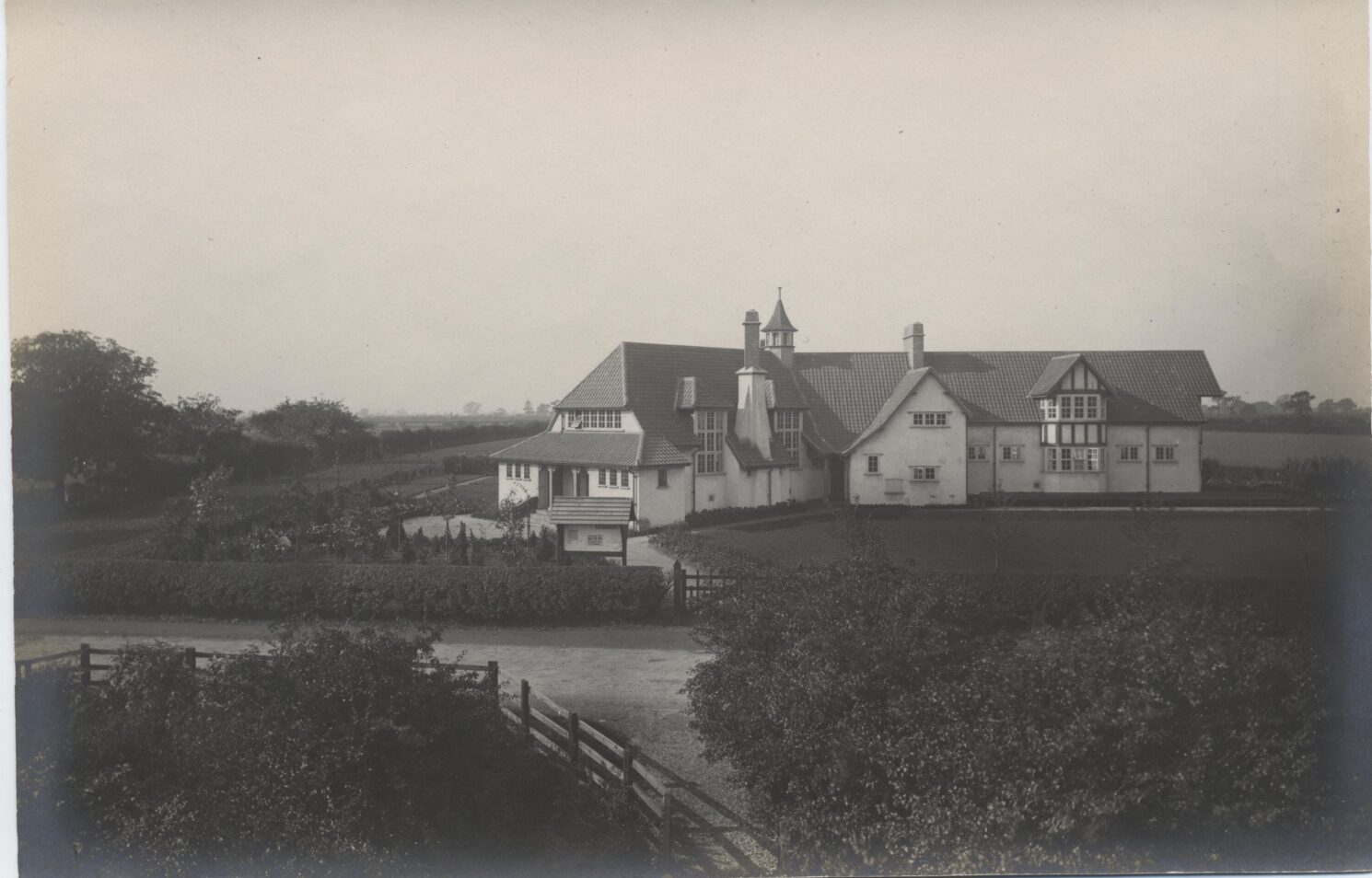
New Earswick Folk Hall, 1907
From originals held at the Borthwick Institute for Archives.
Gulielma – or Gulie – Harlock was born in 1863. Following five years as a boarder at the Quaker Ackworth School in West Yorkshire, she moved to the West Midlands. By 1891 she was governess for the industrialist Frederic Impey’s family. Impey was a Liberal leader, progressive industrial thinker, and a fellow Quaker. Gulielma’s role went beyond looking after the family’s children. She became a member of several welfare and recreation committees at Impey’s new factory, including the entertainments committee. At the time the firm were planning and constructing their first purpose-built entertainment hall to stage staff concerts and performances. Gulielma’s involvement gave her useful experience that she would draw and build on later in her career at York.
Working at Impey’s offers us a characteristic snapshot of Gulie Harlock’s life. She had an extraordinary ability and desire to spin many, many plates at the same time. In December 1896, she qualified as an Inspector of Nuisances (a term for the new profession of public health inspectors) at Bedford College for Women. She went on to do East End settlement work in London’s slums, and to lecture on public health at schools for Worcestershire Health Society. In 1901 we find the first references to her working in York, as a Private Secretary for Seebohm Rowntree. It is important to recognise that by the time she arrived she was a well-qualified, professional woman who brought specialist skills, training, education, and wide experiences to her new role. These were skills that she was to diversify and develop over the next eighteen years in the city, and that were to benefit the Rowntrees’ activities hugely. Gulie Harlock was to become a key employee, close friend, and confidante of the family.
During Harlock’s first months in York Seebohm Rowntree was engaged in writing Poverty: A Study of Town Life (1901). As his assistant, Gulie brought a wealth of academic and practical training to the project. She had direct experience of dealing with the complexities of understanding human beings and their problems. Crucially, she was also trained in conducting and recording the interviews that Rowntree’s work depended on. The significance of her contribution was acknowledged by Seebohm Rowntree in the book’s introduction. Poverty’s publication led to a series of country-wide public-speaking engagements for Harlock. Reports of these tell us she was confident on stage in front of large audiences, and that she skilfully communicated the research and its outcomes to rooms of people that numbered up to three hundred. She also published her own writing on social work and public health. In 1902 she had given a talk entitled ‘Preparation for Effectual Work’ at the Quaker Society of Friends Women’s Yearly Meeting, which was later published as an article for The Friends Quarterly Examiner. It opened with a call for the professionalisation of social work, in which Harlock told her readers that ‘it is now well recognised that to make a useful social worker training as well as gifts is necessary’. That ‘the time-honoured philanthropy of our grandparents has given way to the science of social work, and surely it is the highest science, as it deals with complex human beings’.[2] In her work with Rowntree, her public appearances, and her writing, Gulielma Harlock confidently asserted herself as a representative of a new social science and profession. As an expert in her field.
Private Secretary and Jack of all Trades
During the first two decades of the twentieth century Gulielma continued to take public speaking engagements, conduct research for Seebohm Rowntree and others, undertake charity work, and estate manage New Earswick village. In 1909 the government’s Poor Law Commission report was published. Harlock was one of the professional investigators commissioned by Beatrice and Sidney Webb, and the named author of one of its reports. At the same time she was hard at work at New Earswick, Rowntree’s housing community project that she had run since its inception in 1902. Correspondence and business records held in the Rowntree Family Archive at the Borthwick Institute (University of York), reveal that she was involved in financial and practical planning, calculating rents and planning both housing and public buildings.[3] Harlock oversaw the village and its residents, developed recreational, public spaces, and ensured provision for village theatre.
One key part of this role was her oversight of the development and building of the Folk Hall in 1907: a new multiuse space that was designed to house a range of community events and pastimes, including village stage productions. The importance of staging theatre at the hall is clear from the design of the building. As part of her research, Gulielma had sought advice from her peers, writing to Roger Clark of Clark’s – the shoe-making firm based in Somerset. Clark’s was another Quaker-guided firm, but one remained antitheatrical and still did ‘not allow theatricals’ in their hall. The Folk Hall at New Earswick doubtless benefitted from Clark’s advice in his four-page reply, but it had one distinct difference. The Folk Hall had a large stage, stage curtains, stage trap, and dressing rooms. It was equipped for fully staged theatre, and this was a feature that was foregrounded and celebrated in the newspaper coverage that surrounded the opening event. Village council minutes from the years following its opening reveal that both the scale and regularity of theatrical production increased over the following years, with the new space both enabling and endorsing theatre as a pastime.
Folk Hall Plan (Stage Area), 1934
Ref: JRF/4/1/12/1/7: From originals held at the Borthwick Institute for Archives
By the second decade of the twentieth century Gulie Harlock was very much the public face and professional representative of New Earswick. Henry Aldridge’s manual for town planners, published in 1916 recorded that, ‘the work of administration at New Earswick is in the hands of Miss Harlock, whose sound common sense has found expression in many interesting experiments in the designs of the houses and the distribution of the internal space’.[4] A Sheffield Daily Telegraph reporter who met her on a tour of the village described ‘a very capable lady, who knows all there is to no about village communities and who is an enthusiast on her subject’.[5] The memories of Celia Willey, whose husband worked at the Rowntree’s factory, and who lived at 19 Sycamore Road in the village for 55 years offer us a little more of an idea about Gulielma Harlock’s character. Celia recalled approaching her to apply for housing, and her 9am Monday morning rent-collecting visits when she would look around ‘quick’ and ‘birdlike’ to make sure there were ‘no nails in walls’![6]
Gulielma Harlock’s self-written entry in the 1911 census describes her occupation as ‘Private Secretary and Jack of all Trades’, employed at Rowntree’s Earswick estate. It is very clear that this confidently asserted statement of professional identity was no exaggeration. Gulie was a professionally trained health inspector, skilled in early sociological research methods, author of an expert study for a government paper, public speaker, author, and a respected, authoritative figure in the worlds of housing reform and estate management. She retired in 1918, an event marked by the presentation of a beautiful album of photographs from her friends in the village and the trust that ran it. After finishing work, she returned to her family home in Finedon, where she died in 1941. Her ashes lie in an unmarked plot in the village’s Quaker burial ground.
Photo Album dedication: (New Earswick) Photograph Album Presented to Guiliemia Harlock from friends at New Earswick in remembrance, 1902-1918
Y914.2846: Reproduced from an original held by City of York Council/Explore Libraries and Archives Mutual, York
Gulielma Harlock’s fascinating history lay – in many ways – behind the scenes. For a woman whose working life spanned so many professional areas, led her to encounters with so many groups and individuals, and placed her in public roles as estate manager and public speaker, she is largely absent from the record. To date, I have been unable to find a clearly identifiable photograph of her. Her importance to the history of New Earswick and to women’s leadership roles in industrial culture remind us that the stories we have told, been told, or can easily uncover, are never the full picture of history.
Catherine Hindson Biography
Catherine Hindson is Professor of Theatre History at the University of Bristol and a Fellow of the Royal Historical Society. Her research focuses on how theatre helps us understand societies past, and incorporates topics including celebrity, heritage, ghosts, and well-being. She is the author of three books, Theatre in the Chocolate Factory: Performance at Cadbury’s Bournville, 1900-1935 (2023), Female Performance Practices on the fin-de-siècle stages of London and Paris (2007), and London’s West End Actresses and the Origins of Celebrity Culture, 1880-1920 (2016). She is currently working on women leaders in early twentieth century industry and their connections with arts and creativity, and with the Rowntree Society, Port Sunlight Village Trust, and Unilever archives to share her research with wider communities.
Brynhild Benson: Star of the Cocoa Works Stage
This blog post has been researched and written by Catherine Hindson, Professor of Theatre History at the University of Bristol and a Fellow of the Royal Historical Society. Her research focuses on how theatre helps us understand societies past, and incorporates topics including celebrity, heritage, ghosts, and well-being.
Histories of Britain’s early twentieth-century industrial landscape regularly position a group of benevolent, male factory leaders centre stage. The familiar family names of Cadbury, Rowntree, Lever, Hartley, Clarks shape our ideas about this heyday of British manufacturing. Without doubt these figures created, borrowed, and put in place progressive approaches to workplace recreation, education, and wellbeing. There are, however, other stories to be told, and amongst them are the stories of the women who shaped turn-of-the-century British industry.
Non-conformist beliefs – in particular the religiously-grounded business ethics adhered to by the Quaker Society of Friends – were a common factor amongst these new approaches to business, with the cocoa and chocolate makers Rowntree’s of York and Cadbury’s of Birmingham guiding the way. A second common factor can be discovered in the significant number of senior-level women who worked at the heart of Quaker-led companies. The stories of these employees – stories clearly visible in business records and factory publications (including works magazines) – have remained largely untold. We have much to learn about the role of women in industry leadership.
Quaker organisations shared a commitment to gender equality that was significantly greater than that of the wider world of work. While turn-of-the-century organisations have been both praised and critiqued for their paternalistic policies and structures, women regularly held responsibility for shaping and delivering factory culture, recreation, and education. It was their familiar presences that often represented day-to-day factory life and the sporting, learning and cultural opportunities it offered.
All who know Miss Benson (and who doesn’t)[1]
Brynhild Lucy Benson (1888-1974) was employed by Rowntree’s in November 1911; hired as a gymnastics instructor and based in the factory’s Social Department. She was the daughter of the well-known actor manager Frank Benson (1858-1939), whose company focused on productions of Shakespeare and who was central to the introduction to state school theatre trips as recognised educational activities. Her mother was Constance Fetherstonhaugh (1864-1946), a successful actress in her own right before marriage who continued to work on stage and screen as a wife and mother.
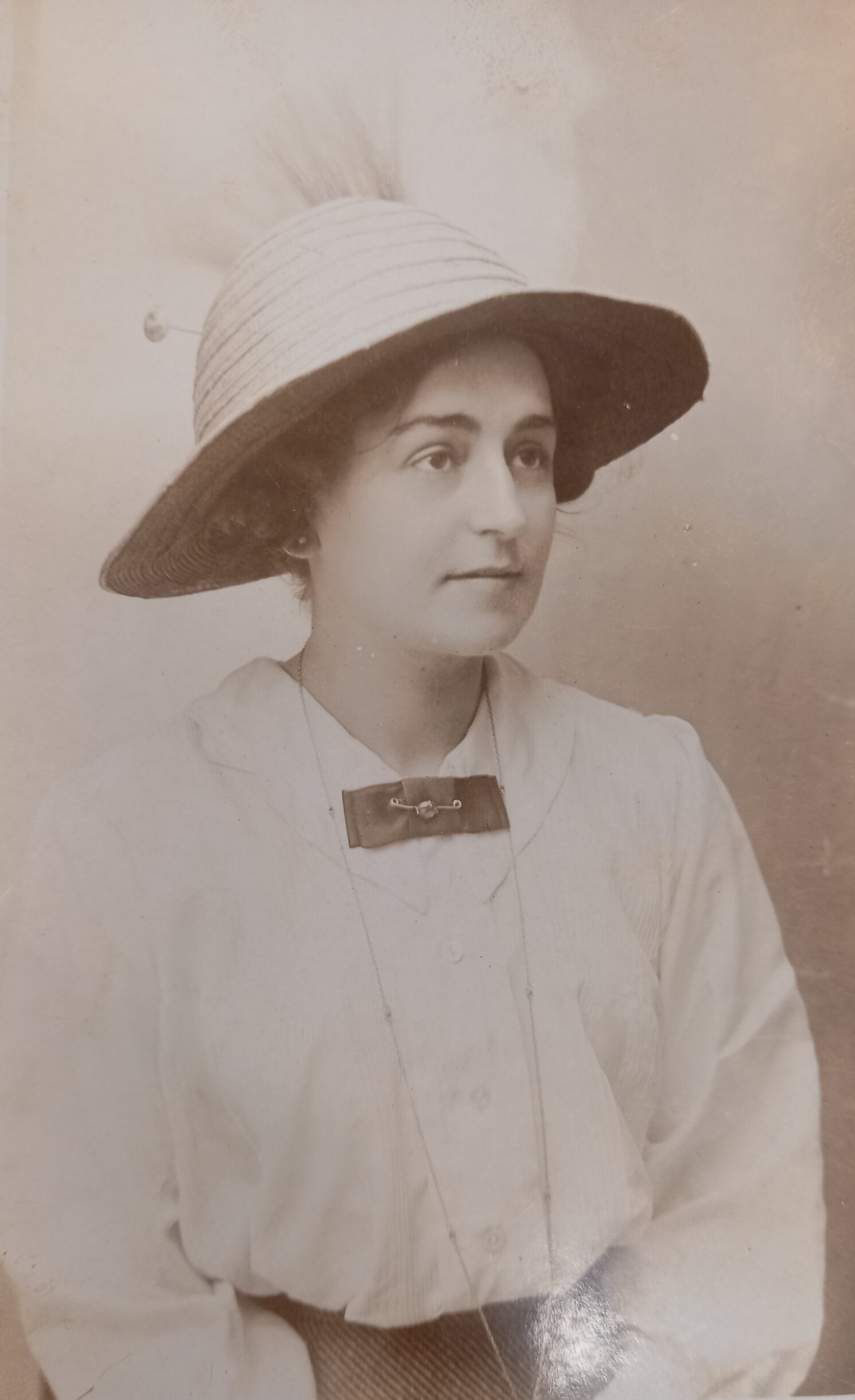
Brynhild Benson
From The University of Bristol Theatre Collection, MM/REF/PE/AC/217.
Frank Benson’s company aligned neatly with developing ideas around theatre, education, and wellbeing at Quaker-led companies. John Gielgud characterised it as ‘a kind of public school company: […] athletics, jokes, and no nonsense’.[2] An unidentified author of a 1958 press clipping remembered him as ‘impenitently what we should today label a “do-gooder”. Pa Benson’. Both Constance and Frank loved sports and exercise, and their two children ‘with their parentage […] quickly had to learn every kind of sport’.[3] Such descriptions and remembrances suggest how Benson’s theatrical company culture sat comfortably with factory culture and with the gradual reduction of anti-theatrical sentiment amongst the Friends that can be traced to the Quaker Renaissance and New Quakerism; shifts that were committed to, and driven in part, by Rowntree.
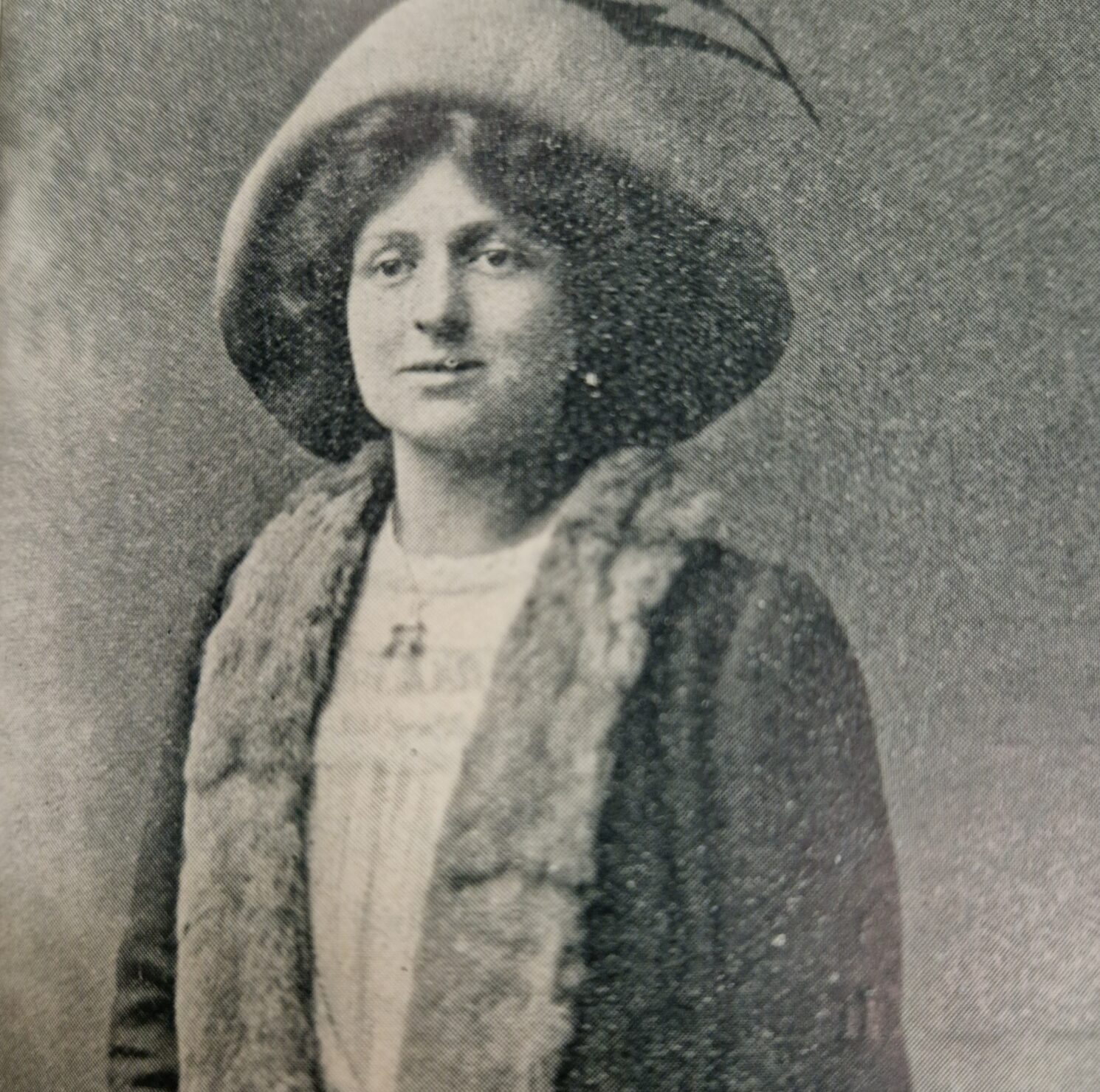
Brynhild Benson
(The Cocoa Works Magazine, 1911)
From originals held at the Borthwick Institute for Archives.
Brynhild Benson’s family connections would no doubt have supported her employment by the company, as would her Quaker heritage. Through her father’s line she was descended from the Rathbone family of Liverpool Quaker merchants, though evidence of key life events indicates that neither Frank nor Brynhild’s generations of the family actively practiced the faith. But nepotism was not a key reason for her employment. Brynhild Benson was more than qualified for the job. Affectionately known as Dick by her friends and family, she had spent little time with her theatrical touring family as a child. Educated at boarding school, she then headed to college at Dartford to train with Martine Bergman-Österberg (1849-1915). A forceful advocate of women’s emancipation in all areas of life, Bergman-Österberg saw her training of gymnastics and physical instructors as a key way to change women’s lives, granting them health, strength and confidence. Graduates of her college were highly sought after by industry leaders of the day.
After successfully completing her Dartford training, Brynhild Benson accepted a job as gymnastics instructor at the Reckitt’s factory in Hull in 1910. The firm produced cleaning and nutritional products, with its best-sellers at the time of Benson’s appointment Robin Starch and Brasso. Established in the 1840s, the company had grown considerably by the time Benson joined them and employed around 5,000 workers at their factory site. Benson stayed for just a year in this first job, but in this short period of time established a successful, growing gymnastics club for women, and led outdoor games, and Morris Dancing classes.
Miss Benson on gymnastics apparatus
With permission from The Österberg Collection
Reckitt’s works magazine published an account of Brynhild Benson’s leaving event that offers engaging details about her personality and her work-style. It records a thank you speech given one of her employees that ended: ‘No ordinary words could express what they felt at losing such a teacher as Miss Benson […] they had all learned to love her as a teacher, and believed she had learned to love them as pupils’. For ‘although Miss Benson had been only such a short time with them, her winning way had gained her the affection of everyone’. Benson’s response to their thanks and affection suggests the community that she created through the activities she led and hints at strong people skills. What she would remember most, she said, was ‘laughter’ and ‘laughter, she thought, was a great bond between people’.[4]
Brynhild left Reckitt’s for a job at Rowntree’s York factory. The culture she found there would have been familiar to her in many ways. Reckitt’s was also a Quaker-led firm; guided by the same tenets of integrity and prioritisation of recreation, welfare, and education as Rowntree’s. Employee numbers were slightly lower at the York cocoa factory at the time, but the firm’s Haxby Road site – opened just five years earlier – was state-of-the-art. Brynhild Benson followed the pattern of Rowntree’s hiring staff educated and trained at leading university colleges.[5] The Social Department might sound incidental to us today, but its staff team sat at the core of the business leading social activities and work at the organisation.
Although she had been hired for her qualifications as a graduate of the country’s leading gymnastics instructors training school, it is perhaps unsurprising, given her heritage, that she quickly became known for her involvement with the factory’s theatre. Reckitt’s had labelled her a ‘versatile instructress’ and we see that versatility throughout her short professional career. In addition to her own performances with the factory’s dramatic society, her contacts came in useful too for the organisation. Her celebrity father paid a visit to the factory in the following year, leading a session at the firm’s boys’ school.[6]
Miss Benson was to quickly become a star of the York cocoa works stage. Her April 1912 performance as Minnie Gilifillian in Arthur Wing Pinero’s three-act domestic comedy Sweet Lavender (a popular choice for dramatic groups across the country) was well-documented by the reviewer from the factory’s Cocoa Works Magazine. The role – the reviewer noted – ‘demands a degree of abandon rarely found in an amateur’, but Miss Benson ‘revelled in the part’. That this revelling also brought some disquiet and criticism from others in the dramatic society and audience is clear in what follows, for ‘we have heard it murmured that the part was overdone [and] at times too much attention was drawn away from the other actors’. Such complaints were met with scant patience by the magazine writer. ‘If that was so’, the reviewer concluded’, then other actors should have infused their parts with a relatively greater intensity’[7]
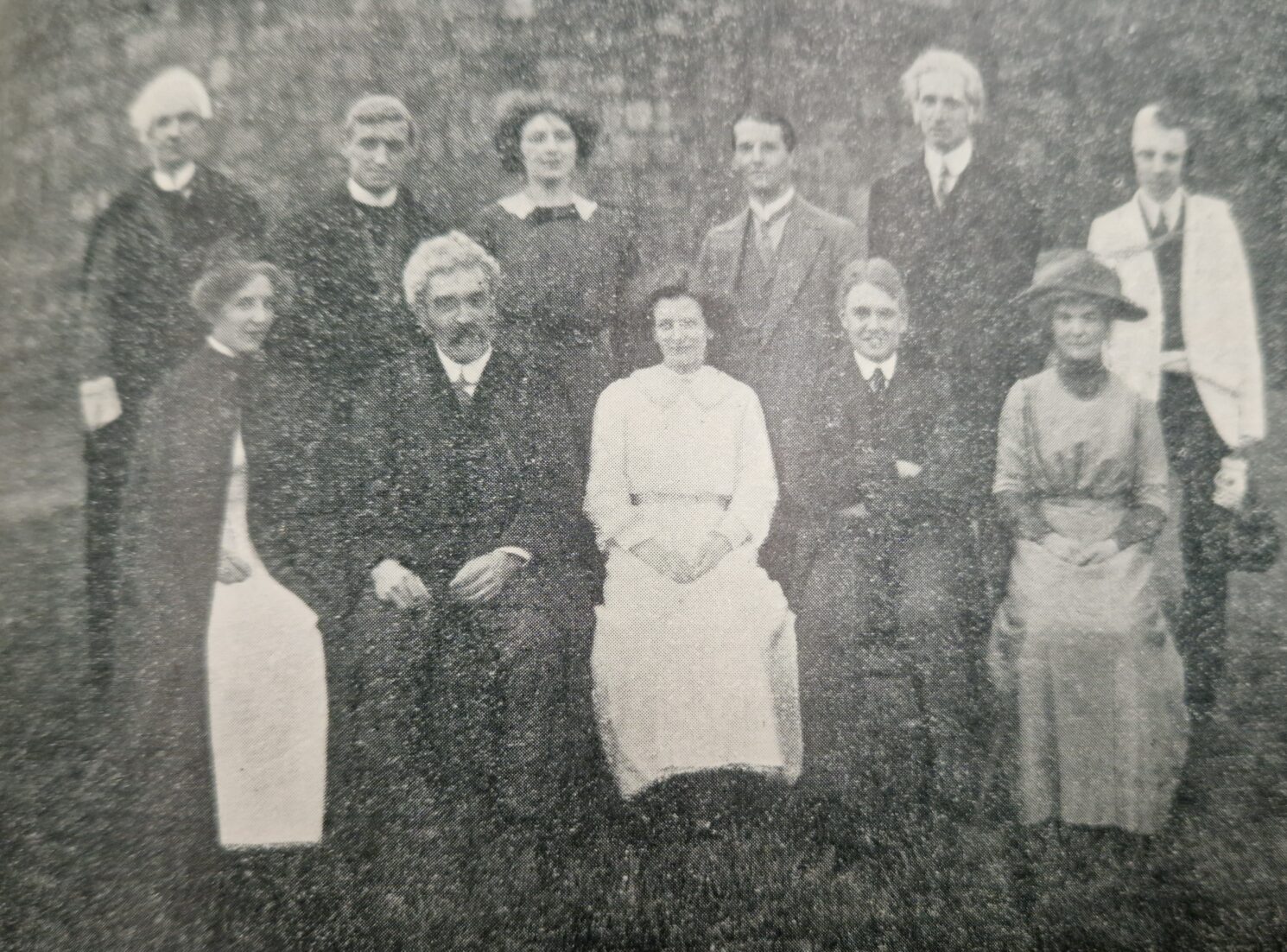
‘Sweet Lavender: Performances by the Works Dramatic Society’
Benson is on the back row, third from the left.
(The Cocoa Works magazine 1912).
From originals held at the Borthwick Institute for Archives.
A 1930 press clipping describes Brynhild Benson’s short industrial career as ‘strenuous social and athletic work among the women of big factories in the North of England’.[8] Ultimately it was to be a small chapter in her life; even in the most progressive of Quaker-led organisations, for women marriage meant resignation. Benson married in June 1917 and her career ended when she left Rowntree’s in May to prepare for her wedding. This was one of a number of limitations present for women staff members at the factory and within wider industry, and not all women’s experiences were the same: ‘class and occupational divides’ offered different levels of access to recreational and educational experiences during the decade that Benson worked at the factory.[9] Despite this, women employees like Brynhild Benson tell us more about the industrial culture of the early twentieth century, In her short time at the Haxby Road factory she modelled the firm’s priorities through both her delivery of physical education classes and societies and through her own active, very visible participation in Rowntree’s recreational schemes through factory theatre. The list of leaving gifts from departments across the factory are testament to the popularity and affection in which she was held.[10] Many other women worked alongside her – including the prominent figure of Miss Gulielma Harlock – who the next blog post on women at Rowntree will feature.
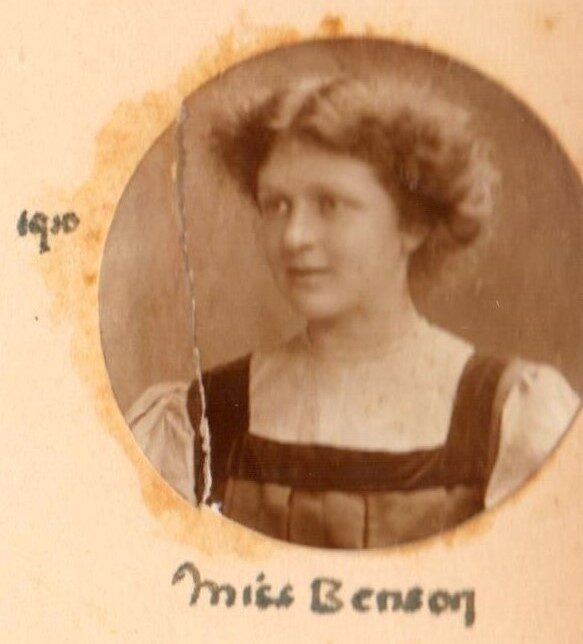
Miss Benson 1910
With permission from The Österberg Collection
Catherine Hindson Biography
Catherine Hindson is Professor of Theatre History at the University of Bristol and a Fellow of the Royal Historical Society. Her research focuses on how theatre helps us understand societies past, and incorporates topics including celebrity, heritage, ghosts, and well-being. She is the author of three books, Theatre in the Chocolate Factory: Performance at Cadbury’s Bournville, 1900-1935 (2023), Female Performance Practices on the fin-de-siècle stages of London and Paris (2007), and London’s West End Actresses and the Origins of Celebrity Culture, 1880-1920 (2016). She is currently working on women leaders in early twentieth century industry and their connections with arts and creativity, and with the Rowntree Society, Port Sunlight Village Trust, and Unilever archives to share her research with wider communities.
Tessa Rowntree, 1909-1999: Caring Humanitarian and ‘Tough Girl’
The Rowntree Society works to build and share knowledge about the Rowntree family, company and Trusts. We are always excited to discover more about family members and are indebted to Richard Essberger, author of the recently published novel ‘All Shall be Well’ for this blog post about Tessa Rowntree – a compelling character who appears briefly in his book – and particularly her work with refugees just prior to the Second World War. The images in this blog post are reproduced with the kind permission of their owners. We also gratefully acknowledge contributions from Tessa’s family to this piece.
Elisabeth Harvey Rowntree – Alison, her daughter, noted: “She was always and only known as Tessa by everyone inside and outside the family. The only time she was ever addressed as Elisabeth that I am aware of was by a doctor in a hospital who read it off her chart, and she didn’t immediately recognize that he was addressing her!” – was born in York. She was the second child and eldest daughter of Arnold Stephenson Rowntree, from Thornton-le-Dale and York, Yorkshire (1872-1951), and Mary Katharine Harvey, (1876-1962). Arnold was a great grandson of the John Rowntree who had founded John Rowntree and Sons, tea and coffee merchants, which later became the confectionery business Rowntree and Co., of which Arnold was a director. He was also Chairman of the North of England Newspaper Co, a director of Westminster Press Provincial Newspapers and, for 10 years, Liberal MP for York.
Tessa attended The Mount School, York, a Quaker school, and later graduated from the London School of Economics, (LSE).
In February 1938 she, with her friend Bridget, was in Germany on a canoeing holiday down the Danube. This was soon transformed into working in Vienna with refugees fleeing from Hitler. They were caught up in the Anschluß – the German invasion of Austria. On one occasion she saw Hitler, finding herself at the far end of a square in which he was speaking. She felt his personal magnetism and, despite ‘his horrid little voice’, she could understand why a lot of people would be swayed by him.
The Friends’ Centre in Vienna was swamped with would-be refugees, many worried about people whom they had not heard from. Tessa and Bridget were asked to see if they could find them and check if they were all right.
Later, when Tessa and Bridget were walking along a street, Goebbels appeared in a car, with people calling “Vielen dank Doktor, Vielen dank…” They thought he was really gruesome.
After a month or so in Vienna she was asked by Emma Cadbury, aunt of her future husband, to go to Prague, where there was no Quaker centre. She went for a fortnight and then wrote a report, noting how the complete calm and confidence in Prague contrasted with the strained atmosphere and mutual distrust in Vienna.
She also toured German parts of Czechoslovakia, making her aware of some anti-Czech feeling. The bridges she went over were all undermined and ready to be blown up at any moment, and she saw plentiful signs of field guns and the Czech army, but her guides seemed to regard it as the army of an occupying power.
In Prague she invited her cousin Jean Rowntree to join her. They worked with Doreen Warriner, Beatrice Wellington – a Canadian – and several other girls in their late 20’s, including Mary Penman, Jean Hoare and Jean Bannister.
When Hitler threatened Czechoslovakia’s Sudetenland the German-speaking supporters of the Social Democratic Party fled in their thousands to Prague, creating an urgent need for food, warm clothes and medical assistance. Tessa visited stranded groups of refugees across the country and local Quakers and international helpers came to their aid.
Whether this story was about Tessa or Jean is unclear, but they were in several respects very much alike, and it demonstrates how they retained their sense of humour under very trying circumstances. One of them said, “I’ve just purchased a thousand men’s undergarments. Now, not many girls can say that, can they!”.
Trains were being organised by Czech military intelligence, Quakers and others to spirit away those Sudetenlanders and anti-Nazi refugees, Czechs, Austrians and Germans, whose lives were threatened by the Gestapo. David Grenfell, a Labour MP representing the party in Prague, suggested that Tessa Rowntree should take one train, saying “she looks a tough girl” (she was also one of the few who held a British passport). The trains had to travel across partially German-occupied Czechoslovakia – which was just waiting to be swallowed up – then across Poland, through the German-occupied city of Danzig, and on to the Polish port of Gdynia, on the Baltic.
From the left: Tessa, Mary Penman and Jean Rowntree, in an apartment rented by Mary for the use of Friends’ workers in 1938 to March 1939. The photo’s exact date is unknown.
Tessa accompanied at least two of these trains and, on one night train, the Polish guard locked her in the guard’s van on her own for her own safety, while the already frightened refugees were crowded into other carriages. The journeys were fraught with difficulties, Tessa and Jean learning how to bribe Polish officials with old stamps to let them go through. With one train running very late, near-panic set in among the refugees. Tessa was so thankful when, in the harbour at Gdynia, the last refugee set foot on board. She herself, as she put it in a letter, “returned to the 4,298 still trapped in Prague”.
In the last months, as war drew near to those in Prague, refugees and their helpers seemed to lead double lives, with tension and panic amongst those trapped by the Nazi invaders and the helpers feeling frustrated by their own inability to find solutions. On the very day in March 1939 that the German troops marched into Prague, Tessa finally returned to England, escorting a party of 66 children on the last Kindertransport train. They all had permission to pass through Germany to England, but some had no travel papers.
Back in England Tessa worked for the British Friends’ relief effort, co-founded the women’s section of the Friends Ambulance Unit and was involved in resettlement issues, including helping evacuate women from London’s East End to Cambridgeshire.
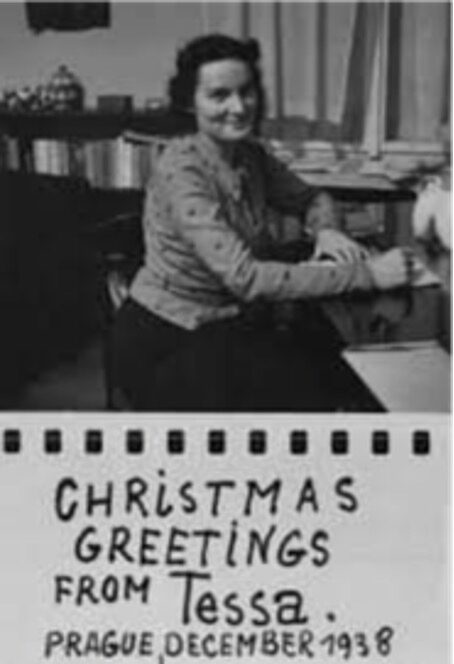
Christmas greetings, 1938
She soon met John Warder Cadbury, a Quaker of Moorestown, New Jersey, who was working at the American Friends Service Committee in 37 Gordon Square, doing similar relief work among the homeless from bombings, evacuated city children and refugees. In August 1942 they married, ‘very quietly’, at the Friends Meeting House, Kirkbymoorside, Yorkshire.
They continued to work for Quaker causes until, in January 1946, they secured passage on a Liberty ship across the North Atlantic to start their new life in America, briefly living with his parents in Moorestown, then at Spung Hollow, near New Lisbon, New Jersey for over 40 years. Their daughter, Alison Harvey Cadbury, was born there on 9 February 1949. For the next 20 years Tessa had a job as a librarian at the Moorestown Free Library. Her love of books and learning lasted into retirement, and in her 70’s she was a straight ‘A’ student at Burlington County College, taking whatever course interested her. She continued to do independent research in areas of interest until her death.
Tessa, with her husband Jack, were dedicated, highly knowledgeable and widely-travelled bird watchers.
Jack passed away on 13 February 1989. Ten years later, on 30 September 1999, Tessa died peacefully at home, aged 90.
Michael Rowntree: Birdwatching from Pembrokeshire to Palestine
The Rowntree Society is committed to offering opportunities for education and skills development, and we recently welcomed two passionate and talented interns to our team. Suzannah explored aspects of Jean Rowntree’s life, and Sacha investigated areas of Michael Rowntree’s life. Check out our Instagram and Twitter to see the campaigns. Below you can read Sacha’s blog post to see what he found.
Over the past four weeks, I have been researching the life of Michael Rowntree (1919-2007). One of Arnold and May Rowntree’s six children, Michael (pictured as a young man) was born into a Quaker family. The importance of public service, social justice and peace were therefore instilled into him from an early age. During World War Two, he was a conscientious objector, and served in the Friends’ Ambulance Unit (FAU) in Finland, the Middle East and Germany. Michael is most well-known for his work for Oxfam, where he served on the Executive Committee from 1952 right until the end of his life.
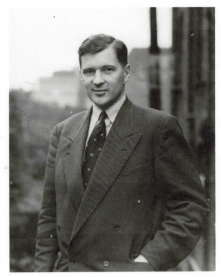
However, my research focused not on Michael’s professional life but rather his lifelong personal passion: birdwatching. I relied predominantly on the Rowntree Archives in the Borthwick Institute for Archives in York; there I found two whole cardboard boxes filled with birdwatching records which Michael kept throughout his life. These records provide a glimpse into Michael’s deep appreciation of the beauty of the world around him.
At first, I was surprised by the fact that the vast majority of records that Michael Rowntree left behind were to do with birdwatching. These stretch from 1929 up until the last years of Michael’s life. Indeed, in the Borthwick, apart from several school letters, Michael’s careful birdwatching descriptions, tables and accounts remain the only records of his life written by Michael himself. I was curious to understand more, and why birdwatching clearly meant so much to him.
The first hint of Michael’s fascination with birds are five double-sided, A5 pieces of paper, dating from the Spring of 1929. These are detailed bird watching records, which Michael wrote on holiday with his family in Palestine when he was just 10 years old. The care with which they were written is immediately evident: for instance, take the key Michael uses to note down where he spotted each species of bird, or the way he divides species into categories of ‘residents’; ‘common residents not seen’; ‘winter visitors’; ‘common winter visitors not seen’; ‘migrants’ and ‘common migrants not seen’. In total, he lists 104 birds in this way. Whilst these papers only feature tables and lists, a sense of the person behind them really shines through: a bright, conscientious, observant child taking pleasure in the beauty of the world around him.
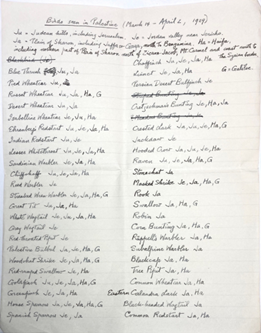
Michael’s birdwatching records in Palestine page 1
Without a doubt, the most impressive and alluring of Michael’s birdwatching records is also the next chronologically: the diary he kept of his trips to the Farne Islands (off the coast of Northumberland) in 1934 and Skokholm (an island of the coast of Pembrokeshire) in 1935 when he was 15 and 16 respectively. The journal is the only record which is not a table or list but instead a story in which Michael’s voice can be heard. Also of interest are the photos of birds and landscapes which Michael glued into the journal. These demonstrate the rigour with which Michael recorded his trips. (The one below shows Michael ringing a puffin with his father in the Farne Islands)
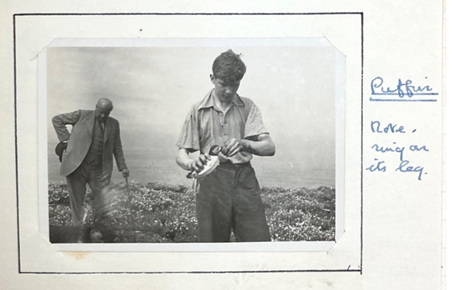
The journal is split into two halves for his two different trips and what is immediately striking is the extremely informative descriptions of the two places Michael visited:
“The Farne Islands are a cluster of some fifteen small, rocky islets, mostly of basalt, lying off the coast of Northumberland, the nearest of which is about two miles from the shore + the farthest about five. In this limited area we observed seventeen different species of bird” (p.3)
“Skokholm is an island of about 250 acres situated about 2 miles from the Pembrokeshire coast Between St Brides Bay and the entrance to Milford Haven. With its neighbouring islands of Skamer, Ramsey + Grassholm, it has acted as a remarkably fine bird island as besides its resident population of sea birds, it lies right in the track of autumn + spring migrants” (p.73)
It is characteristic of his writing that Michael narrates the natural history before describing the nature of his visit. Careful reading is required to discern that, while his trip to the Farne Islands was something of a family holiday, Skokholm was a school trip with some friends from the ornithological society, where they set out to build a trap to study birds. This impersonal tone, whilst it provides insight into Michael’s character as a clearly very mature teenager, serves as a frustrating barrier between the journal and his thoughts at the time. There are several moments where Michael allows us such a glimpse, however. For instance, the description of the rock formations in the Farne Islands known as the pinnacles demonstrates his awe:
“Further on we caught our first glimpse of the pinnacles – a marvellous sight. The pinnacles are a group of sheer basalt rocks as seen in the photo. The rocks are crowded with guillemots in great profusion […] Every moment birds dropped down to the sea to pick up a fish + fly back again.” (p.25)
On Skokholm, Michael’s main task was the construction of a heligoland trap. This large, building-sized, funnel-shaped, structure of netting is used to trap and study birds. It took a week for Michael and his friends to build. Having spent eleven pages detailing the stages of the trap’s construction, including a helpful diagram (pictured), the pride with which Michael describes its completion is evident:
“When the trap was finished we had a grand ceremonial opening since Bootham School had the honour of declaring open the largest Bird Ringing Heligoland Trap in the British Isles” (p.105)
The trap then caught 60 birds over 3 days (two are pictured below). Michael’s pictures of the birds he caught give more of a sense of pride in his work and appreciation of beauty. Overall, the photos in this journal provide an excellent reminder that this was a journal that Michael consciously and carefully crafted. Indeed, the journal would later win him his school’s natural history prize.
Unfortunately, after these two trips, Michael’s birdwatching records are never again as detailed. Michael kept various lists and tables up until his death. These include birds he saw around York in the 1930s, birds he saw whilst working for the Friends Ambulance Unit during World War Two, various records he kept whilst working for Oxfam, and records of birds seen in his Yorkshire garden from the 1990s. One document that Michael evidently wrote in the last few years of his life lists the 1500+ different species of birds which he saw in his lifetime.
This astonishing document (page 1 of 40 is pictured below) would have been one soaked in nostalgia and memory for Michael. Indeed, all these records must have had sentimental value to Michael, as he kept some of them for over 80 years.
After delving into the birdwatching records above, I wanted to get more of a sense of Michael Rowntree as a person. My research led me down 2 different paths: an exploration of his childhood, and a deep dive into his experiences in the Friends Ambulance Unit during the World War Two.
Firstly, at the Borthwick were a collection of letters from 1930-32 written by Michael and his younger brother Richard during their time at Earnseat School at Arnside, in the North of Cumbria. They reveal Michael to be a dutiful son who wrote frequently to his parents, describing grades, interesting outings and football matches. Secondly, York Explore Archives holds records of the magazine of Bootham School in York, which Michael attended afterwards from 1932-6. The school’s natural history prizes, recorded in the magazine each year, provided another perspective. Michael and his friends Geoffrey Appleyard and Archie Willis began a bird-ringing operation at the school’s Ornithological Society, which, in Michael’s final two years of school netted 2000 birds per year and earned them a special commendation from the judges. Michael writes a report on it in 1936 with obvious pride:
“We are now one of the leading trapping stations in the country, and have had birds recovered in Britain at places from Fife to Penzance, and several places abroad”
Michael’s time in the FAU left little archival record in the Borthwick. Three short letters focusing on Michael’s time in North Africa in 1942-3, where he commanded a unit attached to Hadfield Spear’s hospital, were the only physical traces of Michael’s wartime experience. These letters paint a uniform picture of Michael’s character: he was above all a skilled leader, who naturally garnered support and affection from those he commanded. One of the documents references a book written by the head of Hadfield Spear’s hospital. Also of note is the oral history given by Michael, held at the Imperial War Museum. These sources piqued my interest but were unfortunately beyond the scope of the project. Overall, it seems that much of Michael’s time in the FAU will remain a mystery for now, but further research into this topic would certainly be illuminating.
The only other reference to Michael’s time in the FAU are the dozens of letters written to him by his mother Mary from 1940 to 1942. Whilst they unfortunately provide almost no information as to Michael’s experience of the war, they paint a fascinating picture of World War Two, the horrors of the blitz, and the continued importance of the Rowntree family to city life in York during this period. This was not the focus of my project, but again, the opportunity to do more research would be most welcome.
Nonetheless, the letters from Mary do provide a small insight into the nature of Michael’s upbringing. I found this quote, describing a countryside hike, written by Mary on the 25th June 1941, extremely powerful:
“This certainly is the most beautiful district to live in and it was so peaceful up there on the hill side; it seemed as though the horror in the world must be a bad dream and that we should soon wake up and be able once more to rejoice in God’s lovely world and in his overwhelming generosity in his gifts of nature.”
Clearly, Michael was taught to appreciate the natural beauty of the world around him, even (and perhaps especially) in the darkest of times. Indeed, after World War Two, he maintained that it was keeping up bird watching that kept the horrors of war at bay. Michael’s birdwatching records in the Borthwick do indeed confirm he kept up his hobby during the war in North Africa. In fact, during the war, Michael’s birdwatching played a more immediate role in his well-being. For, whilst driving to a trench in Libya, he stopped to observe a mourning wheatear. When he arrived he found the slit-trench had been destroyed by shellfire.
It was this last foray into Michael’s time at the FAU that helped me draw meaning from Michael’s lifelong passion for birdwatching. There are two main themes I wish to highlight, so as to relate Michael’s passion to issues we face today. The first is the danger that humans pose to the natural environment, and the second is the importance of nature to our mental wellbeing.
To start with the most obvious: it is unlikely future generations will be able to enjoy the variety and number of birds that Michael did. A combination of climate change and habitat loss mean that half of the world’s bird population is in decline, according to the ‘State of the World’s Birds’ Report from last year. Sadly, Britain is little different. Of the 628 different species of British birds, over 70 are now on the RSPB’s red list, the highest level of concern, and 103 are on the amber list, a moderate level of concern. And both lists are increasing. This is not a new problem; indeed Michael’s diary from the Farne Islands bears witness to how human activity can harm local wildlife. He recounts:
“Unfortunately, there had been, the day before, a representative of the ministry of agriculture and fisheries who had gone round systematically throwing nests + young (cormorants) into the sea.”
There is no doubt that we will have to work hard to protect our wildlife. But it will be worth it. For, quite simply, nature makes us feel good. During the pandemic, two-thirds of British people surveyed reported that they found solace in the sight or song of a bird. This is unsurprising, for there is every piece of evidence to suggest that the more often we interact with nature, the happier we become. Indeed, a study published in the academic journal Ecological Economics in 2012 managed to put a price on this happiness. Using data on the satisfaction of 26,000 European adults, they found that being near fourteen additional bird species provided happiness equivalent to an additional income of $150 per month. The “gifts of nature” which Mary Rowntree described are certainly invaluable. Let’s conserve and treasure them.
For those interested in birdwatching, this is a great place to start.
Or for those who want to help birds, visit the RSPB’s page here.
Bibliography
- Borthwick Institute for Archives
- RFAM/MR/PD/1
- RFAM/MR/RS/2/2
- RFAM/MR/JRF/1
- RFAM/RSR/PD/1/1/3
- York Explore Archives
- BOO/1/16
- BOO/1/17
- BOO/1/18
- Imperial War Museum: Oral History of Michael Rowntree
- Unpublished Biography by Sarah Sheils
- Birdwatching Statistics
- Photographs (in order)
-
- Unknown source. Please contact us if this image is yours.
- Reproduced with Permission from the Borthwick Institute for Archives RFAM/MR/PD/1/14 p.1
- Reproduced with Permission from the Borthwick Institute for Archives RFAM/MR/PD/1/3 p.47
- Reproduced with Permission of Borthwick Institute for Archives RFAM/MR/PD/1/3 p.25
- Reproduced with Permission of Borthwick Institute for Archives RFAM/MR/PD/1/3 p.89
- Reproduced with Permission of Borthwick Institute for Archives RFAM/MR/PD/1/3 p.113
- Reproduced with Permission of Borthwick Institute for Archives RFAM/MR/PD/1/3 p.117
- Reproduced with Permission of Borthwick Institute for Archives RFAM/MR/PD/1/1 p.1
Jean Rowntree’s Travel Diaries
The Rowntree Society is committed to providing opportunities for education and skills development, and we recently welcomed two passionate and talented interns to our team. Suzannah explored aspects of Jean Rowntree’s life, and Sacha investigated areas of Michael Rowntree’s life. Check out our Instagram and Twitter to see the campaigns. Below you can read Suzannah’s blog post to see what she found.
“My brief for the internship was to create an Instagram campaign by researching the extensive travels from Jamaica to America that Jean Rowntree took in 1920. Jean Rowntree was a fascinating woman: she helped Czech refugees escape the Sudetenland during the Second World War. In later life, she was also instrumental at the BBC and helped to develop broadcasting to assist adult education. I have enjoyed discovering more about her travels and the experiences she had at a key point in history. For example, Jean’s experience of being on set in a Hollywood film studio captures the beginning of the mainstream film industry in California that we know today.
One of the most exciting parts of the internship was being able to go into the Borthwick Institute for Archives to read Jean Rowntree’s travel journals. I found interacting with the physical journals completely engrossing, as the descriptions of Jamaica and America were vivid and gave me further insight into Jean’s personality. Before researching the social and historical context of the time, I read through the journals and took pictures as I went along. This process worked well before planning the posts because I could go back to parts that I could research further. Once I had read the journals, I decided to centre the campaign around the Rowntree family’s love of travel, as their Quaker heritage and position in society enabled travel to be a large part of their lives.
This is a photograph of a drawing Jean did of flowers in Jamaica. I included this in the Jamaica post because of its eye-catching colours.
Alongside reading the journals, my research consisted of using Google’s ‘My Maps’ to plot the journey Jean took. This helped to visualise the large distances covered by boat and train. Jean’s experience of travelling by boat and the large amount of time it took was a key difference to travelling today, as the modes of transport were not as quick as modern methods. For the Instagram posts, I decided to include sections of the map so viewers can see exactly where they went for each leg of their journey. Creating the map was useful when I researched The Sunset Route, a railroad that goes from New Orleans to Los Angeles, because I could make sure the map was correct by referring to old railroad maps. I particularly enjoyed researching if locations that were mentioned in the journals still existed, such as the Hotel Green (now the Castle Green) in California; it meant that I could compare any changes over time.
This is part of the Introductory post: the Google Map contains many locations mentioned in the journals. It starts from Scarborough, includes Jamaica and America, and ends in The Isle of Wight.
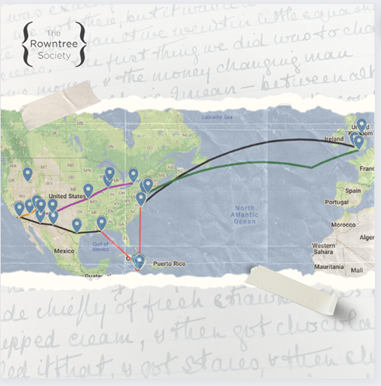
One challenge I faced was selecting the content for the posts because all the entries contained unique insights into travel in the 1920s. To help me select the entries I wanted to post, I narrowed them down by location and how much of the individual entry Jean designated to a place. For example, New Orleans has a post because Jean recounted an unusual St Louis cemetery trip and included what a sexton said to them. I thought that the verbatim inclusion of what the sexton said would make the post more absorbing, and that part of history tangible. Well-explained details such as these helped me to gain a sense of Jean’s personality and opinions of the places and people she interacted with. The journal entries about America were fascinating as Jean visited it when it was becoming an established superpower and at a time of technological change. While in America, Jean visited many beautiful places, such as the Grand Canyon. I found her description to be timeless, as I visited it myself and had a very similar experience.
After spending time on the research process, I began drafting the posts on Canva, an image and video editing programme. It was a useful software to learn how to use because it had an Instagram post template to which I uploaded the journal photos. Due to my research being guided by how many journal pages Jean allocated the locations, it enabled me to already have an idea of what to draft. I enjoyed this process very much because it gave me the opportunity to learn how to use an editing programme to design the posts. At first this was a challenge, but I feel that using this has been the best way to present Jean’s journey in an accessible way. For example, I planned to do a post on the growth of the American automobile industry compared to England in 1920. I decided against this and included it in the post about New York, where traffic continues to be a major problem.
In my free time, I enjoy using Instagram and find that having a mixed post format is an effective method to engage people. For the campaign I created two reels, which are short videos with captions and effects. Using this format means that it is possible to have more information in one place. A particular highlight when drafting the campaign was being able to demonstrate the postcards that Jean collected alongside the relevant journal entry because the art style brought the locations to life. As a result of my research, I created ten posts that encompass the journey Jean made that use the location as the focal point to explore the historical and social context of the time.
The opportunity to learn about Jean Rowntree and the 1920s through the journals has been a fantastic experience. The excellent guidance and assistance available to me has helped to further develop my research and teamwork skills to a point that I feel more confident in my abilities to work to a brief. Interaction with the journals makes it clear that the desire to travel is timeless. Jean travelled to Jamaica and America after the devastating Influenza pandemic following the First World War. Her desire to see a different continent that did not have the physical and mental reminders of war, perhaps is similar to our post-Covid world and the current travel boom. Innovation, whilst respecting tradition, is a key part of The Rowntree Society, and the journals’ self-reflective nature demonstrates this.
Bibliography
LROW/15/7- Picture of flowers in Jamaica
LROW/15/7- Picture of the Google ‘My Map’ of Jean’s journey
Photos reproduced with permission from The Borthwick Institute for Archives.
2. Care and Community: York and the Second Wave
Note: This is the second post in our blog series “Rowntree, York and the 1918 Flu Pandemic”. You can read the first post here and find out more about the series here.
The Second Wave
By the end of July 1918, the influenza virus which had spread throughout York appeared to have subsided. The military authorities gradually lifted restrictions for soldiers in the city, who were allowed to return to theatres, music halls and other places of entertainment. The number of influenza-related deaths fell throughout August and September.[1] But by mid-October, the virus had returned. This was the beginning of the second wave, which would hit the city and the country with redoubled force.
Across York and the towns of the West Riding of Yorkshire – the administrative county which included Sheffield, Wakefield, Bradford, Leeds, Huddersfield among others – 8% of overall deaths from the pandemic had taken place in the first wave, but 65% would occur in the second wave.[1] In York, all schools were gradually closed once again.[2] Cinemas and theatres mostly remained open as they had done during the first wave, but with additional sanitary measures in place. Managers were required to ventilate auditoriums before and after performances and during intervals, supervised by local police and by staff from the Health Department.[3]
Despite these precautions, the city struggled to cope. The month of November 1918 saw the highest number of burials across a prolonged period on record at York Cemetery. 264 people were buried, including 164 whose cause of death was recorded as either influenza or pneumonia, and the local authorities had to seek assistance from the military to help with the digging of graves.[4]
Hospitals Overwhelmed
The numbers of medical staff on the home front were severely depleted by the deployment of doctors and nurses for the war effort, and during the second wave, the city’s health providers were overwhelmed. At York County Hospital on Monkgate, so many nurses were off sick with influenza at the same time that the hospital had to close for two months.[6] The Infirmary at York Workhouse admitted an overflow of patients from the city’s hospitals, and all beds there were full by early November. York Explore holds various records relating to the workhouse and its inhabitants and staff, including for the period of the pandemic. We know that twenty-six patients died there and that some of them were very young.[7]
With bed capacity at maximum and growing numbers of staff becoming infected and incapacitated, York’s Health Committee and hospitals mounted a huge coordinated effort. In late October, The Retreat and York City Asylum both sent nurses to Clifton Hospital, which had 139 patients with influenza and 51 staff who were sick.[8] At the York Fever Hospital near Yearsley Bridge – established in 1880 to manage regular epidemics of infectious diseases in the city – existing patients were transferred elsewhere to make space for an influx of influenza cases. The experiences of one nurse here – Mary Wilson – were captured in an interview conducted with survivors of the pandemic by the journalist Richard Collier. Mary’s memories – preserved at the Imperial War Museum archives in London – would make for fascinating reading when archive visits are possible again.[9]
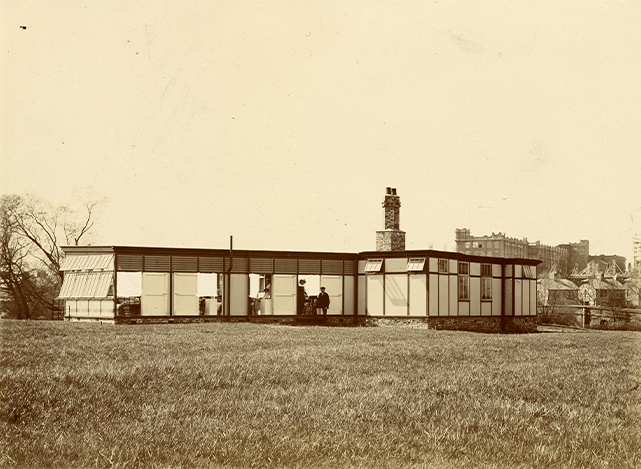
Rear view of an open-air ward at the York Fever Hospital in the 1910s. The Rowntree Cocoa Works factory on Haxby Road can be seen in the distance. Rowntree & Co. donated three wooden shelters for patients in the hospital grounds.[10] Source: City of York Council/Explore York Libraries and Archives Mutual Ltd.
District Nurses and Volunteers
With many of the city’s doctors away on military service and hospitals overrun, residents who fell sick had to seek care in their own homes. In the early twentieth century, those with financial means could pay for a full-time nurse – referred to as a private duty nurse – to live with them until they recovered. A separate system of “district nursing” existed to offer care of the sick poor.
The sociologist Elaine Denny, who has researched the history of nursing in the 19th and 20th centuries, argues that domiciliary nursing – nursing carried out in peoples’ homes – has been “hidden from history”.[11] Various types of archival documents could help to reconstruct this history, but with local records and historic newspapers for York for 1918 and 1919 currently unavailable during the COVID-19 lockdown, we can only wonder what information they might hold about the experiences of ordinary district nurses in York during the outbreak. However, there is one major indication of the scale of their workload during the second wave: the Medical Officer for Health Edmund Smith had to recruit a group of untrained women – including “disengaged midwives and other handy substitutes” [12] – as volunteer domiciliary nurses.
Poverty and Infectious Disease: Influenza in York’s Slums
The majority of influenza deaths during the pandemic in York took place in the home.[13] District and volunteer nurses caring for the poor in the city throughout the second wave would likely have encountered some incredibly difficult scenes. In Leeds, their counterparts reported that in some of the most deprived areas they visited, families were living in cramped conditions, sometimes with only a single bed. One nurse was called to a house where multiple family members were seriously ill and had to take the decision to remove a sick infant from the family’s solitary bed so that the child’s father could die in it.[14]
York too had serious problems with poverty and housing at the time of the outbreak. Throughout the late nineteenth and early twentieth centuries, the Rowntree family had been involved in voluntary welfare activity in the city. This included campaigning for better housing, improved maternity services, and measures against infectious diseases.[15] At the turn of the century, Seebohm Rowntree’s pioneering social study of living conditions in York revealed that almost 28% of the city’s population – over 20,000 people – lived below what he referred to as the “poverty line”.
Seebohm’s report, titled Poverty: A Study of Town Life, identified Walmgate and Hungate as areas of the city where poverty levels were particularly high.[16] Some of the poorest residents were living in tenements, sharing a single water tap in the street and one toilet with multiple other households. Many were unable to afford enough food to meet their nutritional needs. Such insanitary conditions made people vulnerable to outbreaks of infectious disease, and during the second wave of the Spanish flu, seven members of one household in Hungate were recorded as being sick at the same time. Resident Lydia Brown died in October: her two daughters, aged eleven and sixteen, followed her a few days later.[17] In Walmgate, 160 deaths from influenza or pneumonia were officially recorded in the aftermath of the pandemic – a notably high portion of the city’s overall death toll.[18]
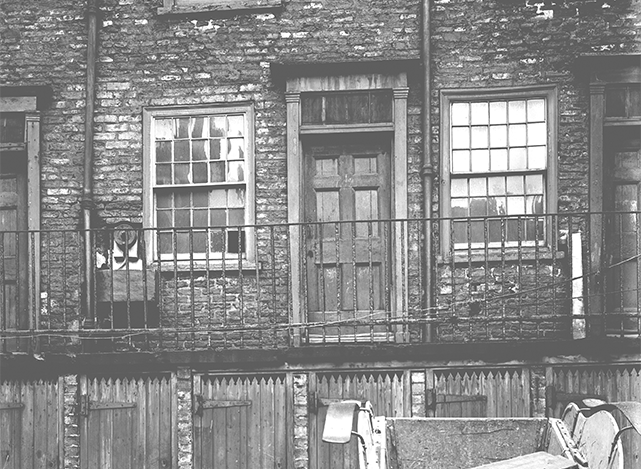
Buildings of Bradley and Co. carriage builders in Hungate, York, 1911. A water pump is visible to the left of the middle door. The row of doors under the gallery were probably outdoor lavatories and coal stores. Source: City of York Council/Explore York Libraries and Archives Mutual Ltd.
Lessons for Today
The medical, civic and philanthropic histories we have explored here feel newly relevant in the context of the COVID-19 pandemic, as national and local authorities draw up responses to the outbreak and health and social care staff work to protect the vulnerable.
The tireless work of medical staff in the 1918 flu pandemic adds additional weight to our renewed sense of the value and risks of care work amidst COVID-19. NHS staff redeployed to COVID care wards at York Hospital echo the journeys taken by midwives and other “hardy” women who volunteered when district nurses were overwhelmed in the Autumn of 1918.
We might note the importance of a strong infrastructure for public health both then and now, at national and local levels. The historian Fred R. Van Hartesveldt has described England’s public health system at national level as being “in disarray” in 1918, and not solely due to the war. He notes that although public health in some areas was well-served, nationally it was “inefficient and uncoordinated.”[19] Therefore, responsibility for public health often lay in the hands of local authorities. Historians have previously identified Manchester as an example of good local practice during the pandemic. Its Medical Officer James Niven is renowned for having saved many lives by adopting social distancing measures and other precautions which went beyond those recommended by the London-based government. Having studied reports from the time, Van Hartesveldt names York as another positive example of a local authority response, citing the rigorous collection of data by the city’s Health Committee and a coordinated effort by medical staff to provide care and comfort to influenza patients.[20]
Another striking parallel between 1918 and the present day is the enduring connection between socio-economic disadvantage and poor health. In the conclusion to his 1901 report, Seebohm Rowntree had recommended that the government introduce measures to protect the very young, the old and the unemployed, who were the groups most likely to fall into poverty. Between 1906 and 1912, Seebohm drew on his expertise and social influence to work with David Lloyd George’s Liberal Government on a number of reforms which laid the foundation for Britain’s welfare state. They included free school meals, sickness and unemployment insurance for working men, and the introduction of state pensions: an unprecedented body of legislation at the time. These were important steps in addressing the stubborn problems of social inequalities in Britain, but they remain pervasive today. For example, recent research from the Office for National Statistics has shown that people in deprived areas are dying from COVID-19 at double the rate of affluent areas.[21]
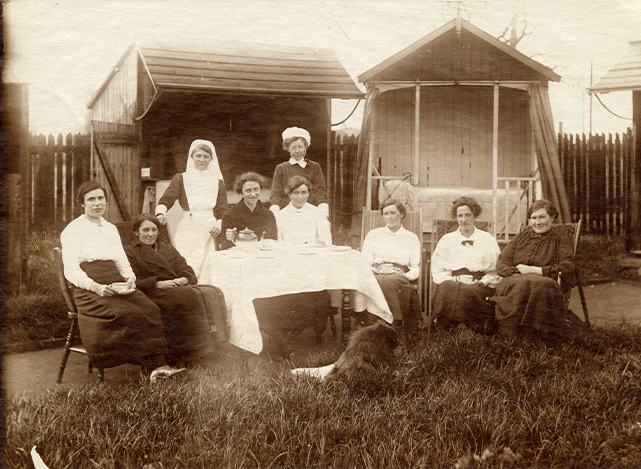
Nurses and patients on the open-air ward of the York Fever Hospital in the 1910s. During the second wave of the influenza outbreak, the hospital moved all existing patients to other facilities and became an influenza hospital. Source: City of York Council/Explore Library and Archives Mutual Ltd.
Nurses and patients on the open-air ward of the York Fever Hospital in the 1910s. During the second wave of the influenza outbreak, the hospital moved all existing patients to other facilities and became an influenza hospital. Source: City of York Council/Explore Library and Archives Mutual Ltd.
Finally, we can also appreciate the strength and compassion of those living York 100 years ago, including within the most deprived communities. In Poverty: A Study of Town Life, Seebohm Rowntree observed the way that those facing hardship in York pulled together. In the slum districts, he noted, “life is lived more in common”:
Families which are, from any cause, in particularly hard straights, are often helped by those in circumstances but little better than their own. There is very much of this mutual helpfulness among the very poor. In cases of illness neighbours will almost always come in and render assistance, by cleaning the house, nursing, and often bringing some little delicacy which they think the patient would ‘fancy.’”[22]
Seventeen years later, the Yorkshire Evening Post noted the same dynamic of care in the community at the height of the second wave of the Spanish flu:
The district nurses can, of course, only pay what may be termed flying visits, and any continuous nursing has to be left to neighbours and friends. Generally speaking, report the nurses, the residents in the poorer neighbourhoods have been real Samaritans to their stricken friends. No thought of a risk of infection has deterred the neighbours from lending a helping hand, and in this way many a silent, unnoticed act of devoted self-sacrifice has been performed.[23]
Over a century later, hundreds of volunteers are working with the City of York Council’s Community Hubs to assist those who are older, who are sick, or who are shielding for medical reasons. The Supper Collective – an award-winning volunteer initiative set up by chefs, independent cafe owners and local residents in York – is cooking nutritious meals and delivering these for free to isolated and vulnerable people and to NHS staff during the COVID-19 outbreak. And the Joseph Rowntree Housing Trust has been working with the Joseph Rowntree Foundation to support older and vulnerable residents in their homes and communities across in York and across the North East. This includes a major staff redeployment programme from across the organisation to support essential services.
As we navigate the challenges of this contemporary pandemic and its consequences, care work and community remain some of our most deeply valuable practices.
We aim to publish a new blog post every fortnight. To be notified when future blog posts are published, you can follow us on Twitter @rowntreesoc, and on our Facebook page.
Rowntree, York, and the 1918 Flu Pandemic: A New Blog Series
How did the 1918 flu pandemic affect the Rowntree family and Rowntree workers? How was the outbreak experienced among vulnerable communities in early 20th century York? What were the responses of Rowntree family members to the crisis as individuals, as employers, and in their roles in civic and public life? And what might the answers to these questions tell us about life with COVID-19, and the world that lies beyond it?
Our new blog series explores these questions and many more, drawing on the experiences and lessons of the 1918 ‘Spanish flu’ to expand understanding of the present-day pandemic. With archives closed as part of lockdown measures in the UK, the blog series is a collaborative effort. Archivists and local historians have helped supply relevant sources, and our volunteers and trustees have also contributed their knowledge. You can read more about how the blog series started and the people involved in our first post via the link below.
You can keep up to date with new posts by following us on Twitter @rowntreesoc and on Facebook.
We’d love to hear what you think. You can get in touch with us via our social media accounts, or via email at info@rowntreesoc.org.uk.
Links
Blog Post 1: A Forgotten History through a Rowntree Lens
Blog Post 2: Care and Community: York and the Second Wave
1. A Forgotten History through a Rowntree Lens
The First Peak
In mid-June 1918, people across the UK began to fall sick. An article in the Yorkshire Evening Post described the signs of their illness for readers fortunate enough to have escaped infection so far:
“Those people who have not yet been affected will be interested to learn that the first symptoms…are an attack of aches and pains all over the body, along with dizziness. Then follow headache, pains in the back, and occasionally sickness, with a feeling of absolute helplessness.”[1]
The disease caused acute suffering. In the most severe cases, the infection led to an immune system response known as heliotrope cyanosis, in which the body turned black or blue as fluid leaked into the lungs and drowned the sufferer. There were also multiple incidences of delirium and psychological disturbances, leading to violence and self-harm.[2]
As the illness spread throughout the population, it disrupted patterns of everyday life which had already been transformed by the turmoil of the First World War. Northern England, with its industrial base and high urban population, was badly stricken. In some streets in Sunderland, every household was affected, and entire families laid up. In Newcastle, police, fire brigade and hospital staff were absent in significant numbers, and in Manchester, more than 200 tramway car drivers and guards went off sick.[3]
In York, all elementary schools were closed in the first week of July and remained closed throughout the whole summer.[4] Independence Day celebrations planned for American troops stationed in the city – including a baseball match, tea at the Assembly Rooms, and a parade – were all cancelled. Cinemas and other places of entertainment were designated as off-limits for soldiers, though they remained open for civilians.[5] Across the city, trained medical staff struggled to meet increased demand for their skills as they contended with an existing national shortage of doctors and nurses. In January 1918, over half of the country’s doctors were on military duty, and of those remaining, nine in York reported at one point that they had visited 6000 cases between them in response to the outbreak. Edmund Smith, the city’s Minister of Health, reported that “the professional nursing staffs of the city and district were absolutely overwhelmed”.[6]
This was the ‘Spanish flu’, so-called because Spain, which remained neutral during the First World War, did not censor news of the epidemic whereas participating nations did. From its origins at a farm in Kansas, USA, the virus spread across the globe, beginning its journey in early March 1918 and ending with the last recorded infection around May 1920. Throughout this period, one in three people on the planet – 500 million – were infected, and one fifth them died.[7] In the UK, a quarter of the British population contracted the virus and one estimate places the national death toll at 228,000.[8] Mortality figures are, however, likely to be underestimates: many deaths will not have been recorded as influenza-related but as pneumonia, tuberculosis, bronchitis or even suicide, all of which were documented secondary complications.[9] The arrival of the virus in England and Wales can be dated around mid-June 1918 and by the end of July, it had diminished. In mid-October, it returned, and this “second peak”, far more deadly than the first, lasted until the end of the year, only to be followed by a third wave between February and May 1919.[10]
Image from the American National Red Cross photograph collection of a woman in the US suffering from influenza during the second wave of the 1918 pandemic. An accompanying note to the photograph says that the Red Cross Home Service was called to the house by the woman’s sister, who had not seen her for a week. The sick woman’s husband was away fighting in France. Source: Library of Congress Prints and Photographic Division.
A Forgotten History
“Don’t talk about influenza. It is already wearing itself out and will go all the sooner if you don’t talk about it. Influenza is a disease that likes to be noticed.”
– From a public information leaflet circulated by a senior London hospital official in 1918[11]
This advice from one senior medical official, circulated in a public information leaflet in 1918, captures one contemporary attitude to the flu. The government was centrally concerned with the war effort, and wartime censorship may played a part in suppressing information about the scale and spread of the epidemic at the time. But the pandemic has also gone relatively unnoticed in the years since. Despite the scale of disruption to everyday life and the massive death toll, it has been largely overlooked by historians and epidemiologists over the last 100 years. As we experience the extraordinary transformations wrought by COVID-19, it’s difficult to imagine that the 1918 pandemic was an unremarkable event for those who experienced it, even amidst the scale of horror and suffering brought about by the First World War. The two events are a century apart, so any comparisons must take into account the many differences between them, but there are also many remarkable parallels.
Why do we know so little about the Spanish flu? A growing number of historians have been exploring the answers to this question in recent decades.[12]
Those of us with an interest in social history might some highlight key factors at play which sound familiar in the context of today’s crisis. People of all social backgrounds were susceptible to the 1918 virus. Yet, there is evidence to suggest that working class communities and those living in poverty were hit particularly hard and their experiences under-documented. In addition, the history of the pandemic is, at least in part, a history of care work, and the history of care work is predominantly the history of another marginalised group: women. “Women were the ones who registered the sights and sounds of the sickroom, who laid out the dead and took in the orphans”, notes historian Laura Spinney.
Spinney also points to the dominance of Western historiography, noting that deaths in Europe and North America were lower than in other areas of the world which were more severely affected.[13] One very early report published by a medical officer of the British Empire in 1920 examined the effects of the virus in the Punjab province of India, and the historian David Killingray has done important research on the effects of the pandemic in Africa and the Caribbean, but there is still much more to explore in this area.[14] We might therefore ask ourselves what social history research with an intersectional approach could reveal about the experiences of the working classes, women, and people of colour in former British colonies during the 1918 pandemic.
The Rowntree Lens
I took up the post of Director of The Rowntree Society in early February this year and over the last few weeks, have began the work of immersing myself in the rich histories and legacies of the Rowntree family, company and charities. The Society exists to facilitate and support activities that engage critically and creatively with these histories through collaborative work with partners in the public sector, education, the voluntary sector and the cultural industries. Our work is driven by our belief in the continuing importance of the Rowntree legacies to the local, national and global challenges facing our contemporary world. As the world entered lockdown, it became clear that the COVID-19 pandemic is not just one of the most pressing of these challenges, but that it has profound implications for the others.
Members of the Rowntree family undertook pioneering work driven by their Quaker values, advocating for equality, democracy and social justice; work which is continued today by the three charitable trusts Joseph Rowntree established in his name in 1904. At The Rowntree Society, we believe that historical perspectives have a distinctive role to play in helping to navigate the current crisis and uncertain future. We share the perspectives of the Social History Society on the distinctive contributions historians can make in navigating the complexities of our situation:
“This is a time of illness, grief, and profound economic and social change.
As historians, we know context is everything. We know that we must analyse the short term in relation to longer term trends.
Much cultural and social history is qualitative in nature, describing and explaining changes and continuities in earlier societies. It complicates our understanding of the past and warns against simplistic comparisons with the future.”[15]
Mindful of historical precedent and the resonance of Rowntree heritage, we have found ourselves wondering: How did the 1918 flu pandemic affect the Rowntree family and Rowntree workers? How was the outbreak experienced among vulnerable communities in early 20th century York – those living in the slums Seebohm Rowntree wrote about in his pioneering survey of poverty published in 1901, and those working on the Rowntree & Co. cocoa estates in the British West Indies? What were the responses of Rowntree family members to the crisis as individuals, as employers, and in their roles in civic and public life? And what might the answers to these questions tell us about life with COVID-19, and the world that lies beyond it?
The fullest answers to these questions lie in the archives. The Borthwick Institute at the University of York is now home to the Rowntree Archives, and an important collection of materials relating to medicine and health in the city. Other relevant records are kept by York Libraries and Archives. Both are currently closed due to the lockdown (though doing some fantastic work around the continuation of their services online). It’s tantalising to have these documents so near and yet so far, and I’ve developed a renewed appreciation for our libraries and archives now that they are temporarily inaccessible.
In the face of these closures, I reached out to the archivists there, together with our volunteers, trustees and local history groups, for help in finding some provisional answers. My original plan was for a single blog post, but the search turned up more information than initially expected. I’ll therefore be sharing thoughts and information on the 1918 pandemic, York, Rowntree’s and COVID-19 in a new blog post series here on our website.
In the meantime, we’d love to hear what you think. You can get in touch with us via email at info@rowntreesoc.org.uk, on Twitter @rowntreesoc, or through our Facebook page.
Acknowledgements
Collating sources for the blog series while libraries and archives are closed has been a collaborative project, with help from the following people:
Anne Grant and Stan Young, The Rowntree Society
Margaret Atherden, PLACE York
Janet Jawando and Dennis Shaw, York Cemetery Genealogy
Dick Hunter, Clements Hall Local History Group
Gary Brannan, Borthwick Institute for Archives
Hannah Mawdsley (@HannahMawdsley)
Julie-Ann Vickers, York Explore
Joseph Oakley