
“Come, Let Us Reason Together”: Trade Unions at Rowntree & Co. in the 1920s Part 2: The 1926 General Strike
This is part 2 of The Rowntree Society’s research into the relationship between the Rowntree family and trade unions in the 1920s. In part 1 we explored Seebohm Rowntree’s approach to industrial relations at Rowntree & Co. You can read it here. This part will examine how the 1926 General Strike impacted Rowntree & Co. as well as Seebohm’s attempts at industrial conciliation in its aftermath.
The General Strike at the Cocoa Works
“Class warfare threatens us today – not because we hate on another, but because we love ourselves – because groups and individuals, bent on their own private ends, forget the common good” – Seebohm Rowntree, 1914[1]
The General Strike which began on 4th May 1926, grew out of a dispute by mining unions who were striking to prevent wage reduction for mine workers. The TUC called a general strike of all workers whose industries benefited from coal – this particularly impacted transport and heavy industry which used coal for electricity. Seebohm Rowntree had little sympathy for the mine owners and disagreed with doing away with the minimum wages for miners. He thought that the miners were paid less than those who worked less hazardous and more pleasant occupations. However, he was also against the idea of a general strike as he saw it as revolutionary and had little sympathy with A.J. Cook, the General Secretary of the Miners Federation of Great Britain.[2]
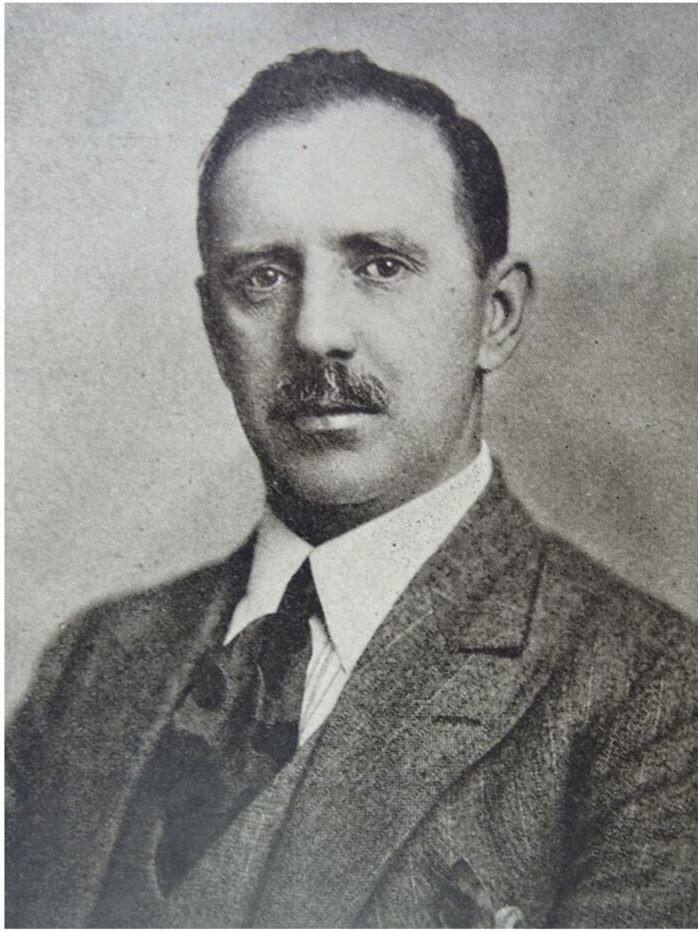 A.J. Cook in 1926 – Degwards CC BY-SA 4.0 via Wikimedia Commons
During the General Strike, there were some exceptions where trade unionists were given exemptions from striking – including those involved in food manufacture. Seebohm and the Rowntree’s board thought their company would therefore be exempt from the strike and that the impact on their Cocoa Works factory would be minimised. However, some of Rowntree’s transport and maintenance engineers were called out on strike by their unions.[3] Another issue facing the company was the disruption to coal supplies. Seebohm had been making sure to stockpile additional coal since the Railway strike of 1919.[4] However, coal shortages would disrupt the electrical supply to the factory, which led to the board taking the decision to put the Cocoa Works on short time. This was presented to a Central Works Council meeting on Monday 3rd May 1926, where Seebohm explained they would only work Mondays, Tuesdays, and Wednesdays during the upcoming strike.[5]
On Wednesday 5th May, Fred Hawksby – Rowntree’s Chief Shop Steward and the president of the York branch of the National Union of General and Municipal Workers (NUGMW) – reported to an emergency meeting of the Central Works Council that his union considered Rowntree’s to be a food factory meaning its members could continue to work. However, despite this, the Transport & General Workers Union considered what Rowntree’s produced to be luxury goods, and so they did not qualify for the food manufacturers’ exemption.[6] This meant that the factory would have to close as transport workers would not carry their goods.
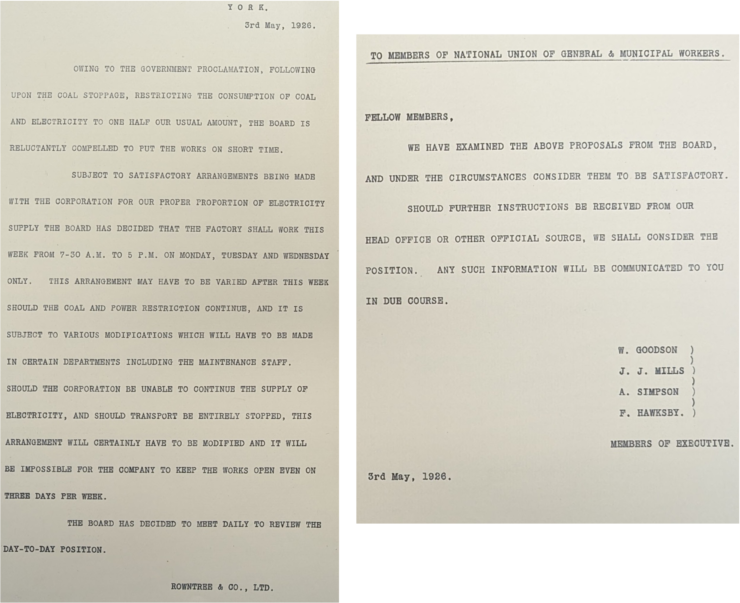 Notices to staff from Rowntree & Co. and their branch of the National Union of General Worker about the Cocoa Works being put on short time during the General Strike – Borthwick Institute for Archives R/DH/OO/20/8
The impact of the General Strike on Rowntree & Co. having to close the Cocoa Works was, therefore, forced on them not by masses of their own workers striking but instead due to a decrease in the electricity supplied from the York Corporation, and striking transport workers. Some of these transport strikers were Rowntree’s employees, and another group of Rowntree’s workers who were called to strike were the maintenance engineers. However, mitigations were agreed with the Cocoa Works maintenance engineers so that they could strike without major disruption to the factory.
William Wallace, an assistant to Seebohm, recalls in his unpublished autobiography that he was approached by the maintenance engineers before the strike. They said they were reluctant to strike due to having no grievance with Rowntree’s, but they were anxious to serve the best interests of their union. Wallace took them to see Seebohm. According to his account, Seebohm “…smiled his friendly smile and said it was a little quaint that he was asked to advise whether they should strike, but if they didn’t this might leave an unhappy relationship with their fellow trade unionists outside. So, his advice was that they should do their utmost to leave important factory machinery so that it would run for days without skilled maintenance and just strike!”.[7]
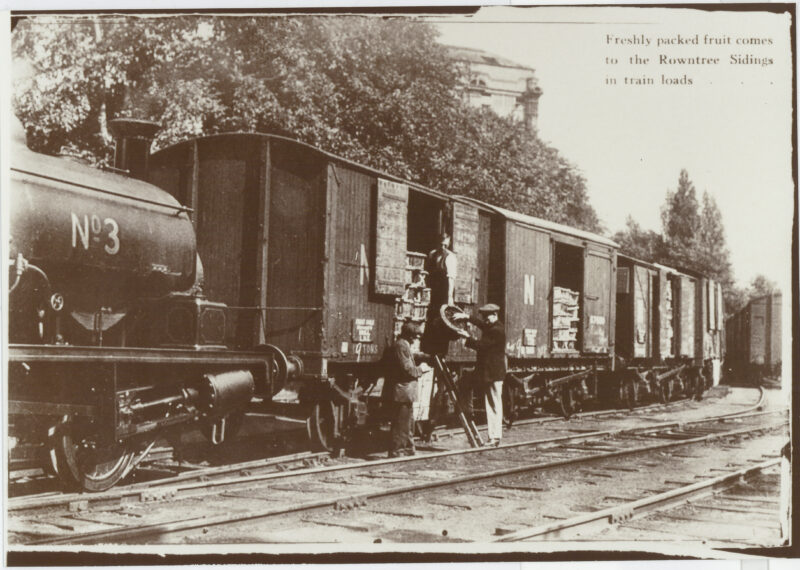
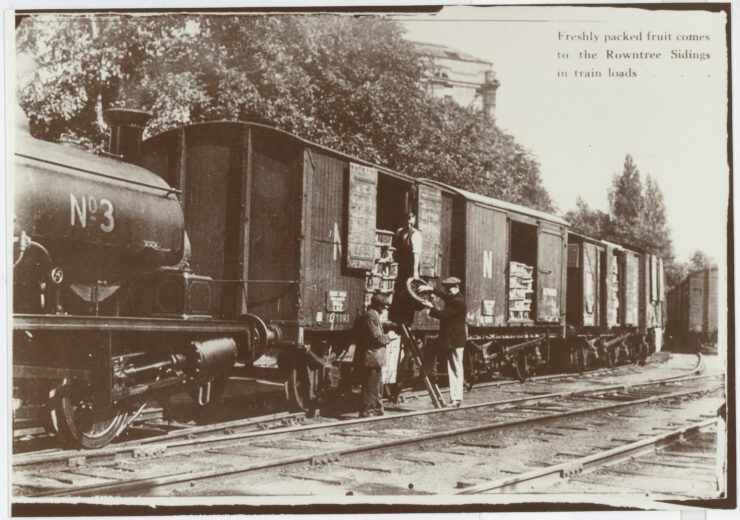 Transport workers at the Cocoa Works unloading fruit in
1920 – Borthwick Institute for Archives Rowntree Photo 6/456
Clarence Northcott, Rowntree’s Labour Manager, recalls that Hawksby was also reluctant to strike but was told by F.G. Fryer, one of the directors, that it would be his duty as a trade unionist to strike should he be called to.[8] When the General Strike was called off by the TUC the following week, Hawksby told the board of directors that his union branch had voted overwhelmingly not to join the strike had it continued.[9] This inversion of industrial relations at Rowntree’s, with management telling workers to strike, is typified by an event on 13th May. The strike had been called off the day before, but this did not stop a Rowntree’s assistant manager turning away lorries accusing the drivers of being “black legs” – strikebreakers.[10]
Industrial Conciliation and Secret Deals
In the years just before and during the 1920s, Seebohm Rowntree got involved in attempts to mediate industrial disputes outside of his own company, particularly those with a national impact and involving the government. He would form a team, usually including some of his assistants who were working on his sociological research and others from the Cocoa Works, to examine the dispute and develop potential resolutions. They would then organise secret meetings with both sides in the dispute to see where they would be willing to compromise and how much of his proposals they would accept. He insisted that these meetings were kept secret so as not to prejudice the negotiations but also, he did not want credit, believing it was more powerful for the unions and the government/employers to be seen to have reached an agreement between them than by his outside influence. In addition, there is something of Seebohm’s Quakerism in wanting to be in the background – letting the outcome of the negotiations, the industrial “peace” which followed speak for itself. He called these methods “industrial conciliation”.[11]
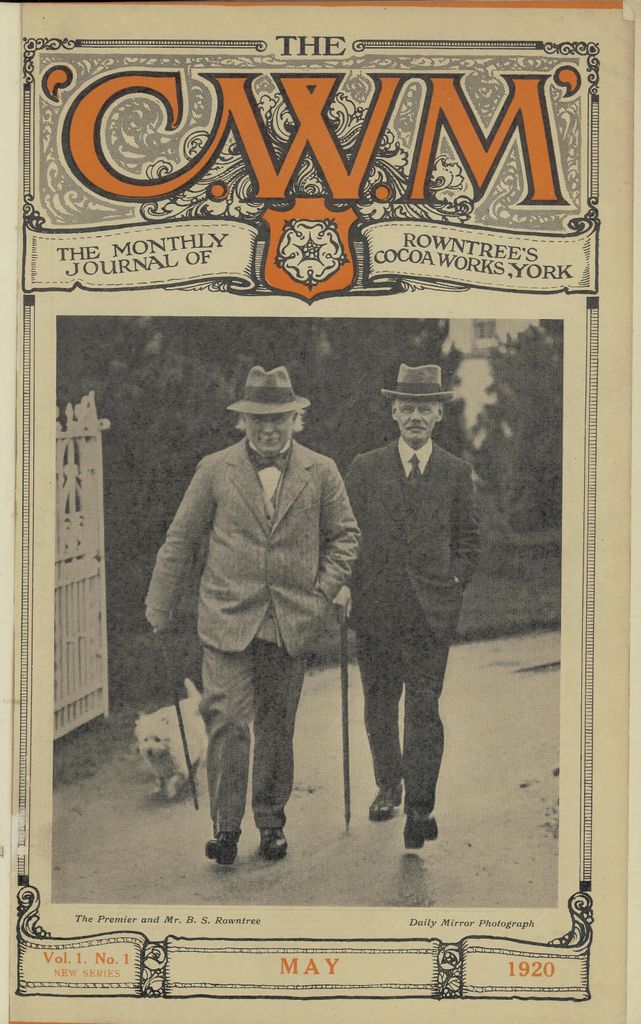 Seebohm with David Lloyd George – front cover of May 1920 issue of the Cocoa Works Magazine
Seebohm could be inventive in how he managed to meet trade unionists, particularly those who would not agree to meet through the usual ways. This would involve asking his assistants to find out where union leaders were going to be and then doorstop them. Once even going as far as climbing the back stairs of the headquarters of the National Union of Railwaymen to approach their General Secretary, Jimmy Thomas, during the 1919 Railway Strike with news of provisional agreement from the government for a deal. Seebohm was helped in getting the government to agree to his plan by his friendship with then Prime Minister, Lloyd George.[12]
Whilst Seebohm’s industrial conciliation was successful in the Railway Strike and earlier coal disputes, it didn’t go as well after the 1926 General Strike. On its eve, Seebohm sent Wallace to London on the last train out of York, to talk to people in parliament and trade union leaders. Wallace says he met J.R. Clynes, MP and President of the N.U.G.M.W, and Jimmy Thomas – who as well as a union leader was also an MP – at the House of Commons. He also visited other trade unionists elsewhere in the capital. He relates that “every trade unionist I met was friendly to me and to Rowntree’s, but nobody seemed in a position to give the necessary authority”. Although he does report that Thomas “quite literally wept”.[13] This is not the only report of one of Seebohm’s team making Thomas cry![14]
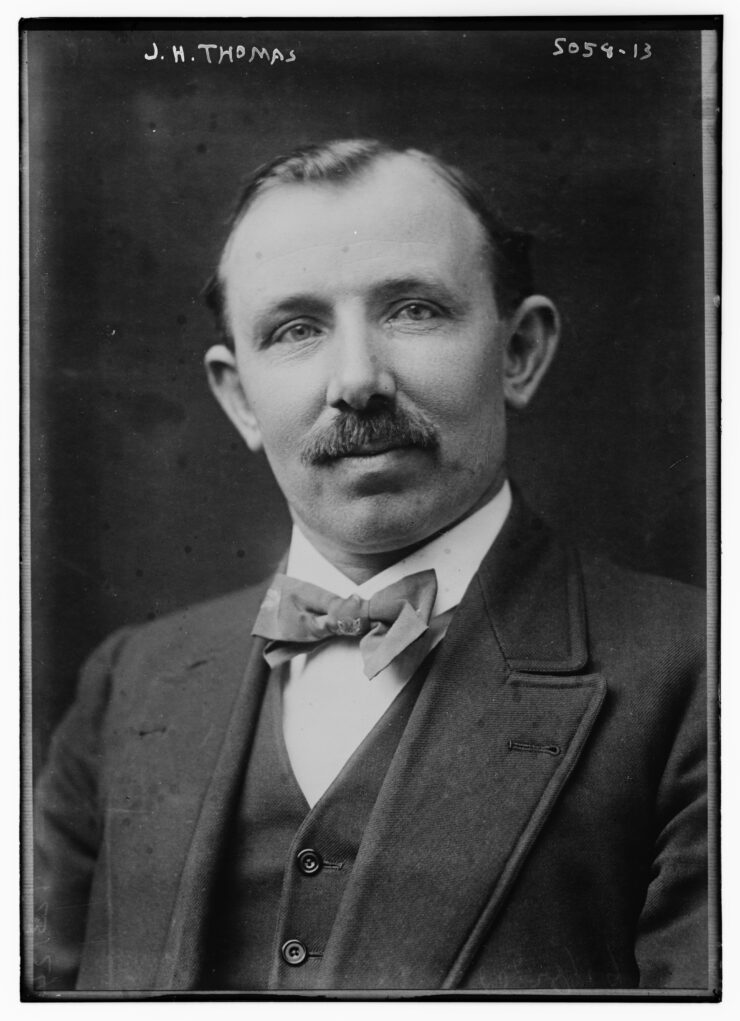 Jimmy Thomas c.1920 – Library of Congress Prints & Photographs Division LC-DIG-ggbain-29625
After the General Strike was called off, Seebohm was concerned for the impact it would have on the miners’ unions who were still on strike, particularly as the government was working on Trade Disputes and Trade Unions Act which banned sympathy strikes, general strikes, and mass picketing as well as diminished the unions political impact. Seebohm felt that the mine owners’ attitude was uncooperative and that the, by then, Conservative government was too hardline. This time, Seebohm turned to his assistant, F.D. Stuart and Liberal politician and editor of The Economist, Walter Lawton. Together they drew up possible terms of a settlement and began work to convince the unions and government to agree to it. The main difficulty lay in persuading A.J. Cook, the General Secretary of the Miners Federation, even to meet with them. This led Stuart to tracking Cook down at a public meeting in the Midlands and eventually got him to reluctantly sign their document to say he agreed with the proposals.[15] However, Cook went public, accused Seebohm of harassment and being the cause of his mental distress[16] – something that Seebohm continued to deny for the rest of his life.[17] The attempted conciliation subsequently failed.
Later, in 1928, Stuart mentioned to Joseph Jones, secretary of the Yorkshire Miners Association, that he could never understand why the Miners Federation had refused to accept the terms of Seebohm Rowntree’s proposals.[18] This led to an investigation by the Miners Federation into Cook’s role in making secret deals.[19] The difficulties Seebohm had dealing with Cook was one of the key reasons for his conciliation plan falling apart, although Seebohm put the blame fully on the concurrent attempt by Church of England bishops.[20]
The impact of this failure continued to be felt by both Seebohm and Stuart for years afterward. In 1935, a young sociologist Dennis Chapman came to York to work with Seebohm on this second Poverty study. He was left disappointed by the experience, and even more so when he was let go in September 1936 when Seebohm moved away from York (other research assistants were kept on). Later Chapman repeatedly made serious allegations about Seebohm’s involvement with trade unions, based on conversations he had had with Stuart and documents he saw in Seebohm’s personal archive. The core of these was that Seebohm’s industrial conciliation was working under Sir Alfred Mond, an industrialist and politician who moved away from Lloyd George’s Liberal Party to join the Conservative Party in 1926.[21] Mond had developed a movement which became known as “Mondism” which aimed to curtail the power of the trade unions by enforcing collaboration with employers and banning strikes. Chapman’s most serious allegation is that Mond gave Stuart a cheque of £70,000 to pass to Jimmy Thomas so that he could clear his stock market debts. This was a bribe to end the General Strike.[22] Chapman alleges he saw a receipt for this cheque in Seebohm’s papers.[23]
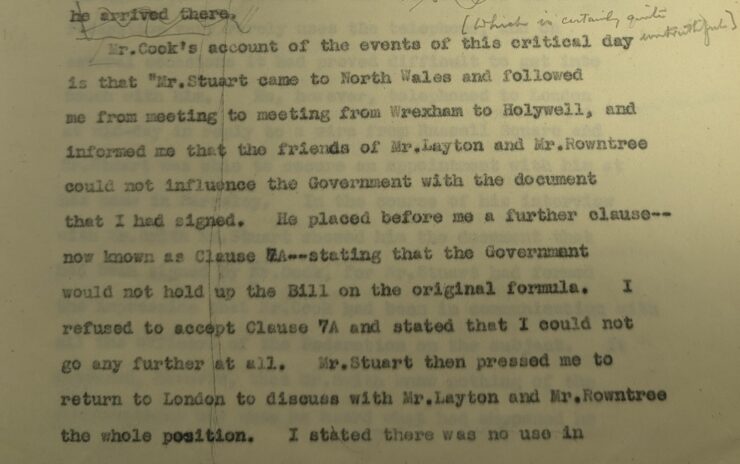 Excerpt from final draft of a report by W.T. Layton on the Rowntree led attempted mediation of the coal dispute in July 1926. Annotation in Seebohm’s handwriting referring to A.J. Cook’s account as “certainly quite untruthful” – Borthwick Institute for Archives RFAM/BSR/JRF/8/5/4/5
While there is some truth in Chapman’s allegations, notably that Seebohm did try to exert influence over union leaders – although not to the extent alleged. Superficially, there are also similarities between Seebohm’s approach to trade unions and Mondism. Both emphasised co-operation between workers and employers, and that improved efficiency would lead to better pay for workers.[24] However, as we have seen, Seebohm tended to side much more with the workers and their trade unions, and in his own business encouraged more radical and dissenting voices to be heard through the Central Works Council and Cocoa Works Magazines.[25] His approach to conciliation seems to have been more grounded in Quakerism than in any plan to curtail the power of the unions, despite his dislike of industrial action such as strikes. That Chapman seems to have genuinely believed his allegations to be true, is supported by his accounts remaining consistent over several decades. The first record of them is from 1956[26], and he recounted that Seebohm and Mond bribed Thomas to call off the General Strike in an interview Chapman gave to the BBC in the early 1980s.[27] The latter was for a documentary about Seebohm Rowntree which was pulled due to the BBC being unable to confirm or deny Chapman’s allegations.[28]
Our research has not been able to find any evidence to link Seebohm with Mond. We went through the list of people invited by Mond to his talks with the TUC,[29] but they did not include any Rowntree connections. In addition, Mond publicly proposed the ideas which became known as Mondism in December 1927 with the first Mond-Turner talks in 1928, whereas Seebohm was doing his industrial conciliation from at least 1919. It is known that Thomas had debts[30] and was involved in various efforts to end the General Strike.[31] However, aside from Chapman’s claims, there has yet to be discovered any evidence of him receiving money from either Mond or Seebohm.[32]
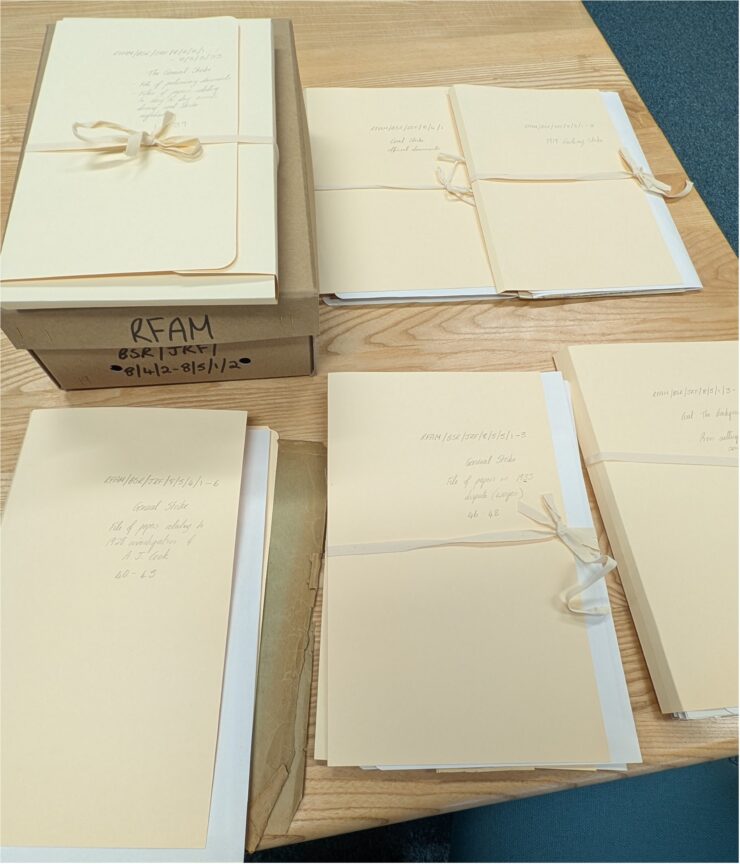
Files from Seebohm Rowntree’s archive relating to ‘Industrial Conciliation’ and the General Strike – Borthwick Institute for Archives RFAM/BSR/JRF/8/3-5
When Seebohm Rowntree moved to Hughenden, near High Wycombe in 1936, he asked his assistants to help him destroy parts of his archive by burning. Chapman was involved in this and stated in 1956 that “it was in this holicaust (sic) that all papers relating to the General Strike in 1926 vanished. BSR (Seebohm) also destroyed the files, such as they were, relating to Industrial Conciliation…”[33]. He specifically states the receipt for the cheque to Thomas was destroyed as part of this.[34] However, not all of these papers were burned as there remain many documents relating to both the General Strike and industrial conciliation in Seebohm’s archive at the Borthwick Institute for Archives in York.[35] Seebohm continued to add to them up until at least the 1940s, and they contain several letters to associates asking for their recollections and for copies of related documents which he remembers but does not have.[36] They contain no mention of Mond or anything relating to money paid to Thomas, but do use phrases such as “industrial conciliation” and other accounts which were subsequently repeated by Chapman, suggesting that these are the files he was referring to.
————————————————————-
This is the end of Part 2 of “Come, Let Us Reason Together”: Trade Unions at Rowntree & Co. in the 1920s. Parts 1, 3 & 4 can be found here.
————————————————————-
We presented this research at our 2025 York Festival of Ideas event as part of the Joseph Rowntree Centenary. You can see the recording of the event here:
———————————————————-
Researched and written by Nick Smith, Executive Director of The Rowntree Society.
Additional research by The Rowntree Society’s research volunteers, Maisie Brenchley & James Heathfield.
References and Footnotes
[1] Rowntree, B.S. 1914 The Labourer and the Land Dent pp.57
[2] Briggs, A. 1961 A Study if the Work of Seebohm Rowntree 1871-1954 Longmans pp.255-256
[3] Fitzgerald, R. 1995 Rowntree and the Marketing Revolution 1862-1969 Cambridge University Press pp. 273; Northcott, C. 1956 Memorandum of interview with C. H. Northcott: Borthwick Institute for Archives RFAM/BSR/JRF/11/26
[4] Cocoa Works Magazine Christmas 1920 pp.192
[5] Central Works Council Minutes 3rd May 1926: Borthwick Institute for Archives R/WC/2/2
[6] Central Works Council Minutes 5th May 1926: Borthwick Institute for Archives R/WC/2/2
[7] Wallace, W. 1985 I Was Concerned pp.141-142: Borthwick Institute for Archives JRRT/8/2/54; Hills, R.I. 1980 The General Strike in York 1926 Borthwick Papers No.57 pp. 12
[8] Northcott, C. 1956 Memorandum of interview with C. H. Northcott: Borthwick Institute for Archives RFAM/BSR/JRF/11/26
[9] Northcott, C. 1956 Memorandum of interview with C. H. Northcott: Borthwick Institute for Archives RFAM/BSR/JRF/11/26
[10] Hills, R.I. 1980 The General Strike in York 1926 University of York – Borthwick Papers 57 pp.23
[11] Briggs, A. 1961 A Study if the Work of Seebohm Rowntree 1871-1954 Longmans pp.247-268; Seebohm Rowntree’s Archives at the Borthwick Institute for Archives: Rail Strike 1919 RFAM/BSR/JRF/8/3, Coal Dispute 1921 RFAM/BSR/JRF/8/4, General Strike 1926 RFAM/BSR/JRF/8/5; Chapman, D. 1956 Memorandum of interview with Dennis Chapman: Borthwick Institute for Archives RFAM/BSR/JRF/11/27
[12] Briggs, A. 1961 A Study if the Work of Seebohm Rowntree 1871-1954 Longmans pp.250
[13] Wallace, W. 1985 I Was Concerned pp.142: Borthwick Institute for Archives JRRT/8/2/54
[14] E.g. also see Briggs, A. 1961 A Study if the Work of Seebohm Rowntree 1871-1954 Longmans pp.251
[15] Briggs, A. 1961 A Study if the Work of Seebohm Rowntree 1871-1954 Longmans pp.256-260, Appendix B pp.359-364; Chapman, D. 1956 Memorandum of interview with Dennis Chapman: Borthwick Institute for Archives RFAM/BSR/JRF/11/27; Layton, W. T. 1928 Memorandum Attempted mediation in the Coal dispute. Memorandum of events in the first fortnight of July 1926: Borthwick Institute for Archives RFAM/BSR/JRF/8/5/4/5
[16] Layton, W. T. 1928 Memorandum Attempted mediation in the Coal dispute. Memorandum of events in the first fortnight of July 1926: Borthwick Institute for Archives RFAM/BSR/JRF/8/5/4/5 – note: next to the part of this report which gives Cook’s account, there is written in what looks like Seebohm’s handwriting “which is certainly quite untruthful”.
[17] Later correspondence on the General Strike: Borthwick Institute for Archives RFAM/BSR/JRF/8/5/6
[18] Briggs, A. 1961 A Study if the Work of Seebohm Rowntree 1871-1954 Longmans pp.267
[19] Cliff, T. 1986 ‘The Tragedy of A.J. Cook’ International Socialism 2:31 Spring 1986 pp. 69–111 https://www.marxists.org/archive/cliff/works/1986/xx/ajcook.html accessed 9/3/2026; Briggs, A. 1961 A Study if the Work of Seebohm Rowntree 1871-1954 Longmans pp.267
[20] Briggs, A. 1961 A Study if the Work of Seebohm Rowntree 1871-1954 Longmans pp.260-265; Correspondence between BSR and William Temple, Archbishop of York: Borthwick Institute for Archives RFAM/BSR/JRF/8/5/6/1
[21] Chapman, D. 1956 Memorandum of interview with Dennis Chapman: Borthwick Institute for Archives RFAM/BSR/JRF/11/27
[22] Interview with Dennis Chapman in ‘BBC programmes on Joseph Rowntree and BSR’: Borthwick Institute for Archives RFAM/BSR/JRF/11/39
[23] Chapman, D. 1956 Memorandum of interview with Dennis Chapman: Borthwick Institute for Archives RFAM/BSR/JRF/11/27; Interview with Dennis Chapman in ‘BBC programmes on Joseph Rowntree and BSR’: Borthwick Institute for Archives RFAM/BSR/JRF/11/39
[24] Rowntree, B.S. 1921 The Human Factor in Business Longmans, Green & Co.
[25] See ‘Come, Let Us Reason Together’ part 1: https://www.rowntreesociety.org.uk/come-let-us-reason-together-trade-unions-at-rowntree-co-in-the-1920s-part-1/
[26] Chapman, D. 1956 Memorandum of interview with Dennis Chapman: Borthwick Institute for Archives RFAM/BSR/JRF/11/27
[27] Interview with Dennis Chapman in ‘BBC programmes on Joseph Rowntree and BSR’: Borthwick Institute for Archives RFAM/BSR/JRF/11/39
[28] Letters to C. Rowntree and Jean Rowntree from BBC producer Allan Kassell 1982: Borthwick Institute for Archives RFAM/BSR/JRF/11/39
[29] McDonald, G.W. & Gospel, Howard F. 1973 ‘The Mond-Turner Talks, 1927-1933: A Study in Industrial Co-Operation’ The Historical Journal Vol.6:4 pp.807-829
[30] Thorpe, A. ‘“I am in the Cabinet”: J. H. Thomas’s Decision to Join the National Government in 1931’ Historical Research 64: pp.389-402
[31] Schneer, J. 2026 Nine Days in May: The General Strike of 1926 Oxford University Press
[32] The Rowntree Society researchers failed to find any evidence of money being paid to Thomas from Alfred Mond or Seebohm Rowntree, the BBC’s researchers in the early 1980s failed to uncover any (see Borthwick Institute for Archives RFAM/BSR/JRF/11/39), nor has Dr. Jonathan Schneer (pers. comm. 2/2/2026)
[33] Chapman, D. 1956 Memorandum of interview with Dennis Chapman: Borthwick Institute for Archives RFAM/BSR/JRF/11/27
[34] Chapman, D. 1956 Memorandum of interview with Dennis Chapman: Borthwick Institute for Archives RFAM/BSR/JRF/11/27; Interview with Dennis Chapman in ‘BBC programmes on Joseph Rowntree and BSR’: Borthwick Institute for Archives RFAM/BSR/JRF/11/39
[35] Borthwick Institute for Archives: RFAM/BSR/JRF/8/3, RFAM/BSR/JRF/8/4, RFAM/BSR/JRF/8/5
[36] E.g. see Exchange of letters between BSR and W. T. Layton 1951: Borthwick Institute for Archives RFAM/BSR/JRF/8/5/6/3