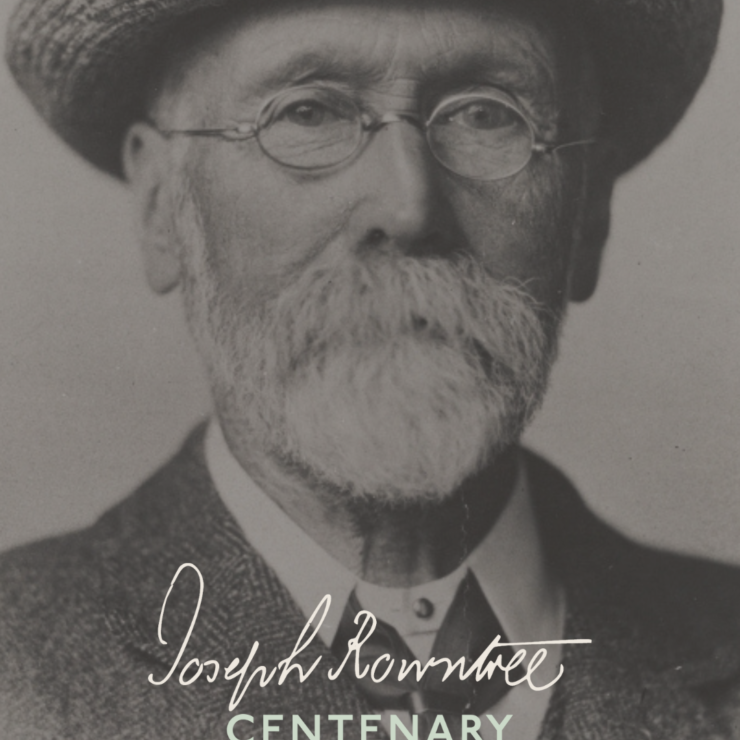
Arnold Rowntree


Rowntree, Arnold Stephenson (1872-1951), cocoa and chocolate manufacturer, was born at 'Mount Villas', York, on 28 November 1872, youngest of the four surviving sons (one of whom died aged 17; there were four daughters) of John Stephenson Rowntree (1834-1907) by his first wife, Elizabeth Rowntree (born Hotham, 1835-1875); there were no children of the second marriage. In July 1875, before Arnold's third birthday, his mother was killed in a carriage accident while the family were on holiday at Ingleton (several of the others in the carriage were injured, but he was unscathed). He and his younger sister, Hilda (b. 1874), were cared for during the next three years by Joel Cadbury (1838-1916) of Birmingham, and Maria Cadbury (born Hotham 1841-1928), who was Arnold's aunt. In 1878, on their father's remarriage, the two children returned to York. Arnold was educated at Miss Latchmore's at Harrogate and at Bootham School; on leaving school in 1889 he learned the grocery trade, first in his father's establishment in Pavement, and then at Barrow's Stores, Birmingham. In the autumn of 189 l, however, he was invited by his uncle Joseph Rowntree (1836-1925) to enter the cocoa and chocolate works, still styled H.I. Rowntree & Co. The offer came, at least in part, because Joseph Rowntree knew that Arnold's father intended in 1892 to retire and sell the grocery business. Arnold might, in any event, have found that business too restricting for his exuberant energies.


He began at the cocoa works in 1892, going from department to department, but was soon put in charge of the new advertising department, which came to include responsibility for the firm's travellers. His bold imaginative flair led to startling but effective experiments, such as the boat race day when a huge mechanical swan drew a barge up the Thames with an outsize tin promoting Rowntree's elect cocoa. In 1918 the marketing and transport departments were added to his responsibilities. In 1897 the firm had moved from the cramped Tanners Moat site to a new purpose-built factory in Haxby Road; at the same time it became a limited company and Arnold's directorship of Rowntree & Co. spanned the years 1897-1941. He married in 1906 Mary (May) Katharine Harvey (1876-1962), daughter of William Harvey (1848-1928) of Leeds, Manchester warehouseman, and Anna Maria Harvey (born Whiting, 1851-1934). There were three sons and three daughters. They made their home at 'Chalfonts', close to his father's home at 'Mount Villas'.


From schooldays Arnold had been politically conscious and in 1907 he was one of the group of Liberals who founded the Nation, a weekly which continued until its amalgamation with the New Statesman in 1931. Meanwhile, Joseph Rowntree had in 1904 established the three trusts and Arnold became a trustee of each. Through the Social Service Trust (which was not charitable) Joseph Rowntree had been able to secure for the Liberal interest the Northern Echo. A North of England Newspaper Co. was established, Arnold becoming chairman; this was merged in 1920 with Westminster Press Ltd, ultimately becoming Westminster Press Provincial Newspapers Ltd (1937). In all, these companies owned 16 newspapers; Arnold was a director of all but two, and was chairman of all those in the north of England. These responsibilities, including the considerable travel involved, demanded an increasing proportion of his time.


He had inherited the family preoccupation with adult schools and with education generally. He began teaching at the Leeman Road adult school in the city and for a time before his marriage had lived in the area so as better to understand the men's background and interests. He was an enthusiastic supporter of the National Adult School Union (1899), serving as honorary secretary 1905-19 and chairman of Council 1922-34; he took a leading part in the effort to spread the adult school ethos through educational settlements, pioneered in York and Leeds (both 1909). Others followed suit and in 1920 a conference on their future led to the establishment of the Educational Settlements Association (of which he was chairman). He had a continuing interest in Bootham and The Mount Schools; he had joined the York Schools Committee in 1895, becoming honorary secretary in 1903 and continuing in that capacity or as chairman until 1945.


He was MP for York 1910-18, championing the cause of conscientious objectors during the First World War. In 1914 he brought before the Meeting for Sufferings the need to provide opportunities for service for young men Friends, a concern which led to the establishment of the Friends Ambulance Unit. In 1924, when Rowntree & Co. agreed to buy a 50% stake in Gray, Dunn & Co., biscuit manufacturers, Arnold was one of the two representatives appointed to the Gray Dunn board; he later took a share in amalgamating Gray Dunn with another firm to create British Biscuits Ltd. These varied business interests had led to his chairmanship of the Conference of Quaker Employers in 1918 and again in 1928. His chairmanships (which also included the Management Committee of The Retreat and the trustees of The Friend) have been described as characterised by 'shrewd common sense, business ability and reconciling influence' and were marked by the fact that people mattered to him more than administration'(1).  In 1921 (a year in which he was sheriff of York) he ceased day-to-day work with Rowntree & Co. and in 1939 the family moved from York to Brook House, Thornton le Dale. He never fully regained strength from a long illness in 1944; in 1949 he was aware of a heart condition; and he died at his home 11 May 1951. His daughter Mary (b. 1916) married in 1939 George Bertram Crosfield (1911-1982), newspaper proprietor, son of Bertram Fothergill Crosfield (1882-1951) of London, newspaper proprietor.

 (1) E. Vipont, Arnold Rowntree: a life (1955), pp. 93, 47.

The above biography is a slightly edited version of a biography drawn from The Biographical Dictionary of British Quakers in Commerce and Industry 1775-1920, by Edward H Milligan, by Edward H Milligan, published by the Sessions Book Trust, York, England in 2007  (ISBN 978-1-85072-367-7). 

It is included here by kind permission of Edward Milligan, and the Sessions Book Trust.


More about Arnold Rowntree: