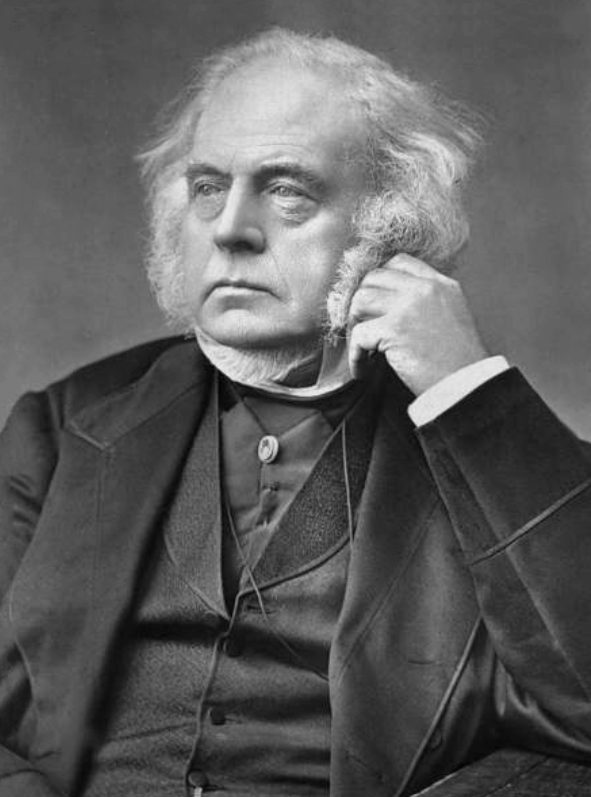
John Bright
John Bright was an influential Victorian Liberal MP and a Quaker who had a significant influence on the Rowntree family, particularly Joseph Rowntree (1836–1925). Joseph was interested in Bright’s life and work and, towards the end of his own life, was working on a biography of him. Bright attended Bootham School in York in 1823, which he later described as the most formative period of his education. He was also a distant relative of the Rowntree family through marriage.
During his youth, Bright worked in his father’s cotton mill in Rochdale. This experience allowed him to understand the conditions faced by working-class families and influenced his later political views.
Bright entered Parliament in 1843 as the MP for Durham. He later represented Manchester before becoming MP for Birmingham, a position he held until his death in 1889. He became particularly well known for his role in the campaign for the repeal of the Corn Laws in 1846. Following their repeal, he continued to campaign for reform of the House of Lords and extending men’s suffrage.
Bright’s approach to workers’ rights was based on the belief that improvements in equality should come from cooperation between workers and employers. Rather than relying heavily on government intervention, he believed that employers and employees should maintain an ongoing dialogue within the workplace to address issues affecting workers.
In 1857, Bright lost his Manchester seat after strongly opposing the Crimean War. He argued that the war benefited the wealthy while serving little worthwhile purpose. His opposition placed him at odds with many other politicians, and he was criticised as being unpatriotic. Despite this, he received public support from Joseph Rowntree senior (1808–1859), who admired Bright for his willingness to speak out against war.