“Come, Let Us Reason Together”: Trade Unions at Rowntree & Co. in the 1920s Part 3: Fred Hawksby

This is part 3 of The Rowntree Society’s research into the relationship between the Rowntree family and trade unions in the 1920s.  In parts 1 and 2 we explored Seebohm Rowntree’s approach to industrial relations at Rowntree & Co. and how the General Strike of 1926 impacted the company.  You can find them here.  This part will tell the story of Fred Hawksby, trade union leader at Rowntree’s and their first Chief Shop Steward.

Chief Shop Steward

One of the innovations Rowntree’s made in their relationship with their unions was in establishing the position of Chief Shop Steward.  This was a role paid for by the company and provided their own office in the Cocoa Works’ Employment Department.  After negotiations with the Executive of National Union of General Workers (NUGW, later became NUGMW), Fred Hawksby was appointed to this role in the summer of 1920.[1]  Hawksby had been working in the Extract Block, and he was the vice-chair of the Central Works Council, as well as the President of the York Branch of the NUGW (making him the main trade union leader at Rowntree’s Cocoa Works).

Seebohm noted “…it would be desirable to have on the staff in the Employment Department someone in close touch with the workers who would be able to voice their point of view, and F. Hawksby’s name had been suggested…”.  Following his appointment as Chief Shop Steward, Hawksby was re-elected on the Central Works Council as a nominated member despite opposition from the more militant trade unionist Jack Baker.[2]

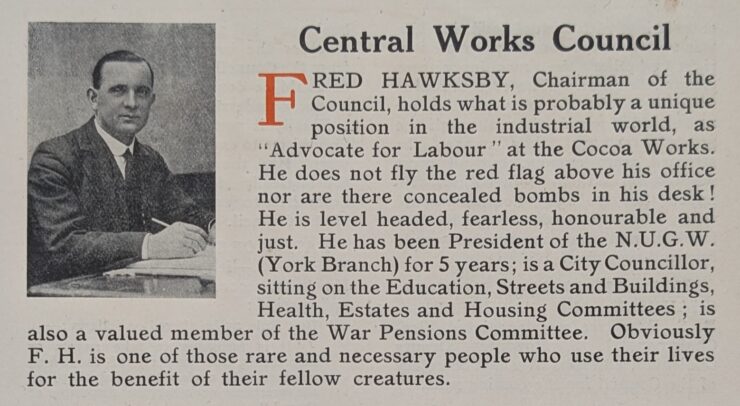
A focus on Fred Hawksby before the Central Works Council minutes in the June 1923 issue
of The Cocoa Works Magazine

Researching Hawksby

The Rowntree Society were keen to find out more about who Fred Hawksby was.  We used the kinds of evidence family historians often consult such as the census and military records.  In addition, we investigated documents held in the Rowntree archives at the Borthwick Institute for Archives, issues of the Cocoa Works Magazine, and even citizen history by asking in York-based Facebook groups.  Through this, we were able to piece together much of his life story.

Hawksby’s Early Years

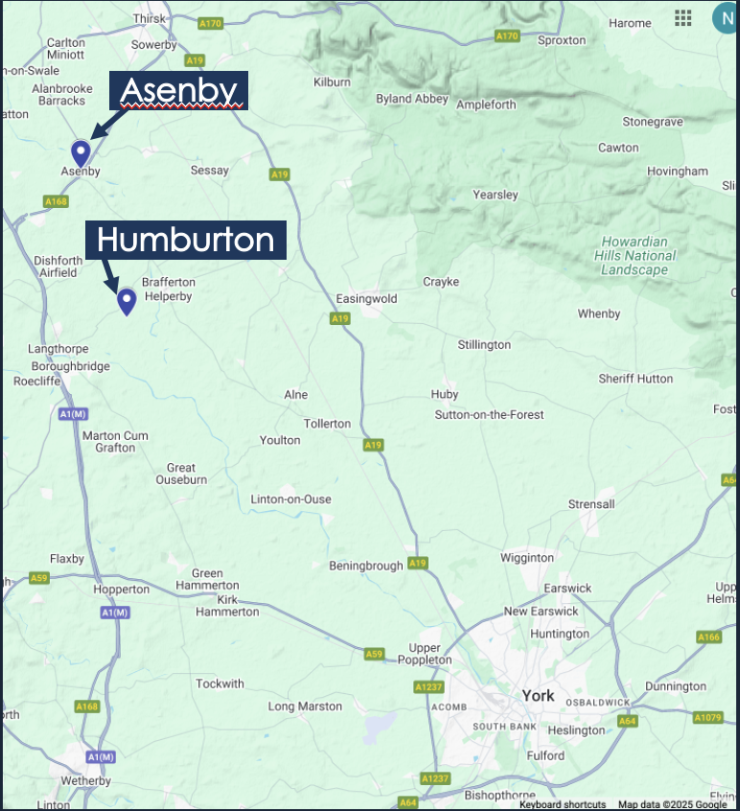
Fred Hawksby was born in Asenby, between Boroughbridge and Thirsk, in 1884.  His father, Thomas, did various low paid rural jobs including working as a gamekeeper and an agricultural labourer.  However, by the time Hawksby was 6 his father had died.  This left his 29-year-old mother, Susannah, as a single parent to three children and working as a charwoman – doing casual, low-paid domestic cleaning in other people’s homes.

Asenby and Humburton in relation to York – Google Maps 8th May 2025

By 1901, when he was 16, Hawksby had left Asenby to work as a servant horseman on a farm at Humburton, about five miles south of Asenby.  While working there, he joined the West Yorkshire Militia, a part-time army reserve force.  From the autumn of 1901 to October 1902, the Militia, with Hawksby among them, were posted to active duty in Malta, protecting communication lines and prisoners-of-war from the Boer War. When not in Malta, the regiment was stationed in Chatham, Kent, alongside the 11th Hussars, which Hawksby enlisted with in August 1902, shortly after turning 18, continuing his work with horses.

On his enlistment paperwork, he is described as 5’4” tall, with a fresh complexion, grey eyes, brown hair, and a tattoo reading “Highland Soldier” on his left forearm.  During his time with the 11th Hussars, he was attached to the 13th Hussars and posted to India for three years, returning in November 1909.  The following year he moved to the Army Reserve, and it is likely that this is when he moved to York.

Fred Hawksby in York

The 1911 Census shows that 26-year-old Fred Hawksby was working at Rowntree’s as a general labourer and was boarding with his colleague Thomas Edward Watson’s family on Redeness Street, in the Layerthorpe area of York. At that time, the area was made up of terrace houses and dominated by the gasworks and power station.  Much of this has since been demolished, and the neighbourhood now bears little resemblance to its early 20th-century appearance.

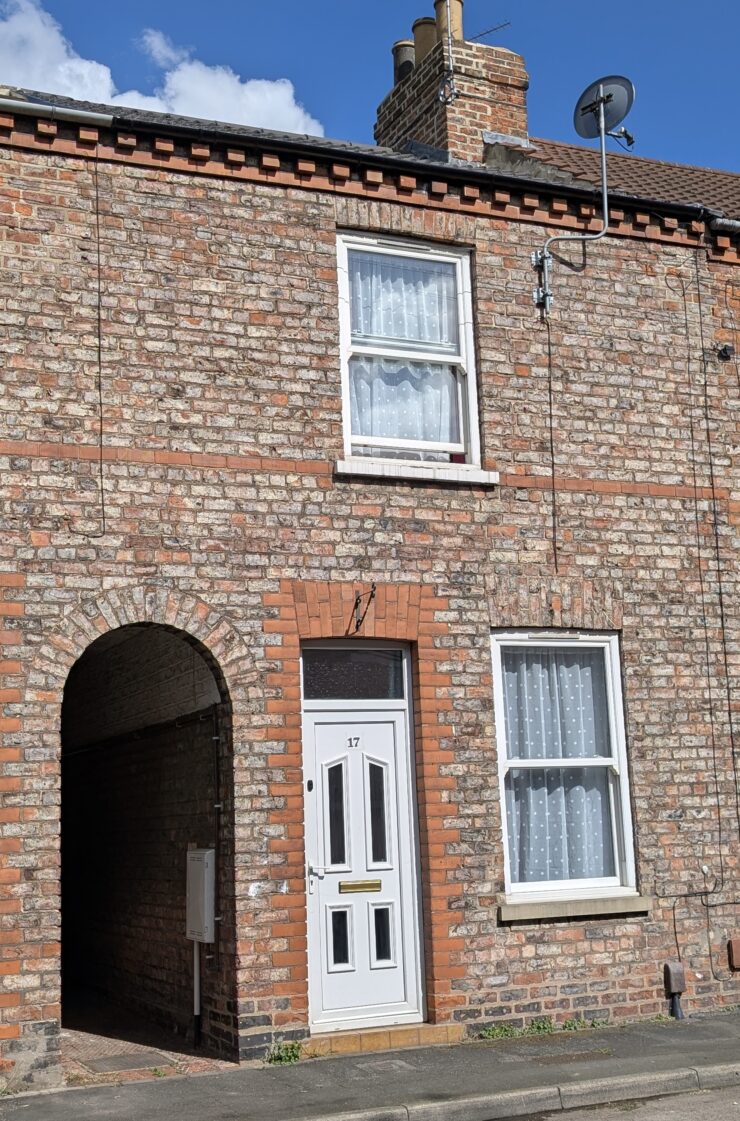
One street that does remain is Hawthorn Street, where Hawksby moved after marrying his wife, Harriet, in 1914.  He continued to live there for the rest of his life. The terraced street was very close to the railway branch line connecting with the Cocoa Works, which must have made living conditions cramped.  By 1921, the household included Fred and Harriet, Harriet’s sister Lydia, and a boarder, Ellen Thompson – both also Rowntree’s employees.  Fred and Harriet Hawksby only had one child, a son called Walter who was born in 1927, who sadly died at the age of seven.

Hawksby’s home, 17 Hawthorn Street in 2025 – The Rowntree Society

In 1912, Hawksby injured his ankle which ruled him out of serving in the First World War.  He became the President of the York branch of the NUGW in 1918 and in November 1921, was elected as a Labour councillor for Monk Ward in what was described as a surprise result.[3]  During his time on the council, he served on committees for Streets and Buildings, Health, Estates, Public Libraries and Housing.[4]  The latter alongside Alderman Oscar Rowntree, Seebohm’s youngest brother and a Rowntree & Co. director.

Fred Hawksby at the Cocoa Works

Something of how Hawksby conducted himself at work, certainly in the early days, can be gained from the minutes of a meeting held in November 1916.[5]  A complaint was made to the factory manager, T.H. Appleton, and other management about Hawksby’s “bullying and domineering attitude” particularly towards the women workers.  It seems like Hawksby had only recently gainer a promotion, likely to some grade of overlooker.  A lower-level manager, only named by the initials G.T.L., asks why this issue was not brought to him first before going to Appleton.  The reason given is that G.T.L. is Hawksby’s brother-in-law!  After much discussion, it was agreed that the issue lay with Hawksby’s blunt manner and G.T.L. would speak to him about it.

It was in his role of Chief Shop Steward where Hawksby had the greatest impact at Rowntree’s.  Seebohm Rowntree seems to have held real affection for him, as did both the Labour Manager, Clarence Northcott, and William Wallace.  Any issues which might impact the workers were brought directly to Hawksby.[6]  Seebohm would often arrange to meet him to discuss company issues at the Station hotel – both a neutral and private space where they could talk freely and Hawksby be shown confidential documents including the company accounts.[7]  Northcott later recalled that before such meetings, Seebohm would declare “come, let us reason together”.[8]  It is a Biblical quote from Isiah 1:18 that reflects Seebohm’s Quaker approach in dealing with issues through dialogue and understanding.

Hawksby was an ever-present member of the Central Works Council, holding leadership positions and serving on many of its sub-committees.  In early 1923, he undertook a review of the workplace democracy structure below the Council and introduced significant changes.[9]

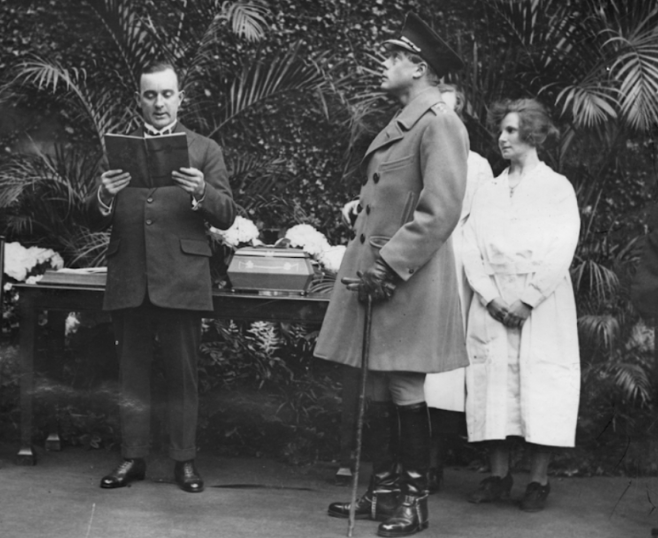
Hawksby presenting a casket of chocolates from Rowntree’s workers to the Prince of Wales in 1923 – City of York Council / Explore York Libraries and Archives Mutual Ltd Asset ID 1002833

Overseas Visits

In early 1925, Hawksby was struggling.  This was just after Joseph Rowntree’s death and in addition to his usual work, Hawksby had been involved in arranging the Cocoa Works’ memorial activities.  The Central Council minutes record that he was suffering from “overstrain”, and so Rowntree’s had arranged for him to visit South Africa for a break from April 1925.  Another trade unionist at the Cocoa Works, Irene Pickup, was appointed Assistant Chief Shop Steward to support Hawksby and cover his duties whilst he was away.[10]  The journey to South Africa was not relaxing though, as the following issue of the Cocoa Works Magazine reports that Hawksby suffered from neuritis during the rough sea crossing.[11]

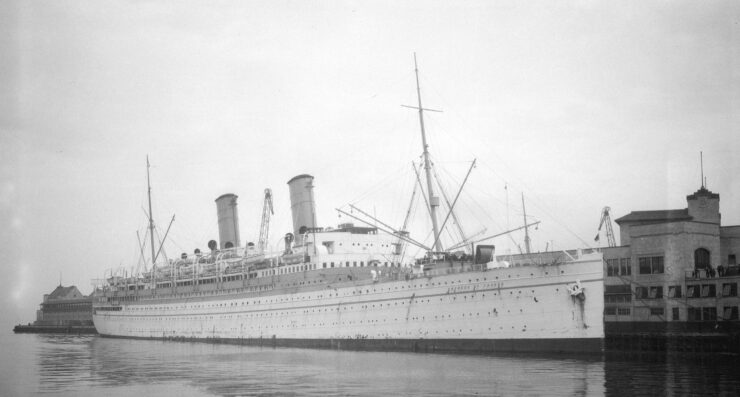
Hawksby made another trip abroad in the 1920s, travelling with Northcott to the United States of America in September 1926.  This was a Rowntree’s initiative to study American companies and what could be learnt from them.  The full report of this visit is preserved in the Borthwick Institute for Archives[12], and the Cocoa Works Magazine printed what Hawksby and Northcott shared with a meeting of workers on their return.

Hawksby’s account conveys an almost giddy excitement about his experiences in the United States and the innovations he believed could be adopted at the Cocoa Works.  He was particularly impressed by the high wages, the co-operation between workers and management, and the more advanced technology.  At the meeting, however, both Northcott and Arnold Rowntree followed with a more cautious tone.  Northcott stated that they had intentionally only visited “good firms”, and recalled that on an earlier visit American businesses “…regarded this factory as a sort of philanthropy, kept up by advertising.  I find that to-day they regard Rowntree’s as an up-to-date efficiently managed place.”  Arnold pointed out that not all problems had been solved in America, but that the company would learn from the report.  He set out a more practical approach, saying “we want less vague talk.  We must get down to practical questions”.[13]

SS Empress of France, the ship Hawksby & Northcott sailed on to USA in 1926 – City of Vancouver Archives ref CVA 447-2191, Public Domain

Fred Hawksby after the 1920s

Hawksby continued as Chief Shop Steward right until his death in August 1946 at the age of 62.  The Cocoa Works Magazines from the time gives the impression of the shock felt through the Cocoa Works at his passing.  He seems to have suffered from bouts of poor health for many years beforehand with letters to him from both Seebohm and Seebohm’s assistant, F.D. Stuart, mentioning his health – Hawksby having been either in hospital or looking well on recovery.[14]

His relationship with Seebohm continued to deepen, and they remained in contact following Seebohm’s move away from York in 1936.  When Seebohm’s wife, Lydia died in 1944, Hawksby wrote a poignant letter of condolence to Seebohm.  In it he remembered that “Mrs Seebohm was indeed a lady who endeared herself with all whom she came in contact with, I well remember the kindly interest she took in the work of the Central Council and the many happy occasions when the members were invited to spend a social evening at the Homestead.  Many who went for the first time told me that they went with a feeling of shyness but Mrs Seebohm by her charms and personality soon made them feel they were members of a happy family.”[15]  Seebohm’s reply is signed off with “I am your friend sincerely”.[16]

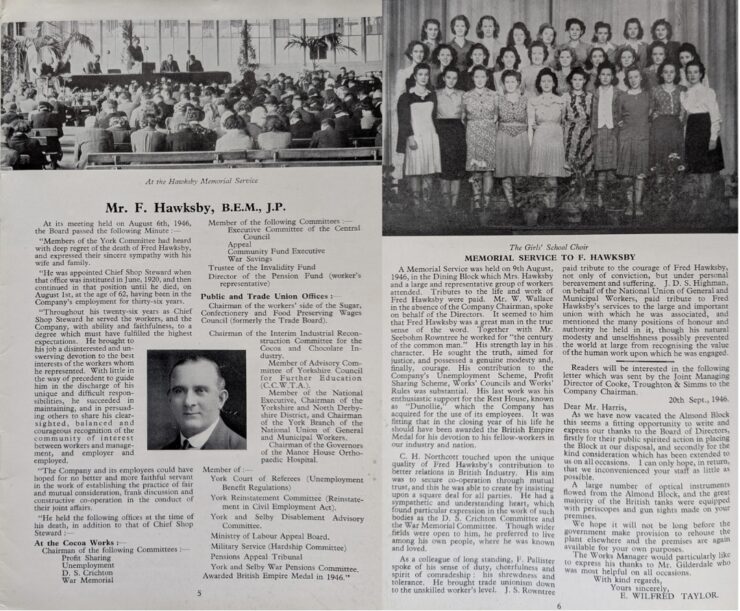
Hawksby was awarded the British Empire Medal shortly before his death.  After he died, a memorial was held for him at the Cocoa Works.[17]  Seebohm’s son, Peter Rowntree, sent a letter of condolence to Harriet Hawksby on behalf of his father who was in Norway.  In it he noted how far Rowntree & Co.’s reputation had travelled, saying, “many years ago I remember in Pennsylvania seeing a notice of an evening service outside a Methodist Church.  The text that was advertised for the evening was “why do the Rowntree girls… sing at their work?” …  I am sure that my father would be the very first person to say that these remarkable achievements [at Rowntree’s] would not have been possible had it not been for the energetic and loyal co-operation of Fred Hawksby.  Wherever these achievements are appreciated the name of Fred Hawksby will be associated with them, and they will be for him a worthy memorial”.[18]

Hawksby’s memorial in the Cocoa Works Magazine Autumn 1946

————————————————————-

This is the end of Part 3 of “Come, Let Us Reason Together”: Trade Unions at Rowntree & Co. in the 1920s.  Parts 1, 2 & 4 can be found here.

————————————————————-

We presented this research at our 2025 York Festival of Ideas event as part of the Joseph Rowntree Centenary.  You can see the recording of the event here:

————————————————————-

Researched and written by Nick Smith, Executive Director of The Rowntree Society.

Additional research by The Rowntree Society’s research volunteers, Maisie Brenchley & James Heathfield.

References and Footnotes

[1] Cocoa Works Magazine August 1920 pp.79

[2] Cocoa Works Magazine August 1920 pp.79

[3] Yorkshire Evening Post 2nd November 1921

[4] City of York Corporation Minutes 1921-1922: Explore York Archives Y/COU/1/2/39; Cocoa Works Magazine June 1923

[5] Meeting with Shilleto, Hutchinson and Two Men and Two Girls on the Subject of Hawksby, 9th November 1916: Borthwick Institute of Archives R/DP/F/11

[6] Briggs, A. 1961 A Study if the Work of Seebohm Rowntree 1871-1954 Longmans pp.107; Wallace, W. 1985 I Was Concerned pp.125-126: Borthwick Institute for Archives JRRT/8/2/54; Northcott, C. 1956 Memorandum of interview with C. H. Northcott: Borthwick Institute for Archives RFAM/BSR/JRF/11/26

[7] Briggs, A. 1961 A Study if the Work of Seebohm Rowntree 1871-1954 Longmans pp.246

[8] Northcott, C. 1956 Memorandum of interview with C. H. Northcott: Borthwick Institute for Archives RFAM/BSR/JRF/11/26

[9] Cocoa Works Magazine March 1923

[10] Cocoa Works Magazine April 1925

[11] Cocoa Works Magazine June 1925

[12] Memorandum ‘Notes on the American tour of Messrs. Northcott and Hawksby’: Borthwick Institute for Archives RFAM/BSR/JRF/5/2/1/4

[13] Cocoa Works Magazine Christmas 1926 pp.257-259

[14] Correspondence between B. S. Rowntree and Fred Hawksby 1942: Borthwick Institute for Archives JRF/RCO/7/6/2

[15] Fred Hawksby’s letter of condolence to Seebohm Rowntree 1944: Borthwick Institute for Archives RFAM/BSR/JRF/1/2/9/2

[16] Seebohm’s reply to Hawksby’s letter of condolence 1944: Borthwick Institute for Archives RFAM/BSR/JRF/1/2/9/2

[17] Cocoa Works Magazine Autumn 1946

[18] Letter of condolence by Peter Rowntree to Mrs Hawksby August 1946: Borthwick Institute for Archives JRF/RCO/6/1/10

Support Us

Our work is enabled by grant funding from the Joseph Rowntree Foundation, the Joseph Rowntree Charitable Trust, and the Joseph Rowntree Reform Trust. If you would like to make a financial donation to further support our work, it is easy to pay online (with or without Gift Aid) by clicking the link below. You can get in touch with us about other ways of giving via info@rowntreesociety.org.uk

Donate

Get Involved

Explore our current projects, find out more about how you can research Rowntree history in the archives, and discover opportunities to volunteer with us.

Support Us

Our work is enabled by grant funding from the Joseph Rowntree Foundation, the Joseph Rowntree Charitable Trust, and the Joseph Rowntree Reform Trust. If you would like to make a financial donation to further support our work, it is easy to pay online (with or without Gift Aid) by clicking the link below. You can get in touch with us about other ways of giving via info@rowntreesociety.org.uk

Donate

Rowntree’s, York, and the 1918 Flu Pandemic: A New Blog Series

Cat Oakley

The First Peak

In mid-June 1918, people across the UK began to fall sick. An article in the Yorkshire Evening Post described the signs of their illness for readers fortunate enough to have escaped infection so far:

“Those people who have not yet been affected will be interested to learn that the first symptoms…are an attack of aches and pains all over the body, along with dizziness. Then follow headache, pains in the back, and occasionally sickness, with a feeling of absolute helplessness.”[1]

The disease caused acute suffering. In the most severe cases, the infection led to an immune system response known as heliotrope cyanosis, in which the body turned black or blue as fluid leaked into the lungs and drowned the sufferer. There were also multiple incidences of delirium and psychological disturbances, leading to violence and self-harm.[2]

As the illness spread throughout the population, it disrupted patterns of everyday life which had already been transformed by the turmoil of the First World War. Northern England, with its industrial base and high urban population, was badly stricken. In some streets in Sunderland, every household was affected, and entire families laid up. In Newcastle, police, fire brigade and hospital staff were absent in significant numbers, and in Manchester, more than 200 tramway car drivers and guards went off sick.[3]

In York, all elementary schools were closed in the first week of July and remained closed throughout the whole summer.[4] Independence Day celebrations planned for American troops stationed in the city – including a baseball match, tea at the Assembly Rooms, and a parade – were all cancelled. Cinemas and other places of entertainment were designated as off-limits for soldiers, though they remained open for civilians.[5] Across the city, trained medical staff struggled to meet increased demand for their skills as they contended with an existing national shortage of doctors and nurses. In January 1918, over half of the country’s doctors were on military duty, and of those remaining, nine in York reported at one point that they had visited 6000 cases between them in response to the outbreak. Edmund Smith, the city’s Minister of Health, reported that “the professional nursing staffs of the city and district were absolutely overwhelmed.[6]

This was the ‘Spanish flu’, so-called because Spain, which remained neutral during the First World War, did not censor news of the epidemic whereas participating nations did. From its origins at a farm in Kansas, USA, the virus spread across the globe, beginning its journey in early March 1918 and ending with the last recorded infection around May 1920. Throughout this period, one in three people on the planet – 500 million – were infected, and one fifth them died.[7] In the UK, a quarter of the British population contracted the virus and one estimate places the national death toll at 228,000.[8] Mortality figures are, however, likely to be underestimates: many deaths will not have been recorded as influenza-related but as pneumonia, tuberculosis, bronchitis or even suicide, all of which were documented secondary complications.[9] The arrival of the virus in England and Wales can be dated around mid-June 1918 and by the end of July, it had diminished. In mid-October, it returned, and this “second peak”, far more deadly than the first, lasted until the end of the year, only to be followed by a third wave between February and May 1919.[10]
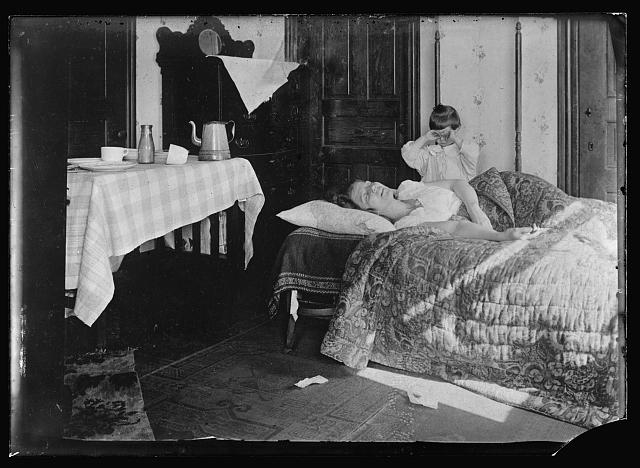


US woman sick with influenza in her home in 1918 with young child crying nearby

Image from the American National Red Cross photograph collection of a woman in the US suffering from influenza during the second wave of the 1918 pandemic. An accompanying note to the photograph says that the Red Cross Home Service was called to the house by the woman’s sister, who had not seen her for a week. The sick woman’s husband was away fighting in France. Source: Library of Congress Prints and Photographic Division.

A Forgotten History

“Don’t talk about influenza. It is already wearing itself out and will go all the sooner if you don’t talk about it. Influenza is a disease that likes to be noticed.”

– From a public information leaflet circulated by a senior London hospital official in 1918[11]

This advice from one senior medical official, circulated in a public information leaflet in 1918, captures one contemporary attitude to the flu. The government was centrally concerned with the war effort, and wartime censorship may played a part in suppressing information about the scale and spread of the epidemic at the time. But the pandemic has also gone relatively unnoticed in the years since. Despite the scale of disruption to everyday life and the massive death toll, it has been largely overlooked by historians and epidemiologists over the last 100 years. As we experience the extraordinary transformations wrought by COVID-19, it’s difficult to imagine that the 1918 pandemic was an unremarkable event for those who experienced it, even amidst the scale of horror and suffering brought about by the First World War. The two events are a century apart, so any comparisons must take into account the many differences between them, but there are also many remarkable parallels.

Why do we know so little about the Spanish flu? A growing number of historians have been exploring the answers to this question in recent decades.[12]

Those of us with an interest in social history might some highlight key factors at play which sound familiar in the context of today’s crisis. People of all social backgrounds were susceptible to the 1918 virus. Yet, there is evidence to suggest that working class communities and those living in poverty were hit particularly hard and their experiences under-documented. In addition, the history of the pandemic is, at least in part, a history of care work, and the history of care work is predominantly the history of another marginalised group: women. “Women were the ones who registered the sights and sounds of the sickroom, who laid out the dead and took in the orphans”, notes historian Laura Spinney.

Spinney also points to the dominance of Western historiography, noting that deaths in Europe and North America were lower than in other areas of the world which were more severely affected.[13] One very early report published by a medical officer of the British Empire in 1920 examined the effects of the virus in the Punjab province of India, and the historian David Killingray has done important research on the effects of the pandemic in Africa and the Caribbean, but there is still much more to explore in this area.[14] We might therefore ask ourselves what social history research with an intersectional approach could reveal about the experiences of the working classes, women, and people of colour in former British colonies during the 1918 pandemic.

The Rowntree Lens

I took up the post of Director of The Rowntree Society in early February this year and over the last few weeks, have began the work of immersing myself in the rich histories and legacies of the Rowntree family, company and charities. The Society exists to facilitate and support activities that engage critically and creatively with these histories through collaborative work with partners in the public sector, education, the voluntary sector and the cultural industries. Our work is driven by our belief in the continuing importance of the Rowntree legacies to the local, national and global challenges facing our contemporary world. As the world entered lockdown, it became clear that the COVID-19 pandemic is not just one of the most pressing of these challenges, but that it has profound implications for the others.

Members of the Rowntree family undertook pioneering work driven by their Quaker values, advocating for equality, democracy and social justice; work which is continued today by the three charitable trusts Joseph Rowntree established in his name in 1904. At The Rowntree Society, we believe that historical perspectives have a distinctive role to play in helping to navigate the current crisis and uncertain future. We share the perspectives of the Social History Society on the distinctive contributions historians can make in navigating the complexities of our situation:

This is a time of illness, grief, and profound economic and social change.

As historians, we know context is everything. We know that we must analyse the short term in relation to longer term trends.

Much cultural and social history is qualitative in nature, describing and explaining changes and continuities in earlier societies. It complicates our understanding of the past and warns against simplistic comparisons with the future.[15]

Mindful of historical precedent and the resonance of Rowntree heritage, we have found ourselves wondering: How did the 1918 flu pandemic affect the Rowntree family and Rowntree workers? How was the outbreak experienced among vulnerable communities in early 20th century York – those living in the slums Seebohm Rowntree wrote about in his pioneering survey of poverty published in 1901, and those working on the Rowntree & Co. cocoa estates in the British West Indies? What were the responses of Rowntree family members to the crisis as individuals, as employers, and in their roles in civic and public life? And what might the answers to these questions tell us about life with COVID-19, and the world that lies beyond it?

The fullest answers to these questions lie in the archives. The Borthwick Institute at the University of York is now home to the Rowntree Archives, and an important collection of materials relating to medicine and health in the city. Other relevant records are kept by York Libraries and Archives. Both are currently closed due to the lockdown (though doing some fantastic work around the continuation of their services online). It’s tantalising to have these documents so near and yet so far, and I’ve developed a renewed appreciation for our libraries and archives now that they are temporarily inaccessible.

In the face of these closures, I reached out to the archivists there, together with our volunteers, trustees and local history groups, for help in finding some provisional answers. My original plan was for a single blog post, but the search turned up more information than initially expected. I’ll therefore be sharing thoughts and information on the 1918 pandemic, York, Rowntree’s and COVID-19 in a new blog post series here on our website.

In the meantime, we’d love to hear what you think. You can get in touch with us via email at info@rowntreesoc.org.uk, on Twitter @rowntreesoc, or through our Facebook page.

Acknowledgements

Collating sources for the blog series while libraries and archives are closed has been a collaborative project, with help from the following people:

Anne Grant and Stan Young, The Rowntree Society

Margaret Atherden, PLACE York

Janet Jawando and Dennis Shaw, York Cemetery Genealogy

Dick Hunter, Clements Hall Local History Group

Gary Brannan, Borthwick Institute for Archives

Hannah Mawdsley (@HannahMawdsley)

Julie-Ann Vickers, York Explore

Joseph Oakley

References

[1] “Influenza Plague Still Active”, Yorkshire Evening Post, Wed 3 July, 1918, p.3.

[2] Hannah Mawdsley, “‘Infectious’ Humour in the Face of History’s Deadliest Pandemic”, Viewpoint, pp.4-6 (p.4) https://www.bshs.org.uk/wp-content/uploads/Viewpoint_118_Web.pdf

[3] Influenza Ravages, Yorkshire Post and Leeds Intelligencer, Wed 3 July 1918; “Influenza Plague Still Active”.

[4] Martin Knight, The Influenza Pandemic of 1918-1919 in the towns of the West Riding and York, Place: 2016, p.p. 22-23

[5] “Influenza Ravages”, Yorkshire Post and Leeds Intelligencer, Wed 3 July 1918

[6] Fred R. van Hartesveldt, “The Doctors and the ‘Flu’: The British Medical Profession’s Response to the Influenza Pandemic of 1918-1919”, International Social Science Review 85.1-2, 2010, p. 32; “Medical Officer of Health report for York, 1919, Borthwick Archives, MOH/Y/10, cited by Gary Brannan, “When the Guns Fell Silent: York and the 1918 Flu”, http://borthwickinstitute.blogspot.com/2018/11/when-guns-fell-silent-york-and-1918-flu.html

[7] Laura Spinney, Pale Rider: the Spanish Flu of 1918 and how it changed the world, Jonathan Cape, 2017, ebook, n.p.

[8] Jennifer Meierhans & Daniel Wainwright, “Spanish flu: ‘We didn’t know who we’d lose next’”, BBC News, 20 September 2018 https://www.bbc.co.uk/news/uk-england-45097068

[9] Knight notes that “In 1918 there were about 2,700 pneumonia deaths compared with an average of about 1700 in 1916, 1917, and 1919.” (p.10) Several inquests reported in the Yorkshire Evening Post in Spring 1919 delivered verdicts of suicide in which influenza was cited as a factor (see also Knight, p. 43).

[10] Knight, p.8

[11] “Hints to the Public”, Newcastle Daily Chronicle, Thurs 31 Oct 1918, p.6

[12] See Laura Spinney, Pale Rider; Mark Honigsbaum, Living with Enza: The Forgotten Story of Britain and the Great Flu Pandemic of 1918, Macmillan, 2009; Hannah Mawdsley, https://ahrc.ukri.org/research/readwatchlisten/features/remembering-the-spanish-flu/; David Killingray and Howard Philips (eds.) The Spanish influenza pandemic of 1918-1919: new perspectives, Routledge, 2011; Niall Johnson, Britain and the 1918-19 influenza pandemic: a dark epilogue, Routledge, 2006.

[13] Laura Spinney, Pale Rider, ebook, n.p.

[14] Thomas Herriot, “The Influenza Pandemic 1918, as observed in the Punjab, India”, PhD Thesis, University of Edinburgh, 1920, https://era.ed.ac.uk/handle/1842/22305; David Killingray, “A new ‘Imperial Disease’: The Influenza Pandemic of 1918-19 and its impact on the British Empire”, Caribbean Quarterly 49.4, December 2003

[15] “COVID-19 and the future of our discipline”, Social History Society, May 7, 2020 https://socialhistory.org.uk/2020/05/07/covid-19-and-the-future/

Support Us

Our work is enabled by grant funding from the Joseph Rowntree Foundation, the Joseph Rowntree Charitable Trust, and the Joseph Rowntree Reform Trust. If you would like to make a financial donation to further support our work, it is easy to pay online (with or without Gift Aid) by clicking the link below. You can get in touch with us about other ways of giving via info@rowntreesociety.org.uk

Donate